
Clinically reviewed by Dr. Ponlawat Pitsuwan, Physician, Doctor Samui.
Last reviewed: November 2026
Fungal skin infections are common in Thailand’s heat and humidity. Ringworm, tinea versicolor, athlete’s foot, and jock itch all thrive in Koh Samui’s warm, wet climate. Most cases respond well to topical antifungal creams from a pharmacy, but using the wrong cream, especially one containing a steroid, can make the infection significantly worse. If your rash spreads, is on your face or scalp, or has not improved after two weeks of treatment, see a doctor.
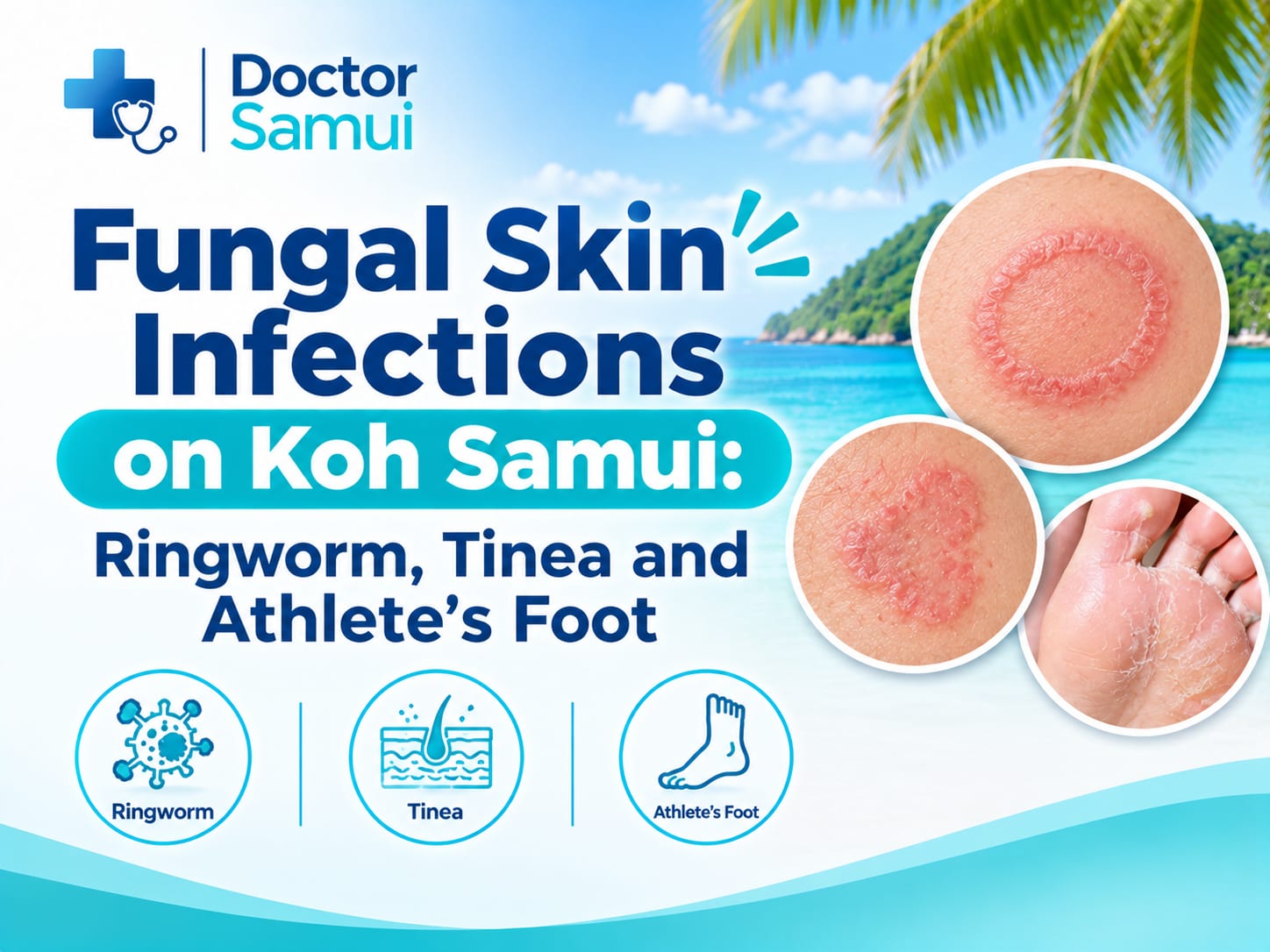
You peel off your wetsuit after a dive near Chaweng, rinse under the beach shower, and two days later a ring-shaped red patch appears across your chest. It itches. The edge is raised and slightly dry. You are not sure if it is a suit rash, a bite, or something else. It is probably ringworm, and in Koh Samui’s Gulf of Thailand humidity, it is not surprising at all.
Fungal skin infections are a frequent reason visitors seek medical care mid-holiday. The rainy season pushes humidity well above what most travellers are used to, skin stays damp longer after every swim, and activities like diving, snorkelling at Angthong, or walking barefoot between beach clubs all create easy conditions for fungi to spread. This article covers what each type looks like, when pharmacy cream is enough, and when you need something stronger.
Common Fungal Infections You Get in Hot Climates
The same group of fungi, called dermatophytes, causes ringworm on the body (tinea corporis), jock itch in the groin (tinea cruris), and athlete’s foot between the toes (tinea pedis). Despite the name, ringworm has nothing to do with worms. It is a fungal infection that forms a ring-shaped patch on the skin.
You can pick these up almost anywhere on Samui: pool surrounds, shared towels, changing rooms at beach clubs, or the damp floor of a dive shop. The fungi survive on shed skin cells and move from person to person easily in communal, wet environments. If you have been walking barefoot between beach bars or borrowing a towel at a resort, that is a plausible route.
Jock itch and athlete’s foot often appear together because the same fungus can spread from feet to groin when you pull up clothing after a shower. In this climate, skin folds stay moist and fungi take hold faster than they would at home. A rash that might have cleared on its own in a cooler climate can deepen and widen here within days. If you notice broken skin, weeping, or a secondary bacterial infection developing on top, that needs a doctor, not just cream.
Tinea Versicolor Patches
Tinea versicolor is caused by a yeast called Malassezia, which lives on everyone’s skin but overgrows in heat and sweat. The result is uneven patches, lighter or darker than your normal skin tone, usually on the chest, back, or upper arms. These patches do not tan evenly, which is often when people notice them on holiday.
Tinea versicolor is not itchy in the same obvious way as ringworm. It is easy to mistake for a sunburn pattern or even seborrheic dermatitis, a flaky skin condition caused by the same yeast but on the scalp and face. If you are not sure which you have, do not guess and reach for a steroid cream. That is where things go wrong. For a broader look at holiday rashes on Koh Samui, the skin rash guide at Doctor Samui covers conditions that can look similar but need different treatment.
How Tropical Activities on Koh Samui Raise Your Risk of Fungal Skin Infection
Diving and snorkelling create risks that generic travel advice does not cover. A wetsuit traps heat and moisture against skin for hours. If the suit is shared or not fully dried between uses, it can carry fungi from one person to the next. The same applies to shared snorkel masks, fins, and rash vests at rental shops near Chaweng or Lamai.
Waterfall swimming at Na Muang or Hin Lat is a different route. Rock pools and wooden walkways stay wet all day and are walked barefoot by hundreds of people. Tinea pedis spreads easily in these environments, often showing up two to three weeks after a trip. Beach sand itself carries a lower but real risk if someone with active tinea pedis has walked there before you.
Children are particularly at risk at resort pools and beach clubs, where they share kick boards, towels, and play in the same water for hours. In children, tinea capitis (scalp ringworm) is more common than in adults, and topical cream will not reach the hair follicle. Scalp ringworm in a child needs oral antifungal treatment, not an over-the-counter cream. If your child has a patchy, scaly area on their scalp with any hair loss, get them seen promptly.

Fungal Rash or Something Else?
A fungal infection is not the only thing that makes holiday skin itch. Contact dermatitis from sunscreen, coral, or new clothing can look almost identical. Eczema flares in heat. Scabies causes intense itch, usually at night, and spreads in shared accommodation. Heat rash appears in clusters of small red bumps, not rings.
The clues that point to fungal: a defined, ring-shaped or arc-shaped border, scaling at the edge, central clearing in ringworm, pale or darker patches that do not tan, and a location in a skin fold, between the toes, or on the chest and back. If the rash is spreading despite treatment, or you are not sure what you are looking at, do not guess. Doctor Samui can assess it the same day, either at the clinic in Chaweng or at your hotel.
One thing to watch for: an itchy rash that gets briefly better then worse with steroid cream is a red flag for tinea incognito. The steroid suppresses the inflammation enough to look like improvement while the fungus spreads underneath. It is a common mistake in Thailand. By the time patients come in having used combination steroid-antifungal creams, the infection is often much larger than it started.
Pharmacy Versus Prescription Creams
Thai pharmacies stock antifungal creams without a prescription. Clotrimazole, miconazole, and terbinafine are all available and effective for most common dermatophyte infections when used correctly and for the full recommended course. For tinea versicolor, ketoconazole shampoo or cream is what works, not a standard ringworm cream.
The problem is combination products. Many Thai pharmacy shelves carry creams that mix an antifungal with a steroid. These are sold widely and look almost identical to standalone antifungal products. Using a steroid on a fungal infection without a diagnosis is how tinea incognito happens. If you are not confident you have identified the right product, ask the pharmacist to show you one without steroid, or come in for a prescription.
There is also an emerging issue worth knowing about. Trichophyton indotineae, a strain of ringworm first flagged in South Asia and now documented across Southeast Asia, can be resistant to terbinafine. Research published between 2024 and 2025, including a first case series from Thailand published in 2025, has documented its spread in the region. If your ringworm is not clearing with terbinafine cream after two weeks, it may need oral itraconazole rather than a different topical cream. That requires a prescription and a clinical assessment. For anyone who is immunocompromised, treatment-resistant infections are a more urgent concern, and oral antifungal therapy needs closer monitoring. Our page on eczema and related skin conditions covers other presentations we treat at the clinic.
Preventing Fungal Infections From Coming Back
Fungal infections recur if you change the cream but not the conditions. The main driver here is moisture. If skin stays wet for hours after swimming, fungi stay active. Dry off thoroughly after every swim or shower, paying attention to skin folds, between the toes, and the groin. An antifungal powder used in shoes or underwear can help during a long stay.
Moisture-wicking clothing makes a real difference in Samui’s climate. Cotton holds sweat against skin. Synthetic moisture-wicking fabrics reduce contact time between sweat and skin throughout the day, which matters during back-to-back water activities. Do not share towels or clothing, even at a resort where both appear clean.
Flip-flops in communal showers and changing rooms are the simplest and most effective barrier against tinea pedis. Rinse and dry snorkel and dive equipment before it goes back in the bag, and ask rental shops whether gear is dried between uses. If you have had a fungal infection before on Samui, completing the full treatment course even after symptoms clear is the most important step to avoid it returning.
If your rash is spreading, not responding to pharmacy cream, in a skin fold, or on a child’s scalp, Doctor Samui can assess it the same day. We offer walk-in consultations at our clinic in Chaweng and 24/7 hotel and villa visits across the island for patients who cannot travel. We can confirm the diagnosis, prescribe the right antifungal, and advise on what to avoid during treatment. No appointment needed at the clinic.
Frequently Asked Questions
Dr. Ponlawat Pitsuwan
Physician, Doctor Samui
a walk-in clinic based in Chaweng, Koh Samui, with 24/7 hotel and villa visits across the island. He sees tourists, families, and long-stay expats for skin infections and rashes caused by the island’s tropical climate, including fungal infections, coral injuries, and infected wounds. His focus is straightforward, evidence-based care delivered in plain language.
References
- Leung AKC, Lam JM, Leong KF, Hon KL. Tinea corporis: an updated review. Drugs in Context. 2020;9:2020-5-6.
- Emergence of resistant dermatophytosis caused by Trichophyton indotineae: First case series in Thailand. PubMed Central, 2025.
- Terbinafine Resistance in Trichophyton rubrum and Trichophyton indotineae: A Literature Review. PubMed Central, 2025.
- Centers for Disease Control and Prevention. Ringworm: information for healthcare professionals. CDC.gov.
- DailyMed. Label: Ketoconazole shampoo, suspension. U.S. National Library of Medicine.
- Merck Manual Professional Edition. Tinea Capitis (Scalp Ringworm).
The information in this article is for educational purposes only and does not constitute medical advice. It should not be used to self-diagnose or replace a consultation with a qualified physician. If you have concerns about your health, contact a licensed medical professional. For appointments at Doctor Samui, visit doctorsamui.com.
