Clinically reviewed by Dr. Ponlawat Pitsuwan, Physician, Doctor Samui. Last reviewed: August 2026
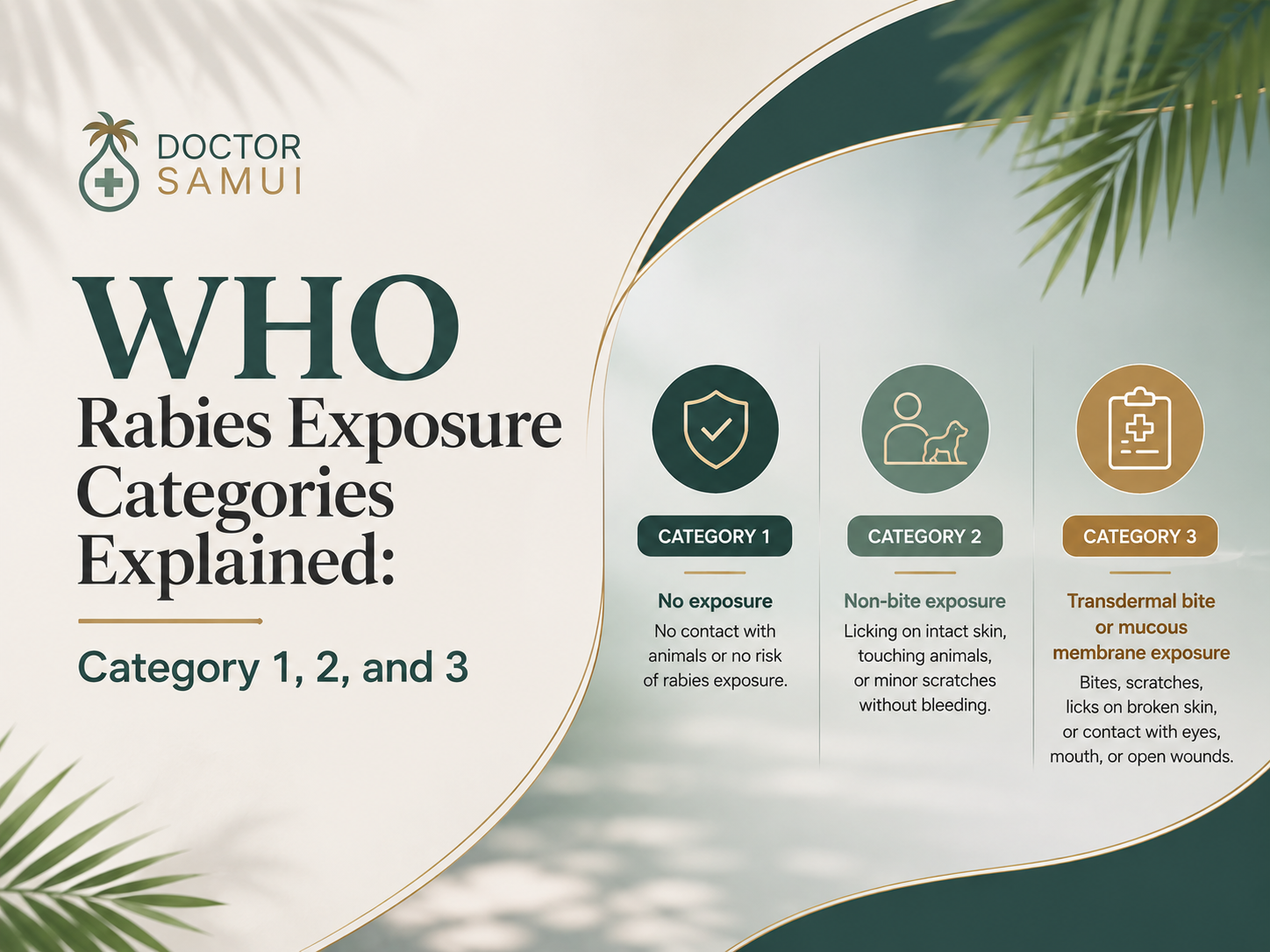
The WHO divides animal exposures into three categories. Category I means no risk and no vaccine needed. Category II means a minor exposure requiring prompt vaccination. Category III means a severe exposure requiring both vaccine and rabies immunoglobulin (RIG) the same day. Your category depends on the wound type, its location on your body, and whether the animal’s saliva reached broken skin or a mucous membrane. A doctor needs to confirm your category — self-assessment often gets it wrong.
You are on the trail up to Na Muang waterfall when a macaque darts out and catches your hand. It happens in a second. Now you are sitting at the trailhead, heart rate up, staring at a scratch that may or may not have broken the skin, wondering whether you need a vaccine today or whether you are overreacting. That question has a precise answer. The WHO uses three categories to classify every animal exposure, and your category tells your doctor exactly what treatment you need and how fast.
Koh Samui has real rabies risk. Stray dogs on Chaweng Beach, macaques at both Na Muang falls, temple dogs at Wat Plai Laem, and bats in jungle bungalows around Taling Ngam are all potential sources. Thailand is a rabies-endemic country. The disease is fatal once symptoms appear. These categories exist so that treatment is fast, precise, and not left to guesswork.
Category I — What You Do Not Need to Worry About
Category I covers contact with an animal where no exposure to saliva or secretions actually occurred. Touching a dog or cat, feeding a monkey, or having an animal lick your completely unbroken skin all fall here. No vaccine. No treatment. Just wash your hands.
The key word is intact. Intact means no cuts, no abrasions, no sunburn breaks, no insect bites nearby. If your skin is fully continuous, saliva cannot carry the virus into your body. If a beach dog licked your arm and there is no wound on that skin, you do not need a rabies shot.
Where people go wrong is assuming their skin is intact without checking carefully. A child who has been playing on the reef or in the sand often has small abrasions they never noticed. If there is any doubt, let a doctor examine the skin properly before deciding.
Category II — What Counts as a Minor Exposure
Category II means the animal made contact with your skin in a way that could deliver saliva across a break. This includes scratches or grazes that break the skin without causing spontaneous bleeding, minor bites, and animal saliva contacting a pre-existing cut or abrasion.
The macaque scratch at Na Muang is a classic Category II scenario, provided it is a surface scratch and not a deep puncture. A scab reopened and then licked by a dog is Category II. A cat that bites through one layer of skin without deep penetration is Category II. These exposures need prompt vaccination, starting the same day if possible.
The 14-day animal observation rule applies in theory here. If the animal stays healthy for 14 days, remaining doses can sometimes be stopped. In practice on Koh Samui, you almost never have the ability to observe a stray animal for that long. Complete the full course. That is the right call every time with a stray.

Category III — Severe Exposures That Need Vaccine and RIG the Same Day
Category III is the serious one. It covers bites that go through the skin, scratches with spontaneous bleeding, saliva reaching a mucous membrane such as the eyes, nose, or mouth, and any contact with bats regardless of whether you can find a wound.
A temple dog at Wat Plai Laem that bites through your skin is Category III. A monkey that scratches deeply enough to bleed at the waterfall is Category III. A bat found in your bungalow near Nathon that you handled is Category III even if you cannot find a mark. Bat teeth are small enough that bites are often invisible.
Category III requires both the rabies vaccine and rabies immunoglobulin (RIG). RIG provides immediate antibodies while your body builds its own response to the vaccine. It must be infiltrated directly into the wound, not just injected elsewhere. Not every clinic on the island stocks RIG, so confirm availability before attending. Doctor Samui keeps RIG at the Chaweng clinic and carries it on 24/7 hotel and villa visits.
Why Bite Location Changes the Picture
Two people can have what looks like the same Category II scratch and need very different levels of urgency based on where that scratch is. A scratch on the forearm and one on the fingertip are not the same risk. Fingertips, the face, and the neck have dense nerve endings close to the surface. The virus travels along nerves, so the closer the wound is to the brain, the shorter the window for treatment to work.
A bite to the face or neck, even one that appears minor, is often managed as Category III in practice. This is a clinical judgment call, and it is another reason why sitting on Chaweng Beach searching categories on your phone is a poor substitute for having a doctor look at the wound.
Koh Samui Exposures — Which WHO Rabies Category Are You In?
| Scenario | WHO Category | Treatment |
|---|---|---|
| Fed a monkey without being scratched | I | None |
| Stray dog licked intact skin | I | None |
| Macaque scratch at Na Muang, no bleeding | II | Vaccine course |
| Cat bite through one skin layer | II | Vaccine course |
| Dog licked open sunburn or reef cut | II | Vaccine course |
| Temple dog bite with bleeding | III | Vaccine plus RIG same day |
| Deep monkey bite at waterfall | III | Vaccine plus RIG same day |
| Bat contact in bungalow | III | Vaccine plus RIG same day |
| Scratch to face or neck, any depth | III in practice | Vaccine plus RIG same day |
Does Pre-Exposure Vaccination Change Your Category?
This confuses many travellers. Pre-exposure prophylaxis (PrEP), the rabies shots you may have had before your trip, does not change which exposure category you are in. A Category III bite is still a Category III bite. What changes is the treatment required.
If you completed a full, confirmed PrEP course before travel, you need only two booster vaccine doses after any exposure, on day 0 and day 3. You do not need RIG. That matters because RIG is the harder thing to source quickly on the island.
This only applies if your prior vaccination was complete and documented. Partial courses or uncertain records change the picture. Bring documentation if you can. If you cannot, tell the doctor what you remember and they will advise you. Doctor Samui can verify your history and provide booster doses the same day.
How a Doctor Assesses Your Category — and Why Self-Assessment Gets It Wrong
Patients routinely undergrade their own exposure. Someone comes in describing a scratch, and on examination there is clear skin penetration with bruising underneath. Children in particular often miss bites entirely. After any animal encounter involving a child, a full skin check is standard, not just the obvious area of contact.
Wound depth, location, the animal’s behaviour, and your vaccination history all factor into the final clinical category. Whether the animal was provoked or unprovoked matters. Whether it was a domestic pet with a known vaccination record or a street animal with none matters. These are not things you can reliably assess in a hotel bathroom with a phone torch.
Come in and let a doctor look at it. That is the fastest and safest route to knowing what you actually need.
Getting PEP on Koh Samui — Timing and What to Expect
Wash the wound first. Soap and water for at least 15 minutes under running water. This step alone meaningfully reduces viral load. Then seek care immediately. Do not wait to see how it feels tomorrow.
At the Chaweng clinic, the team assesses the wound, confirms your WHO category, checks your vaccination history, and starts the right protocol the same day. Category II means the first dose of a cell culture vaccine. Category III means vaccine plus RIG, infiltrated at the wound site. Intradermal vaccine delivery, a WHO-approved route using smaller doses into the skin rather than muscle, is also available.
If you are near Maenam, Lamai, Hua Thanon, or anywhere else on the island, the 24/7 hotel and villa visit service means there is no logistical reason to delay. You can read more about vaccine options and rabies risk on Koh Samui through our rabies vaccine and risk page.
Scratched or bitten by an animal on Koh Samui? Doctor Samui’s Chaweng clinic provides same-day rabies post-exposure assessment, vaccine, and rabies immunoglobulin for Category III exposures. We offer 24/7 hotel and villa visits across the island — Chaweng, Lamai, Bophut, Maenam, Choeng Mon, and beyond. Walk in or call us now. Do not wait until tomorrow.
Frequently Asked Questions
Dr. Ponlawat Pitsuwan
Physician, Doctor Samui
a walk-in clinic based in Chaweng, Koh Samui, with 24/7 hotel and villa visits across the island. He sees tourists, families, and long-stay expats for animal bite assessment, rabies post-exposure prophylaxis, wound care, and travel health. His focus is straightforward, evidence-based care delivered in plain language.