Clinically reviewed by Dr. Ponlawat Pitsuwan, Physician, Doctor Samui. Last reviewed: August 2026
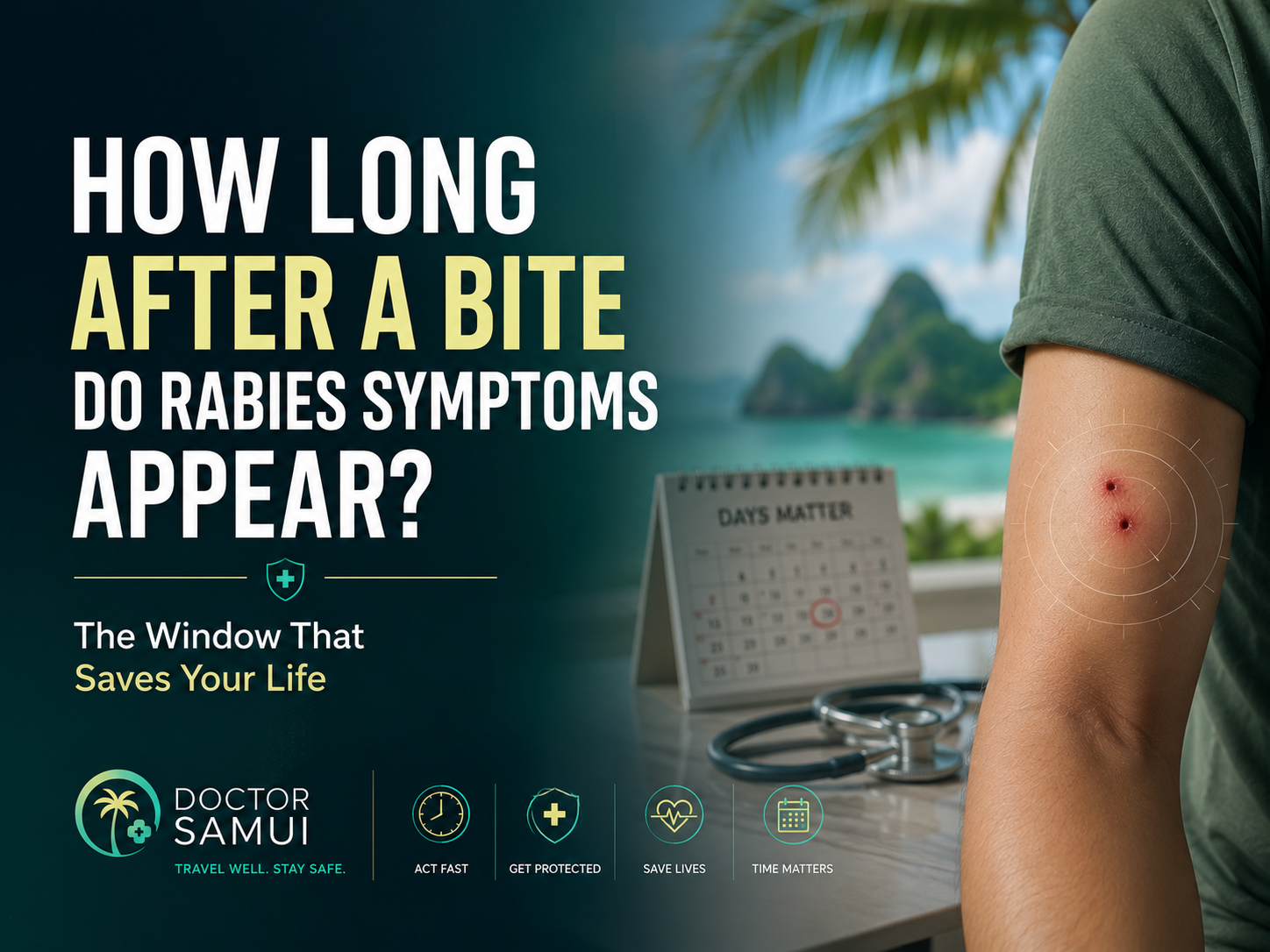
Rabies symptoms usually appear two to three months after a bite, but can come on in as little as five days for bites close to the face or neck. Once symptoms start, the disease is almost always fatal. Post-exposure prophylaxis (PEP), the vaccine course started after a bite, only works before symptoms begin. If you have been bitten on Koh Samui, start PEP the same day, not after the weekend.
A stray dog wanders over while you are eating near Chaweng Beach. A temple monkey reaches down at one of the inland shrines and catches your hand. There is a scratch, maybe a small puncture. It did not bleed much, the animal ran off, and you feel completely fine. That feeling of being fine is exactly what makes rabies so dangerous.
The virus travels silently from the bite wound along your nerve pathways toward your brain. You feel nothing during that journey. By the time any symptom appears, treatment is no longer possible. The only window that saves your life is the time between the bite and the first symptom, and you must use it.
Local Risk Animals and Where Bites Happen on Koh Samui
Koh Samui has a real rabies risk. Stray dogs are everywhere: at Chaweng Beach, around the Lamai night markets, outside 7-Elevens at 2am, along the waterfall trails at Na Muang. Temple monkeys at the inland shrines bite tourists regularly, usually when food is involved. Beach cats are a lower but not zero risk.
Thailand is considered endemic for rabies, meaning the virus is present in the animal population across the country. On an island where strays roam freely and tourists interact with them daily, the exposure risk is not theoretical.
The animals that concern us most at our Chaweng clinic are dogs and monkeys. If the animal that bit you cannot be captured and observed, which covers almost every stray dog and monkey on this island, treat the bite as a rabies exposure and start PEP the same day.
How Long After a Bite Do Rabies Symptoms Appear?
The WHO puts the average at two to three months. Most cases develop symptoms somewhere in that window. But the range is wide: as short as five to seven days for a severe bite on the face, as long as a year or more for a small wound on the foot.
That wide range is not reassurance. It simply means the virus has not reached your brain yet. It is still moving.
Bite location is the biggest factor affecting speed. The closer the bite is to your brain, the shorter the journey along the nerve pathway, and the faster symptoms appear. Depth and number of wounds matter too, as does the amount of virus introduced at the time of the bite.
How Bite Location Changes the Clock
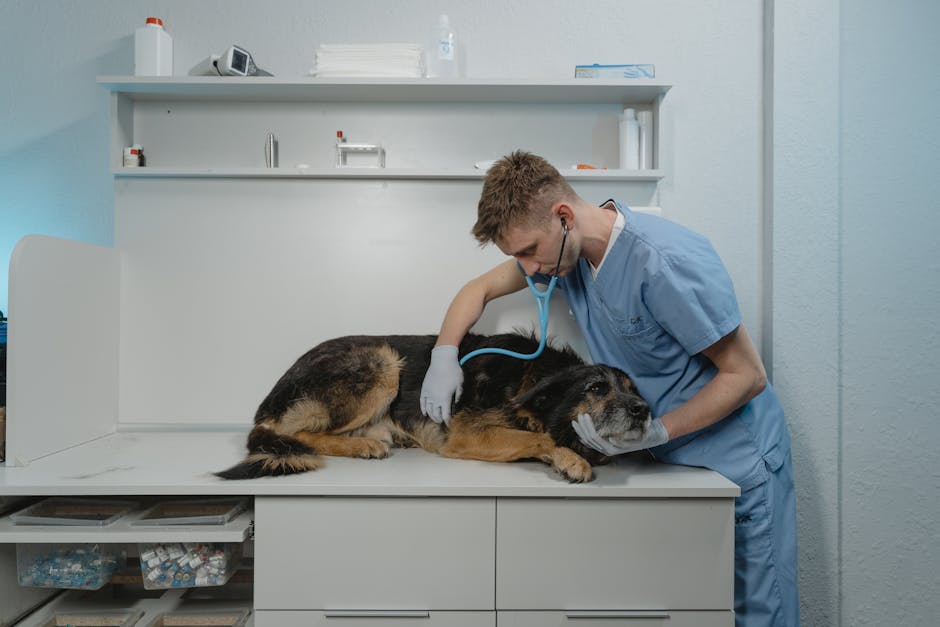
A bite on the face or neck from a temple monkey is a WHO Category III exposure: the highest risk category. It requires immediate wound cleaning, rabies immune globulin injected into and around the wound, and the full vaccine course. Symptoms can appear in less than two weeks with this type of bite.
A puncture on the hand from a stray dog at Chaweng is still a Category III exposure if it broke skin and bled. The nerve pathway to the brain is longer, so you may have weeks before symptoms emerge. But more time is not the same as safe. PEP must still start the same day.
A graze on the foot or ankle, even a minor one, can have an incubation period of several months. That longer timeline is part of what creates the false sense of safety. People wait, feel fine for weeks, and then symptoms begin.
Why the Long Incubation Period Is Dangerous, Not Reassuring
This is the point we make to every patient who walks into Doctor Samui after a bite. Feeling well is not evidence the virus is absent. It is evidence the virus has not reached your brain yet.
PEP works by building your immunity faster than the virus travels. Once the virus reaches your central nervous system, PEP has no effect. That treatment window closes at the moment symptoms start.
The average tourist who gets bitten on a Monday and feels fine by Wednesday does one of two things. They start PEP and survive. Or they go back to the beach and put it out of their mind. The long incubation period creates a false sense of safety that kills people.
The Prodromal Phase: The Earliest Warning Signs
Before the acute neurological phase begins, most patients go through a prodromal phase lasting two to ten days. By the time this starts, PEP can no longer help. That is why recognising it matters.
The most telling sign is tingling, itching, burning, or pain returning to the original bite site, a wound that had already healed. This happens in a significant proportion of cases and signals the virus is now near the central nervous system.
Other early symptoms include low-grade fever, headache, and fatigue. These are easy to dismiss as a holiday bug. Do not dismiss them if you have had a bite in the last several months. Come in.
What Rabies Symptoms Actually Look Like
Once the virus reaches the brain, there are two patterns. The more common form brings extreme agitation, confusion, muscle spasms, and the hallmark signs: painful throat spasms when swallowing triggered by water, and similar spasms triggered by a puff of air near the face. The less common form progresses quietly with weakness and paralysis spreading from the bite site upward.
Both are almost universally fatal once they begin. There is no effective treatment at this stage.
This is not written to frighten you. It is written so the answer to "should I wait and see?" is completely clear. The answer is no.
Should You Wait and Watch the Animal Before Starting PEP?
The WHO 10-day observation rule states that if the biting dog or cat is healthy at the time of the bite and remains healthy under observation for ten days, PEP can be stopped. This rule applies only to dogs and cats that can be confined and reliably watched by a qualified observer.
On Koh Samui, this almost never applies. Stray dogs disappear into the island. Temple monkeys scatter immediately. Beach cats are not catchable. If the animal cannot be observed, you do not wait.
We have had patients tell us someone in the village said the dog seemed fine. That is not the same as veterinary observation. Start PEP, and stop it later only if a genuinely verifiable observation confirms the animal was healthy.
What to Do in the First 15 Minutes, Before You Reach a Clinic
Before anything else: wash the wound. Soap and running water for fifteen minutes. WHO guidance confirms this step alone reduces rabies transmission risk significantly. No beach, waterfall trail, or hotel room is too far from a tap or water bottle.
Do not close the wound tightly or cover it with a tight bandage. Let it bleed gently if it is bleeding. Clean it thoroughly, then get to a clinic.
If you are at Na Muang waterfall or anywhere across the island away from Chaweng, Doctor Samui can come to you. Our 24/7 hotel and villa visit service covers the whole island.
Getting Rabies PEP on Koh Samui
PEP is a course of vaccines given on specific days. The standard schedule for someone with no prior rabies vaccination is four doses over fourteen days. For a Category III exposure, rabies immune globulin is also given on day one, injected into and around the wound.
We stock rabies vaccine and immune globulin at our Chaweng clinic. If you are staying in Maenam, Bophut, Lamai, Choeng Mon, or anywhere else on the island, we can start the process at your accommodation and coordinate follow-up doses whether you stay on Samui or continue your trip elsewhere. You can read more about the rabies vaccine on Koh Samui on our clinic page.
If you were bitten several days ago and have not started PEP yet, come in now. As long as you have no symptoms, you are still in the treatment window.
If you have been bitten by a dog, monkey, or any animal on Koh Samui, Doctor Samui can start rabies post-exposure prophylaxis the same day, including rabies immune globulin for Category III exposures. Walk into our Chaweng clinic or call for a 24/7 hotel and villa visit anywhere on the island. Our English, German, and Hebrew-speaking team is available around the clock. Do not wait for symptoms. Contact Doctor Samui now.
How long after a dog or monkey bite on Koh Samui would rabies symptoms appear?
The WHO average is two to three months, but a bite to the face or neck from a temple monkey can produce symptoms in as little as five to fourteen days. Stray dog bites on the hands or feet allow more time, but the virus is still moving. The long window is not safety, it is the treatment window, and Doctor Samui can start PEP the same day.
I was bitten a few days ago and feel completely fine. Do I still need the rabies vaccine?
Yes. Feeling fine is exactly what the incubation period looks like. The virus has not reached your brain yet, which is why PEP can still work. Once symptoms appear, no treatment can help. Come to our Chaweng clinic or request a hotel visit today, not after the weekend.
What are the very first signs that rabies is starting after a bite?
The earliest warning is tingling, itching, or burning returning to the original bite site, alongside fever, headache, and fatigue. This phase lasts two to ten days before acute neurological symptoms begin. If you have had a bite in the past months and these symptoms appear, seek care immediately.
Does where I was bitten change how quickly symptoms appear?
Yes, significantly. A bite on the face or neck has a short nerve pathway to the brain, and symptoms can appear in under two weeks. A bite on the foot or leg can allow several months before symptoms emerge. Both require the same response: start PEP the same day.
Can I wait to see if the animal gets sick before starting the rabies vaccine?
Only if the animal can be caught and confined for ten days of qualified veterinary observation. On Koh Samui, stray dogs, temple monkeys, and beach cats almost never can be. In practice, you start PEP immediately and stop only if a qualified observer confirms the animal remains healthy throughout.
Is it too late to start PEP if the bite was a week ago?
Not if you have no symptoms. PEP works throughout the incubation period, not just in the first 24 hours. A bite one week ago with no symptoms is still fully treatable. Start now. Every day of delay shortens the safety margin, but you are still in the window today.
Dr. Ponlawat Pitsuwan
Physician, Doctor Samui
a walk-in clinic based in Chaweng, Koh Samui, with 24/7 hotel and villa visits across the island. He sees tourists, families, and long-stay expats for animal bites, rabies post-exposure prophylaxis, wound care, and travel health. His focus is straightforward, evidence-based care delivered in plain language.