Clinically reviewed by Dr. Ponlawat Pitsuwan, Physician, Doctor Samui.
Last reviewed: June 2025
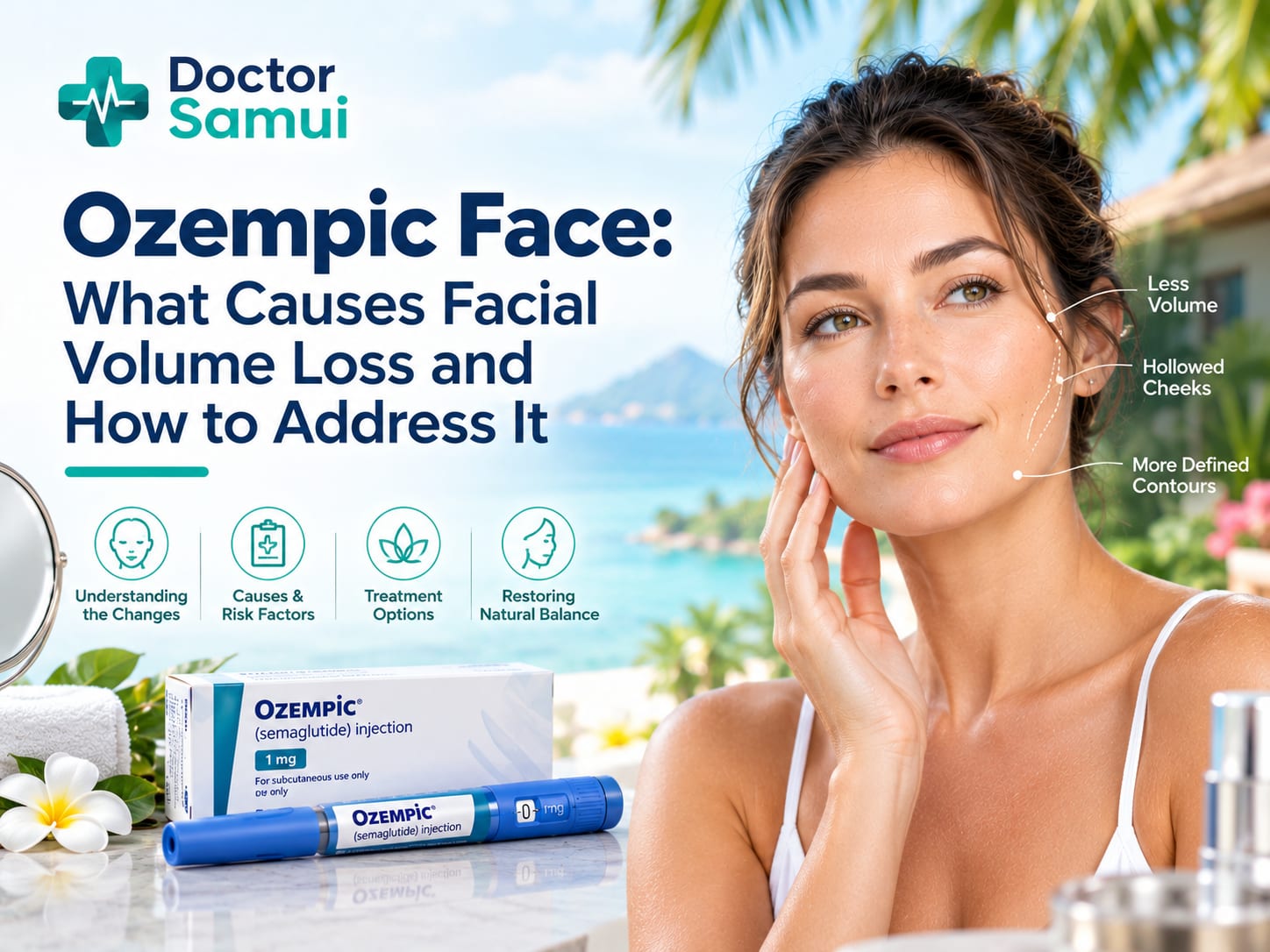
Ozempic face refers to sunken cheeks, hollowed temples, and a gaunt appearance that can follow significant weight loss on semaglutide, tirzepatide, or other GLP-1 medications. Current evidence points mainly to rapid loss of fat throughout the body, including the facial fat pads, rather than a direct effect of the drug, though researchers are still studying this. Treatment options range from collagen-stimulating skin treatments to dermal fillers, and timing matters: published advice is generally to wait until your weight has been stable before placing filler.
You started a GLP-1 medication, the weight came off, and the numbers on the scale finally moved in the right direction. Then someone mentioned your face. Or you caught yourself in a hotel mirror here on Samui and thought you looked older, more tired, more hollow than you expected.
That gap between what you hoped for and what you are seeing is what most people mean when they say ozempic face sunken. It happens because fat loss on semaglutide, Wegovy, tirzepatide, or any GLP-1 drug does not pick and choose. The facial fat pads go along with everything else. In patients over forty, or anyone who loses weight quickly, the skin does not always snap back. There are real options for addressing this, and the right one depends on where you are in your weight loss journey, not just what you see in the mirror.

Is Ozempic Face Caused by the Drug or the Weight Loss?
You can read the full explanation at our GLP-1 medication page, but the short answer is: it appears to be mainly the weight loss, not the drug acting directly on your face.
GLP-1 receptor agonists reduce appetite and slow how quickly your stomach empties. The result is a calorie deficit, and your body burns stored fat to fill that gap. That fat comes from everywhere: your abdomen, your thighs, and your face. The facial fat pads, including the malar fat pad in the cheek, are part of the same subcutaneous fat system. When they shrink, the face looks hollowed out.
The same effect happens after bariatric surgery or any other form of rapid, significant weight loss. Speed matters. The faster the loss, the less time your skin has to adapt, and the more pronounced the sunken appearance tends to be.
What Ozempic Face Sunken Actually Looks Like
Most people notice more than one change at once. Hollow cheeks are a common sign: the face loses its rounded midface fullness and takes on a flatter or concave shape. Sunken temples make the outer edges of the forehead look bony.
Periorbital hollowing, a shadowed, tired look under and around the eyes, is another frequent complaint. Deeper nasolabial folds, the lines running from the sides of the nose to the corners of the mouth, become more visible as the fat supporting them disappears. The jawline may look less defined rather than sharper, because skin laxity can cause sagging rather than the crisp contour patients expect.
If several of these match what you are seeing, a clinical assessment is the right next step rather than guessing which treatment to try first.

Who Tends to Notice Ozempic Face Most
Age is one important factor. Patients over forty have less skin elasticity to begin with, so the skin is less able to contract after fat loss. The volume reduction becomes visible more quickly and more severely.
Speed of loss is another factor. A large drop in body weight over a short time gives the face no gradual adjustment period. Lean mass loss may also play a role: GLP-1 medications can reduce lean mass alongside fat, and some of that loss may affect the structural support of the face. Patients who are not doing resistance training or eating enough protein during their weight loss phase tend to lose more lean mass overall.
How to Slow Facial Volume Loss Before It Gets Worse
You cannot entirely prevent ozempic face if you are losing significant weight, but you can reduce how pronounced it becomes. Adequate protein intake during weight loss helps preserve lean mass, which may also help maintain the structural support underneath your facial skin. Your prescribing doctor should give you a specific protein target, but the general direction is clear: protein at every meal matters.
Resistance training serves the same purpose: preserving muscle while fat is being lost. Strength training is generally advised to help keep muscle, though research on combining it with GLP-1 medications is still limited. Keeping weight loss gradual where possible, by not escalating your dose faster than your prescribing doctor recommends, also gives your skin more time to adapt. GLP-1 medications are not for people who are pregnant or who have a personal or family history of medullary thyroid cancer or MEN2. See a doctor straight away for severe belly pain that will not go away, especially with vomiting. Hydration matters too: well-hydrated skin maintains elasticity better, and patients on GLP-1 drugs sometimes eat and drink less overall without realising it.
Treatment Options for Ozempic Face Sunken: From Skin Tightening to Fillers
The right treatment depends on one question above all others: are you still actively losing weight?
If you are still losing, most published advice is to hold off on fillers. Placing hyaluronic acid filler into a face that will continue to lose volume means the anatomy keeps shifting underneath the filler. Many doctors suggest starting with collagen-stimulating treatments instead. RF microneedling uses radiofrequency energy delivered through fine needles to stimulate collagen production in the deeper layers of skin. It may help improve skin laxity while you are still in the active phase.
Once your weight has been stable, injectable options become more suitable. Hyaluronic acid fillers restore immediate, visible volume to hollowed cheeks, temples, and the area around the eyes. The filler is dissoluble with hyaluronidase if adjustment is needed, which makes it a forgiving option when you are still working out where your final weight will land. Filler is not recommended during pregnancy or breastfeeding, or where there is a skin infection at the injection site. Rarely, filler can block a blood vessel, so get urgent help for vision changes, severe pain, or skin that turns pale or dusky after treatment.
Sculptra is a biostimulator. It works by triggering your own collagen production over several months rather than adding volume directly. It suits patients who have reached their goal weight and want longer-term structural rebuilding rather than immediate correction. The right choice between these options depends on your age, skin quality, how much volume was lost, and how stable your weight is now.
Getting Assessed and Treated on Koh Samui
If you are on the island mid-treatment, whether you are a long-stay expat, a tourist who started GLP-1 therapy at home and is now noticing changes, or someone who just had a shock in a mirror at their Chaweng resort, a medical consultation is the practical first step.
Doctor Samui can assess your situation, advise on where you are in your weight loss journey, and help you understand which treatment approach is appropriate now versus what should wait. For patients staying out toward Lamai, our house call doctor service in Lamai can come to you, and the same applies for guests further along the coast toward Choeng Mon or Chaweng. The consultation always comes first.
Noticed sunken cheeks or a gaunt appearance after starting a GLP-1 medication? Doctor Samui offers medical consultations where a doctor can look at your situation and talk through your options. Walk in to our Chaweng clinic or book a 24/7 hotel or villa visit anywhere on the island.
Frequently Asked Questions
Dr. Ponlawat Pitsuwan
Physician, Doctor Samui
a walk-in clinic based in Chaweng, Koh Samui, with 24/7 hotel and villa visits across the island. He sees tourists, families, and long-stay expats on Koh Samui for GLP-1 medication consultations, weight loss-related health concerns, and general medical care. His focus is straightforward, evidence-based care delivered in plain language.
References
- U.S. Food and Drug Administration. Dermal Fillers (Soft Tissue Fillers). FDA.
- U.S. Food and Drug Administration. Sculptra (injectable poly-L-lactic acid) patient labeling, PMA P030050/S039. FDA.
- Novo Nordisk. STEP 1: Research Study Investigating How Well Semaglutide Works in People Suffering From Overweight or Obesity (NCT03548935). ClinicalTrials.gov.
- Haykal D, et al. The Role of GLP-1 Agonists in Esthetic Medicine: Exploring the Impact of Semaglutide on Body Contouring and Skin Health. Journal of Cosmetic Dermatology, 2025.
- Interest in Facial Volume Restorative Procedures With the Rise in "Ozempic Face": A Google Trends Analysis. PubMed Central.
- Mayo Clinic Press. Let’s stop using the term "Ozempic face." Mayo Clinic Press.
The information in this article is for educational purposes only and does not constitute medical advice. It should not be used to self-diagnose or replace a consultation with a qualified physician. If you have concerns about your health, contact a licensed medical professional. For appointments at Doctor Samui, visit doctorsamui.com.