Clinically reviewed by Dr. Ponlawat Pitsuwan, Physician, Doctor Samui.
Last reviewed: October 2026
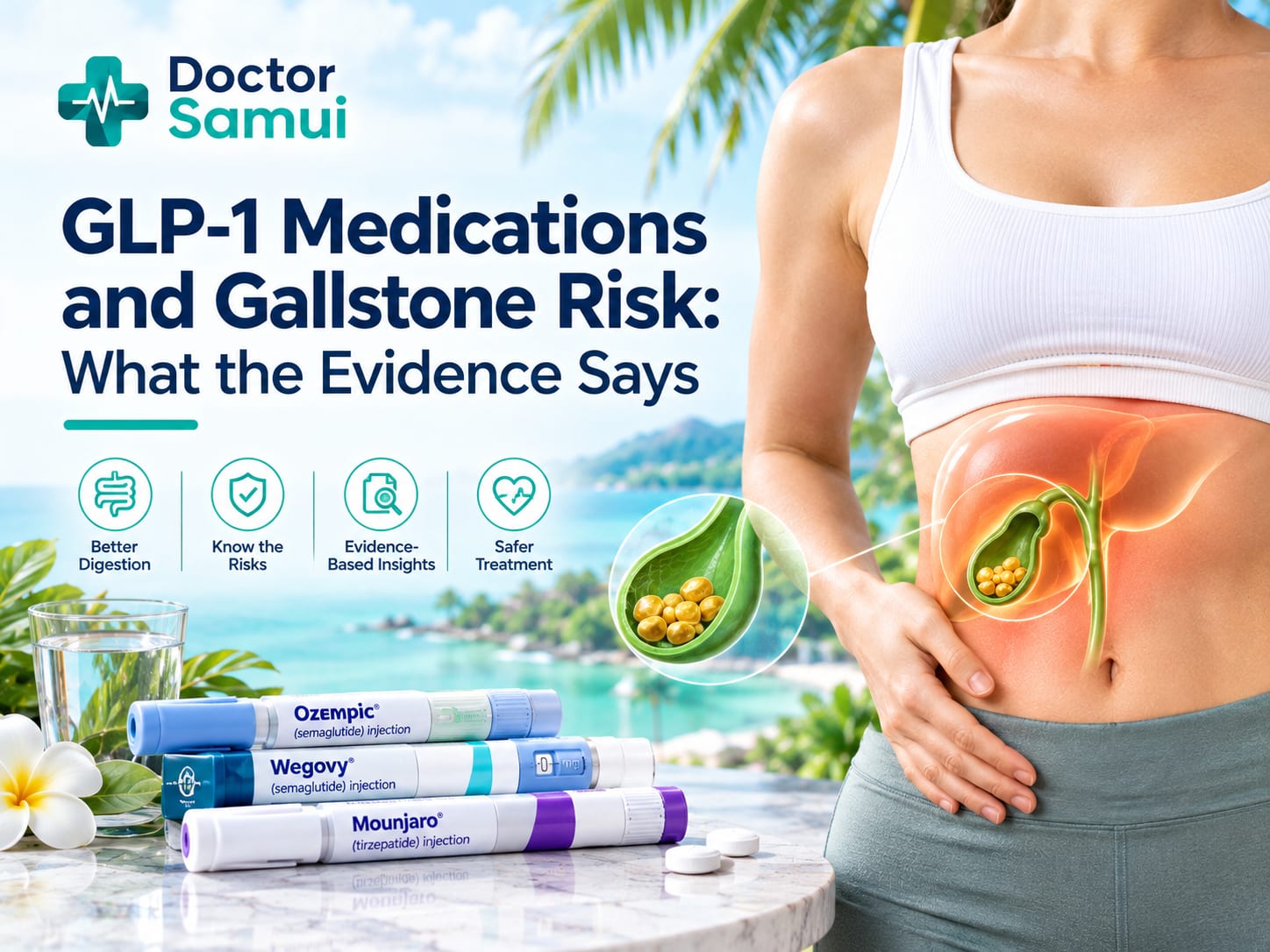
GLP-1 medications, including semaglutide and tirzepatide, are associated with a small but real increase in gallstone formation, particularly during periods of rapid weight loss. The risk comes from two things: changes in bile composition and reduced gallbladder emptying. Most people on GLP-1 therapy will not develop symptomatic gallstones. But the warning signs matter, and recognising them early, especially when you are away from home, can prevent a minor problem from becoming a serious one.
You are three months into your GLP-1 medication, losing weight steadily, feeling better. Then, at dinner on your second night in Samui, a sharp pain hits under your right ribs. It fades after an hour. You are not sure if it is the food, the medication, or something else. This is exactly the situation where knowing the difference matters.
GLP-1 medications do raise the risk of gallstones and the gallbladder inflammation that can follow. That risk is real but modest, and for most people the benefits of the medication outweigh it. GLP-1 medications should not be used by people with a personal or family history of medullary thyroid cancer or a condition called MEN 2, or by anyone who has had a serious allergic reaction to the drug. The practical question is what you actually do when abdominal pain appears while you are travelling, far from your usual doctor. This article covers the evidence on GLP-1 gallstones risk, which medications carry more of it, how to tell gallstone pain from ordinary side effects, and what to do if symptoms find you on the island.
Why GLP-1 Medications Increase Gallstone Risk
Two things happen when you start a GLP-1 medication that together raise gallstone risk.
The first is rapid weight loss itself. When body fat breaks down quickly, the liver releases more cholesterol into bile. Bile becomes saturated with more cholesterol than it can keep dissolved. Crystals begin to form, and over time those crystals become stones. This process happens with any fast weight loss, whether from medication, surgery, or extreme dieting.
The second factor is specific to GLP-1 drugs. These medications appear to reduce how well the gallbladder contracts and empties after meals. As a result, the gallbladder empties more slowly. Bile pools inside it longer than it should, creating ideal conditions for stone formation.
The Research Behind GLP-1 Gallstones Risk
The strongest evidence comes from a 2022 meta-analysis in JAMA Internal Medicine, which pooled results from 76 randomised controlled trials covering more than 103,000 patients. It found that GLP-1 receptor agonists as a class were associated with a statistically significant increase in gallbladder disease events compared to placebo or other treatments.
Trial data from the STEP programme for semaglutide reported more gallbladder events than placebo. In the tirzepatide weight-loss trials, gallstone rates were similar to placebo, but gallbladder inflammation was more common. The absolute numbers were not large, but the pattern was consistent across studies.
Does Your Specific GLP-1 Carry a Different Level of Risk
It is not yet clear whether some GLP-1 medications carry more risk than others.
Studies do not give a clear ranking of individual drugs, and results differ between studies. STEP 1 reported gallbladder events, mostly gallstones, in about 2.6% of participants on semaglutide 2.4 mg, compared with about 1.2% on placebo. In the tirzepatide weight-loss trials, gallstones were reported in about 1.1% of people on tirzepatide and 1% on placebo, while gallbladder inflammation was reported in 0.7% versus 0.2%. These trials did not compare the drugs directly, so their numbers cannot be used to rank them.
One consistent finding across all drugs is that weight-loss doses carry higher risk than the lower doses used for blood sugar control. Higher doses drive faster weight loss, and faster weight loss accelerates both mechanisms above.
The practical point: all GLP-1 medications carry some gallstone risk. The risk is higher with faster weight loss and higher doses, regardless of which drug you are using.
GLP-1 Side Effects vs. Gallstone Pain
This is a key question when abdominal pain appears on GLP-1 therapy, and it can be hard to answer without an assessment.
Standard GLP-1 gastrointestinal side effects, nausea, bloating, and upper abdominal discomfort, tend to be diffuse. They often improve over the first weeks of therapy. They are not usually triggered by a specific meal and do not typically radiate anywhere.
Gallstone pain is different. It tends to be episodic and sharper, sitting under the right ribs or in the upper-centre of the abdomen. It often starts after a meal, sometimes a fatty one, and can refer up to the right shoulder blade. An episode typically lasts between 30 minutes and a few hours, then fades.
Fever alongside that pain changes the picture entirely. Fever with right upper quadrant pain suggests cholecystitis, inflammation of the gallbladder, and needs same-day medical review. Do not apply a wait-and-see approach abroad, where your usual doctor is not available.
When Gallstones Become an Emergency
Most gallstone episodes are painful but not dangerous. Some are.
Biliary obstruction occurs when a stone blocks the bile duct completely. This can cause jaundice, a yellowing of the skin and eyes, alongside pain and fever. When all three appear together, this signals cholangitis, an infection of the bile ducts, and it is a hospital-level emergency.
Gallstone-induced pancreatitis is another serious complication. A stone that blocks the opening where the bile duct and pancreatic duct meet can trigger severe upper abdominal pain that often radiates straight through to the back. The pain is usually constant, not episodic, and comes with nausea and vomiting. This also requires urgent hospital-level care.
If you develop fever with severe abdominal pain, or any yellowing of the skin or eyes, seek emergency assessment immediately. Doctor Samui’s 24-hour service can assess you at your hotel or villa and advise on whether urgent transfer is needed.
Who Is Most at Risk and When
Risk is linked to fast weight loss. In the large 2022 review of trials, risk was also higher with higher doses, longer use, and use for weight loss.
Additional risk factors include a personal or family history of gallstones, obesity, female sex, older age, and a history of rapid weight fluctuations. People with existing gallbladder sludge, a thicker precursor to stones, may progress to symptomatic stones more quickly once bile stasis is added.
How to Reduce Your Gallstone Risk on GLP-1 Therapy
Gradual dose escalation is the standard way to start these medications. It mainly helps with stomach side effects, and it has not been proven to prevent gallstones.
Eating regular meals with moderate fat content may help the gallbladder contract normally. Skipping meals or eating a very low-fat diet reduces that stimulus and allows bile to pool.
For patients considered high risk, some clinicians prescribe ursodeoxycholic acid as a preventive measure. It reduces cholesterol saturation in bile and has been studied in other rapid-weight-loss contexts, including after bariatric surgery. Whether to use it alongside GLP-1 therapy requires individual medical review. If you think this applies to you, raise it with your doctor rather than sourcing it independently. It is not suitable for people with an inflamed gallbladder or a blocked bile duct.
Getting Assessed on Koh Samui
If right upper quadrant pain appears while you are on the island, the practical path is straightforward.
A clinical assessment at Doctor Samui in Chaweng, or a hotel or villa visit anywhere on the island, allows us to take a history, examine you, and determine whether your symptoms fit a GLP-1 side effect pattern or something that needs imaging. We can advise on abdominal ultrasound access on Samui for structural assessment of the gallbladder. If your symptoms point toward cholecystitis or anything more serious, we will guide you on next steps and referral.
If you are managing GLP-1 therapy during a longer stay on Samui and have questions about your gallbladder risk, a health check-up in Koh Samui is a sensible starting point. Our house-call service reaches Lamai, Bophut, Chaweng, Maenam, Choeng Mon, and the rest of the island around the clock. Knowing when GLP-1 abdominal pain needs a doctor is not always obvious. When you are not sure, come in.
If you are on a GLP-1 medication and have developed abdominal pain, right-sided discomfort, or any symptoms that concern you while on Koh Samui, Doctor Samui is available around the clock. Walk in to our Chaweng clinic or call for a hotel or villa visit anywhere on the island. We can assess your symptoms, advise on whether further imaging is needed, and help with management. Long-stay expats on ongoing GLP-1 therapy can also book a health checkup with a local doctor.
Frequently Asked Questions
Dr. Ponlawat Pitsuwan
Physician, Doctor Samui
a walk-in clinic based in Chaweng, Koh Samui, with 24-hour hotel and villa visits across the island. He sees tourists, families, and long-stay expats for GLP-1 medication management, abdominal complaints, medication side effects, and urgent care when symptoms arise away from home. His focus is straightforward, evidence-based care delivered in plain language.
References
- He L, Wang J, Ping F, et al. Association of Glucagon-Like Peptide-1 Receptor Agonist Use With Risk of Gallbladder and Biliary Diseases: A Systematic Review and Meta-analysis of Randomized Clinical Trials. JAMA Internal Medicine, 2022.
- Ukkonen M, Kivivuori A, Starckjohann P, et al. Gallbladder-Related Adverse Events With Semaglutide 2.4 mg: Pooled Analysis of Placebo-Controlled STEP Trials. Diabetes, Obesity and Metabolism, 2026.
- Eli Lilly and Company. ZEPBOUND (tirzepatide) US Prescribing Information, Section 5.4 Acute Gallbladder Disease. Eli Lilly, 2025.
- Novo Nordisk. WEGOVY (semaglutide) injection label: Contraindications and Acute Gallbladder Disease. DailyMed, US National Library of Medicine.
- European Association for the Study of the Liver (EASL). EASL Clinical Practice Guidelines on the prevention, diagnosis and treatment of gallstones. Journal of Hepatology, 2016.
The information in this article is for educational purposes only and does not constitute medical advice. It should not be used to self-diagnose or replace a consultation with a qualified physician. If you have concerns about your health, contact a licensed medical professional. For appointments at Doctor Samui, visit doctorsamui.com.