Clinically reviewed by Dr. Ponlawat Pitsuwan, Physician, Doctor Samui.
Last reviewed: October 2026
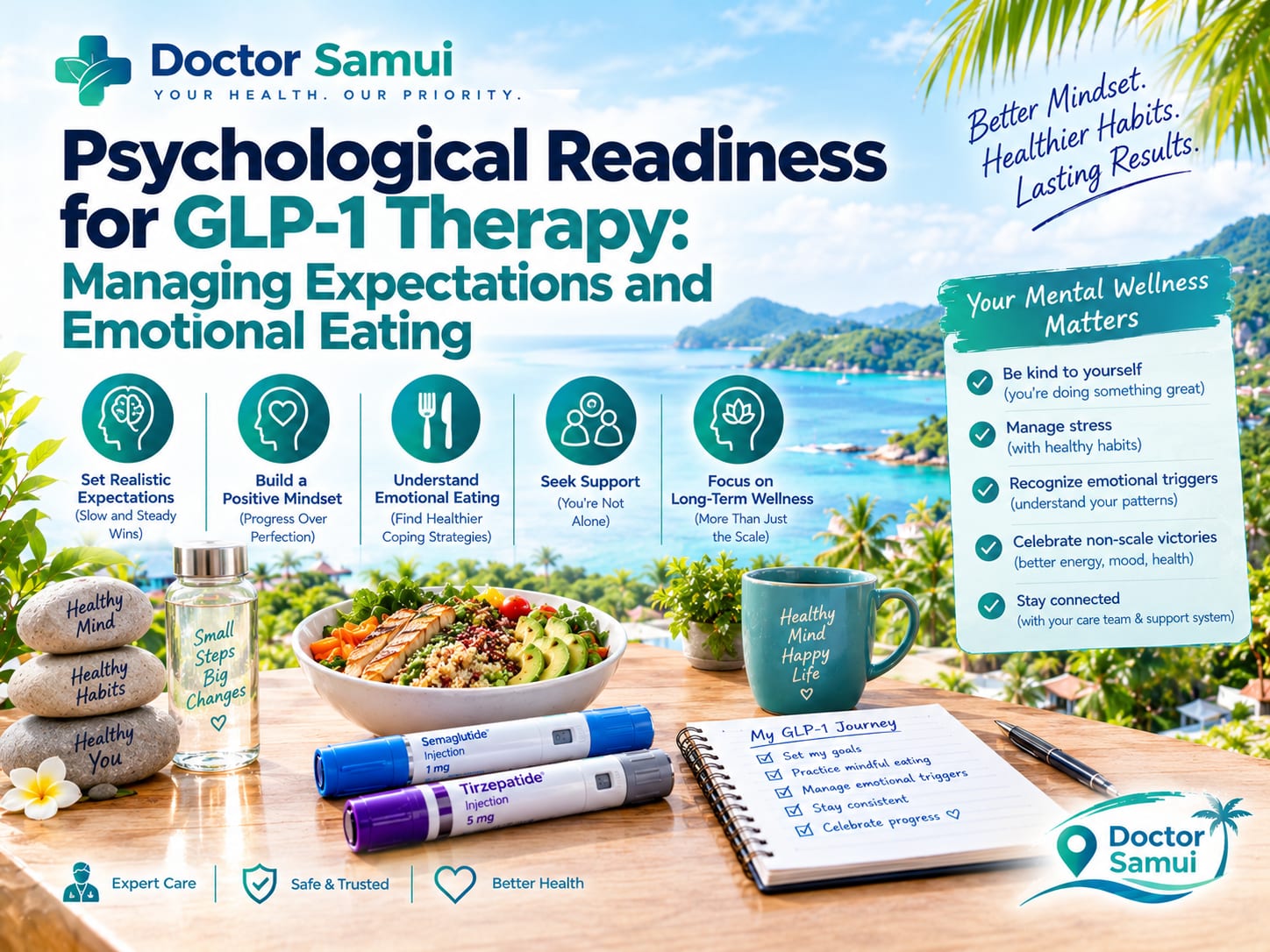
GLP-1 medications like semaglutide and tirzepatide reduce physical hunger and quiet food noise, but they do not resolve emotional eating on their own. Psychological readiness means understanding what the drug can and cannot do, setting realistic expectations about timelines and plateaus, and having a plan for the emotional side of weight loss before you start. Without that foundation, many people stall well before they reach their goal.
You are three months into a long stay on Samui. The prescription is within reach, your home clinic is far away, and you have been thinking about starting a GLP-1 medication for a while. Before the first dose, the question that matters most is not a medical one. It is this: are you ready for what this medication changes, and what it does not?
GLP-1 drugs, semaglutide and tirzepatide among them, are effective tools for medication-assisted weight loss. They lower physical hunger and reduce what many patients call food noise, the constant background pull toward eating. What they do not do is rewire the reasons you eat when you are stressed, bored, or upset. That gap is where most people run into trouble. Getting clear on it before you begin matters for how well the treatment works over time.

What GLP-1 Drugs Do to Appetite and What They Leave Untouched
GLP-1 receptor agonists act on satiety pathways in the brain and gut. They lower the pull toward food, which is why patients describe less obsession with eating and smaller portions feeling satisfying. That is real and useful.
But it is specific. The drug targets physiological hunger. Emotional eating is not driven by hunger. It is driven by stress, habit, grief, boredom, and a lifetime of using food to manage feelings. Those triggers sit outside what the medication reaches.
If you eat when you are overwhelmed after a long day, or when you are lonely, or as a reward ritual, the drug may quiet your appetite but it will not change that pattern. You may find yourself eating past fullness anyway, because the urge was never about hunger in the first place.
Why Emotional Eating Creates an Early Plateau on GLP-1 Therapy
Research published in Frontiers in Clinical Diabetes and Healthcare found that people using GLP-1 therapy who scored high on emotional eating measures lost less weight than those driven by external cues or restraint. Emotional eating behaviours also tended to return toward their pre-treatment levels by twelve months, even while the medication continued working. The study was small and observational, so these findings should be treated as preliminary.
This is the gap that catches people out. The drug does its job. The emotional pattern reasserts itself. The scale stops moving. Most people assume the medication has stopped working, or that they are failing. Neither is true.
Two separate problems need two separate tools. GLP-1 handles the physiological side. Behavioural work handles the emotional side. Running one without the other is what creates the plateau.

Defining Your GLP-1 Psychological Readiness Before You Start
Readiness is not a feeling. It is a set of honest answers to a few questions.
Why do you want to lose weight? If the main driver is social pressure or an event deadline, motivation tends to drop off early. If it is tied to how you want to feel in your body, or your health five years from now, it holds.
Do you understand this is not a short course? GLP-1 therapy is ongoing. Weight typically returns when the medication stops unless you have built habits that carry weight management forward independently. Do you know your emotional eating triggers? You do not need to have solved them. You need to know they exist.
Managing Expectations: Timelines, Plateaus, and All-or-Nothing Thinking
Most people lose weight steadily in the first few months on a GLP-1 drug. Then it slows. This is normal physiology, not failure. But all-or-nothing thinking, the sense that if you are not losing you must be doing everything wrong, is one of the most common reasons people abandon treatment that is actually working.
A plateau does not mean the drug has stopped. It often means your body has adapted and the emotional eating layer is now more visible than before. This is the point where behavioural support earns its place.
Mood can shift in early weeks as your relationship with food changes. Some patients feel unexpectedly flat or even grieve the loss of food as a comfort source. That is a real and common experience. It needs to be named before it catches you off guard.
Identity Shift and the Mental Lag Behind the Scale
Your body can change faster than your mind catches up. Patients who lose weight quickly on GLP-1 therapy sometimes continue to see themselves as they were before. They feel uncomfortable in the new body. They do not trust the change. This is a recognised pattern in rapid weight loss, and it can quietly undermine the process.
Body image does not update automatically. It needs deliberate attention, the same way physical habits do. Journalling, talking to a therapist, or simply naming what is changing can help the psychological self catch up to the physical one.
There is also an identity question that goes deeper. If eating has been part of how you connect with people or manage stress, losing that role leaves a gap. That gap needs filling with something intentional, or the old patterns step back in.
Building the Behavioural Scaffolding GLP-1 Cannot Provide
Cognitive behavioural therapy, CBT, has a good evidence base for dysfunctional and disordered eating, and is a reasonable first choice for addressing emotional eating alongside medication. It does not require months of weekly sessions. A focused course targeting eating triggers and restructuring responses can shift outcomes meaningfully.
Mindful eating is a lower-barrier practice that helps too. Not as a diet rule, but as a way of noticing what prompts each eating episode: physical hunger, or something else? Pausing before eating and naming the feeling behind the impulse builds real self-knowledge over time.
Self-monitoring, logging not just what you eat but how you were feeling when you chose to eat, is practical and free. It surfaces patterns you cannot see in the moment. If low mood, persistent anxiety, or emotional distress emerges during treatment, that is a conversation for your clinician, not just a motivational push.
Starting or Continuing GLP-1 Treatment on Koh Samui
If you are on Samui for months, or living here full time, starting or continuing GLP-1 treatment requires a licensed doctor’s prescription under Thai regulations. This is not a formality. Counterfeit and unverified GLP-1 products circulate online and through unregulated channels, and they carry real risk.
Doctor Samui provides GLP-1 consultations at the Chaweng clinic, including a full health history review, a discussion of your goals and readiness, and a prescription where the medication is appropriate. GLP-1 medications are not suitable for everyone: people with a personal or family history of medullary thyroid carcinoma or multiple endocrine neoplasia syndrome type 2 should not use them, and anyone who develops severe abdominal pain, persistent vomiting, or signs of an allergic reaction while taking them should seek medical attention promptly. That conversation includes the psychological side: what to expect, what the drug will not fix, and what support you may need alongside it. You can read more about managing expectations on GLP-1 at doctorsamui.com.
For long-stay expats who need continuity, the clinic also provides ongoing monitoring and follow-up. That matters more with GLP-1 than many medications because the psychological and physical picture changes significantly over the first six to twelve months of treatment. If you need a doctor at your villa or hotel while you work through early side effects or a difficult week, house call and IV therapy services are available across Lamai and the wider island. A health check-up in Koh Samui before you begin is also worth considering if you have not had a recent baseline assessment.
Planning for the Long Term: Life After or Between Doses
Weight regain after stopping GLP-1 therapy is well-documented. This does not mean the medication failed. It means that without ongoing medication or strong independent habits, the physiological drivers of weight tend to reassert themselves.
The behavioural work you do during treatment builds habits that do not depend entirely on the drug. Eating patterns, hunger awareness, emotional regulation, movement. These are what create durable change. The medication reduces the noise and buys you time. What you do with that window shapes the long-term picture.
If you are on Samui and approaching a planned gap in medication supply, or thinking about stopping, discuss it with your doctor before it happens, not after the weight starts returning.
Doctor Samui’s GLP-1 service includes a full consultation, health assessment, psychological readiness discussion, and prescription where appropriate, from the Chaweng walk-in clinic or via a 24-hour hotel or villa visit anywhere on the island. If you are a long-stay expat or extended visitor looking for proper medical oversight of your GLP-1 treatment on Koh Samui, get in touch to book your consultation.
FAQ
Dr. Ponlawat Pitsuwan
Physician, Doctor Samui
a walk-in clinic based in Chaweng, Koh Samui, with 24-hour hotel and villa visits across the island. He sees tourists, families, and long-stay expats for GLP-1 consultations, weight management assessments, and ongoing medication monitoring. His focus is straightforward, evidence-based care delivered in plain language.
References
- Nakahara M, et al. "Eating behavior predicts weight loss outcomes in GLP-1 receptor agonist therapy for type 2 diabetes." Frontiers in Clinical Diabetes and Healthcare, 2025.
- Wilding JPH, et al. "Once-Weekly Semaglutide in Adults with Overweight or Obesity." New England Journal of Medicine, 2021.
- Davies M, et al. "Semaglutide 2·4 mg once a week in adults with overweight or obesity, and type 2 diabetes (STEP 2)." The Lancet, 2021.
- World Health Organization. "Obesity and overweight: key facts." WHO, 2024.
- Vainik U, et al. "Uncontrolled eating: a unifying heritable trait linked with obesity, overeating, personality, and the brain." European Journal of Neuroscience, 2019.
- Novo Nordisk / EASD. "INFORM survey: semaglutide reduces food noise in adults with overweight or obesity." Presented at EASD, 2025.
The information in this article is for educational purposes only and does not constitute medical advice. It should not be used to self-diagnose or replace a consultation with a qualified physician. If you have concerns about your health, contact a licensed medical professional. For appointments at Doctor Samui, visit doctorsamui.com.