Clinically reviewed by Dr. Ponlawat Pitsuwan, Physician, Doctor Samui.
Last reviewed: October 2026
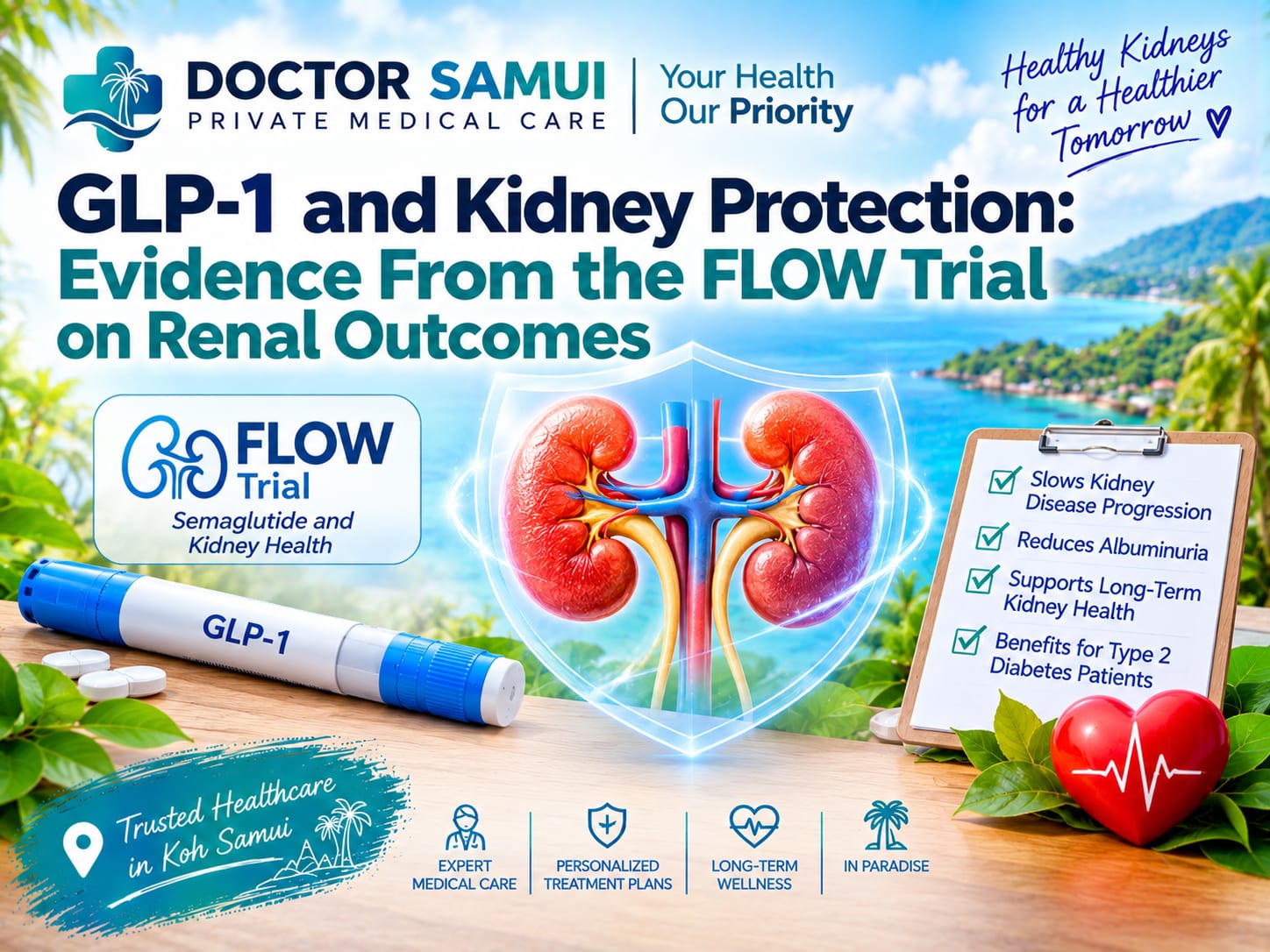
The FLOW trial showed that semaglutide 1.0 mg reduced the risk of a major kidney or cardiovascular event by 24% in people with type 2 diabetes and chronic kidney disease, compared to placebo. The trial was stopped early because the benefit was already clear. This is the strongest direct evidence to date that a GLP-1 receptor agonist protects kidney function in diabetic kidney disease.
Your last blood test came back with flagged kidney numbers. You are a long-stay expat on Koh Samui, your regular specialist is in Europe or Australia, and your diabetes has been ticking along quietly for years. Now your doctor back home has mentioned semaglutide, and you are trying to understand what that actually means for your kidneys before your next appointment.
The evidence is real and clinically significant. The FLOW trial, published in 2024, is the first dedicated kidney outcomes trial for a GLP-1 receptor agonist, the class of diabetes medicines that includes semaglutide. It showed a meaningful reduction in the risk of kidney failure and cardiovascular death in people who already have diabetic kidney disease. This article explains what the trial found, who benefits most, and how to act on it from Koh Samui.

What the FLOW Trial Actually Measured
The FLOW trial enrolled people with type 2 diabetes and chronic kidney disease (CKD). CKD means the kidneys are already working below normal, measured by eGFR, your estimated glomerular filtration rate, which shows how well your kidneys filter waste from your blood. Participants also had elevated uACR, the urine albumin-to-creatinine ratio, which measures protein leaking into urine, a key sign of kidney stress.
All participants were on standard background therapy, including RAAS blockers such as ACE inhibitors or ARBs, medicines that reduce pressure inside the kidney’s filtering units. Semaglutide 1.0 mg weekly was tested against placebo on top of this existing care.
The primary endpoint covered four events: a sustained drop in eGFR of 50% or more, eGFR falling below 15 (the threshold where dialysis or a transplant becomes likely), kidney failure requiring dialysis or transplant, or death from kidney or cardiovascular causes. Each one represents a serious clinical event, not an abstract number.
FLOW Trial Results and What They Mean for Patients
The data monitoring committee stopped the trial early because the benefit was already clear before the planned end date. Early stopping for efficacy is generally a positive signal for the treatment, though it introduces some uncertainty around the final effect size.
The headline result: semaglutide reduced the composite kidney and cardiovascular endpoint by 24% compared to placebo. Fewer people in the semaglutide group reached kidney failure, sustained eGFR decline, or died from cardiovascular causes. The trial ran over a median of approximately 3.4 years.
Albuminuria also fell significantly in the semaglutide group. Reducing uACR is one of the earliest and most reliable signs that a treatment is protecting the kidney’s filtering units. High albuminuria is independently linked to faster kidney decline, so this matters beyond the headline figure.

How GLP-1 Drugs Protect the Kidney
The kidney benefit is not simply a result of lower blood sugar. GLP-1 receptor agonists appear to work through several overlapping pathways.
One is reducing glomerular hyperfiltration. In early diabetic kidney disease, the filtering units are often pushed to work too hard. Semaglutide appears to ease that excessive pressure, which reduces structural damage over time. There is also evidence of effects on inflammation and oxidative stress inside kidney tissue, both of which drive scarring and eGFR decline in diabetic nephropathy.
Healthier blood vessel linings also play a role. The kidneys rely on precise blood vessel function to filter correctly, and GLP-1 receptor agonists appear to improve this at the tissue level, separate from glucose control. These pathways together are why GLP-1 kidney protection is broader than a blood sugar story.
GLP-1 Kidney Protection and SGLT2 Inhibitors: Do You Need Both?
Many patients with type 2 diabetes and CKD are already taking an SGLT2 inhibitor, such as empagliflozin or dapagliflozin, which also has kidney-protective evidence. The natural question is whether semaglutide still helps if you are already on one.
A subgroup analysis from the FLOW trial, published in Nature Medicine, found no statistically significant interaction between semaglutide’s effect and SGLT2 inhibitor use at baseline. The subgroup of participants already taking an SGLT2 inhibitor was small, around 16% of the total, and the analysis was not powered to draw firm conclusions about that group specifically. Current evidence suggests the two drug classes work through different but overlapping pathways.
This does not mean everyone with CKD needs both. That is a clinical decision based on your eGFR, your uACR, your cardiovascular risk, and what you are already tolerating. What the data show is that adding semaglutide to SGLT2 inhibitor therapy is not redundant.
Who Benefits Most From GLP-1 Kidney Protection
A 2026 analysis in the Clinical Journal of the American Society of Nephrology looked at subgroups by CKD severity within the FLOW trial. The benefit was consistent across different stages of CKD, including participants with more advanced disease. There is often a clinical instinct to wait and start kidney-protective treatments only in earlier stages. The data do not support waiting.
Patients with macroalbuminuria, very high protein levels in the urine, appeared to see some of the strongest early signals, particularly in uACR reduction. Macroalbuminuria marks a kidney under significant stress, and reducing protein excretion in these patients is directly linked to slower long-term decline.
Why This Matters for Expats and Long-Stay Residents on Koh Samui
Managing type 2 diabetes and CKD from an island in the Gulf of Thailand is not the same as managing it five minutes from a specialist nephrology clinic. Many long-stay expats on Koh Samui monitor chronic conditions with infrequent trips to Bangkok or back home. Blood tests get delayed. Dose reviews get postponed.
The FLOW trial results argue for proactive, not reactive, kidney protection. If your eGFR is already declining and your uACR is elevated, waiting for your next specialist appointment to discuss semaglutide carries clinical consequences.
Doctor Samui can arrange baseline kidney function testing, including eGFR and uACR, at the Chaweng clinic or through a hotel or villa visit across the island. For expats already on diabetes medication, a consultation here lets us review your current regimen, explain what your kidney numbers mean, and refer or co-manage where needed. You do not need to wait for a Bangkok trip to have this conversation. You can find more about our GLP-1 services at doctorsamui.com/glp-1/.
Getting Started With GLP-1 Therapy for Kidney Protection on Koh Samui
Before starting semaglutide, a baseline assessment matters. This means your current eGFR, your uACR, your HbA1c, your existing medications including any RAAS blockers, and your cardiovascular risk profile. A health check-up in Koh Samui that includes these kidney markers gives a clearer picture of how closely treatment needs to be managed.
Semaglutide is not suitable for everyone. People with a personal or family history of medullary thyroid carcinoma, or with a rare condition called multiple endocrine neoplasia type 2, should not use it. A history of pancreatitis or severe gastrointestinal disease also requires careful assessment before starting. These are the key contraindications a prescribing doctor will go through with you.
If you are visiting Koh Samui short-term and need to document your kidney status before returning home, Doctor Samui can arrange testing and provide a written clinical summary for your home physician. For longer stays, repeat kidney function testing and medication review can be handled locally. Expats based further from Chaweng, from Maenam across to Lamai, can access house call services without travelling to the clinic.
Cardiovascular and Kidney Outcomes: Cardiorenal Protection Together
The FLOW trial’s composite endpoint included cardiovascular death alongside kidney outcomes. This was deliberate. Patients with diabetic kidney disease carry a very high cardiovascular risk, and the two systems deteriorate together. Cardiorenal protection, treating both simultaneously, is now a recognised treatment goal in current KDIGO and ADA guidelines.
Semaglutide’s benefit across both kidney and cardiovascular endpoints in the same trial makes the GLP-1 class particularly relevant for patients who face risk from both sides. The kidney protection does not come at a cardiovascular cost. For patients managing type 2 diabetes and CKD from Koh Samui, that combined risk picture is exactly why this evidence matters in practice. A routine health check-up that includes kidney and cardiovascular markers is a practical starting point for any conversation about this therapy.
If you have type 2 diabetes and have been told your kidney function is declining, the FLOW trial evidence is worth acting on now, not at your next specialist visit. Doctor Samui offers health check-ups including eGFR and uACR kidney function testing at the Chaweng clinic, with 24/7 hotel and villa visits across the island for long-stay expats and visitors who need a consultation without travelling. Our team can review your current diabetes medications, arrange baseline kidney testing, and discuss whether GLP-1 therapy is appropriate for you.
Frequently Asked Questions
Dr. Ponlawat Pitsuwan
Physician, Doctor Samui
a walk-in clinic based in Chaweng, Koh Samui, with 24/7 hotel and villa visits across the island. He sees tourists, families, and long-stay expats for chronic disease management including type 2 diabetes, kidney function monitoring, and GLP-1 therapy assessment. His focus is straightforward, evidence-based care delivered in plain language.
References
- Perkovic V, et al. Semaglutide and Kidney Outcomes in Type 2 Diabetes and Chronic Kidney Disease. New England Journal of Medicine. 2024;391(2):109-121. DOI: 10.1056/NEJMoa2403347.
- Mahaffey KW, et al. Effects of semaglutide with and without concomitant SGLT2 inhibitor use in participants with type 2 diabetes and chronic kidney disease in the FLOW trial. Nature Medicine. 2024. PMC11485243.
- Tuttle KR, et al. Kidney and Survival Outcomes with Semaglutide by CKD Severity in the FLOW Trial. Clinical Journal of the American Society of Nephrology. 2026;21:841-851.
- Kidney Disease: Improving Global Outcomes (KDIGO). KDIGO 2022 Clinical Practice Guideline for Diabetes Management in Chronic Kidney Disease. Kidney International. 2022.
- American Diabetes Association. Standards of Care in Diabetes 2024 — Section 11: Chronic Kidney Disease and Risk Management. Diabetes Care. 2024;47(Suppl 1):S219-S230.
- U.S. Food and Drug Administration. Ozempic (semaglutide) Prescribing Information. Novo Nordisk. Revised 05/2026.
The information in this article is for educational purposes only and does not constitute medical advice. It should not be used to self-diagnose or replace a consultation with a qualified physician. If you have concerns about your health, contact a licensed medical professional. For appointments at Doctor Samui, visit doctorsamui.com.