Clinically reviewed by Dr. Ponlawat Pitsuwan, Physician, Doctor Samui.
Last reviewed: October 2026
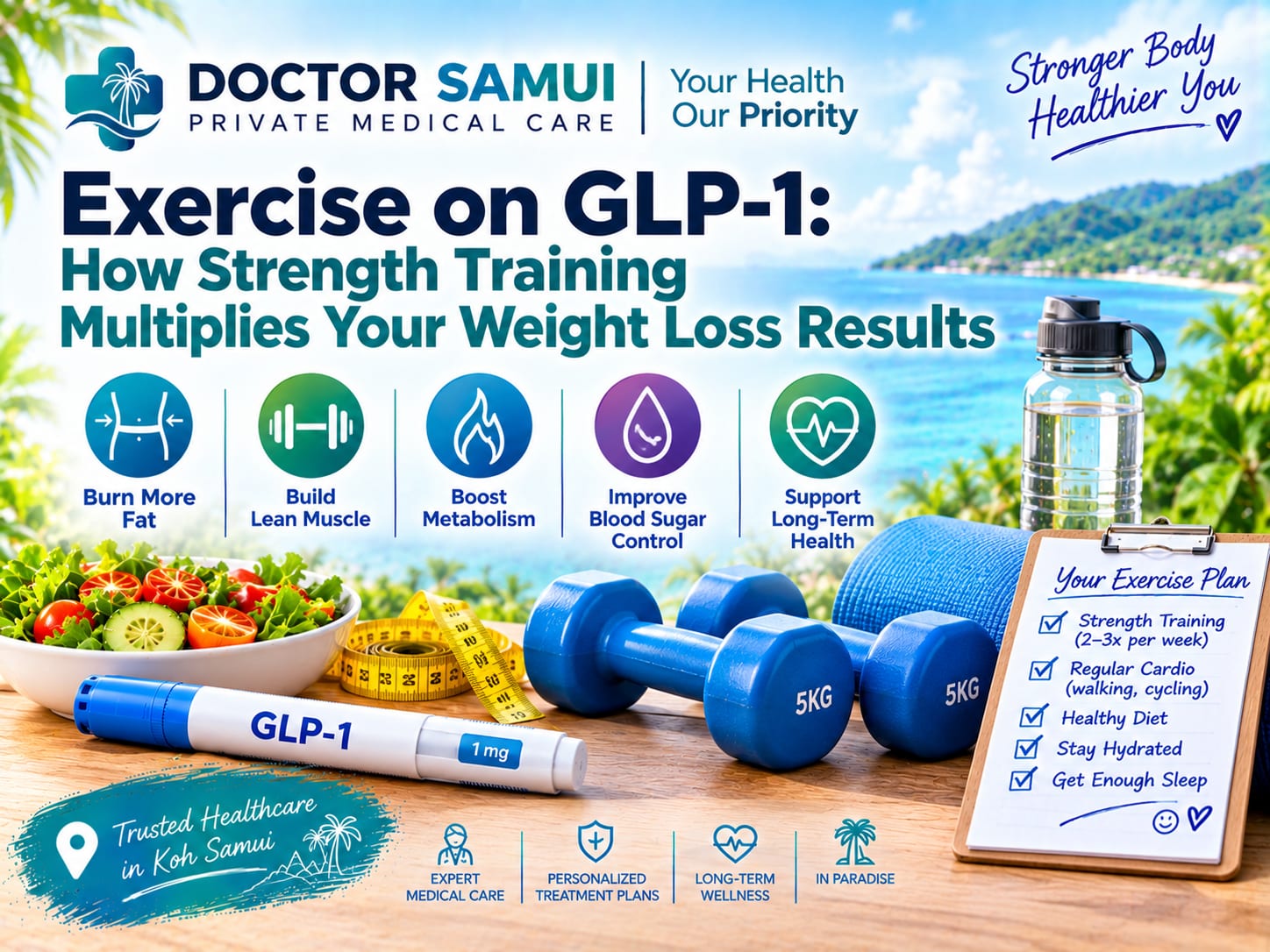
Adding resistance training while taking a GLP-1 medication like semaglutide or tirzepatide significantly improves the composition of weight lost, shifting the balance toward fat rather than lean muscle. Without it, a meaningful portion of weight lost on GLP-1 comes from muscle, which lowers your resting metabolic rate and increases the risk of regaining weight after stopping. Two to three resistance sessions per week, combined with adequate protein intake, is the practical minimum to protect muscle mass during treatment.
You have been on your GLP-1 medication for two months. The scale is moving. But you feel softer, not leaner, and more tired than you expected. That is not your imagination. When your body runs on a steep caloric deficit, it does not burn fat exclusively. It burns whatever is available, and muscle is available.
GLP-1 medications are powerful tools for reducing appetite and driving weight loss. But the research is clear: exercise on GLP-1 results, specifically resistance training, changes what kind of weight you lose. It is the difference between a lighter version of the same body and a genuinely leaner, stronger one. Here is what you actually need to do about it.
What GLP-1 Medications Do to Your Body Composition
When you lose weight quickly through caloric restriction, the body loses both fat mass and lean mass. Lean mass includes muscle, connective tissue, and bone. On GLP-1 medications, where caloric restriction can be dramatic, this process is accelerated.
Emerging evidence suggests tirzepatide (Mounjaro) may be associated with greater lean mass loss than semaglutide (Ozempic, Wegovy), particularly at higher weight-loss percentages. This is clinically relevant if you are already on tirzepatide and not yet exercising.
There is also the issue of fat infiltration in muscle. When muscle is not regularly loaded and stimulated, intra-muscular fat can increase over time. This affects strength, function, and metabolic health, even if the number on the scale looks good.
Why Cardio Alone Will Not Protect Your Muscles on GLP-1
Walking, swimming, and cycling are all worth doing. They support cardiovascular health, mood, and calorie expenditure. But they do not provide what muscle tissue needs to survive a caloric deficit: mechanical tension.
Mechanical tension is the force placed on muscle fibres during resistance exercise. That signal, applied repeatedly through progressive overload, tells your body that the muscle is needed and should be kept. Without it, no amount of steps or swim laps will prevent lean mass loss on a significantly reduced calorie intake.
Resistance training also raises your resting metabolic rate. More muscle means your body burns more energy at rest, which compounds your results over weeks and months. Cardio burns calories during exercise. Strength training changes how many calories you burn around the clock.

How to Structure Your Workouts Without Burning Out
This is where many people on GLP-1 run into trouble. Standard workout plans assume normal caloric intake. You are not eating normally. Your available energy for training is reduced, which means volume needs to be managed carefully, especially in the first few months.
Start with two full-body resistance sessions per week. Focus on compound movements: squats, hip hinges, rows, pressing patterns. These recruit large muscle groups and give the most return on limited energy. Three sets per exercise at a challenging but manageable effort level is a reasonable starting point.
As nausea and fatigue from the medication ease, usually after the initial dose titration period, volume can increase gradually. Your exercise tolerance on reduced calories is the real limiting factor, not your fitness level.
Beyond Muscle: What Else Strength Training Protects on GLP-1
Bone density loss is a documented concern during rapid weight loss. Bone responds to mechanical loading the same way muscle does. Resistance training places compressive force on bone, which stimulates maintenance and formation. For patients on long-term GLP-1 treatment, this matters.
Strength training also supports joint integrity, balance, and functional capacity. For long-stay expats on Samui who are hiking the trails around Na Muang, diving, or spending time on the water, functional strength matters in practical terms every single day.
The psychological benefit is real too. Becoming visibly stronger and more capable sustains motivation through a long treatment course in a way that watching a number on a scale often cannot.
Exercising on GLP-1 in Koh Samui: What Is Different Here
Samui’s heat and humidity change the exercise equation. Even moderate effort in midday heat adds a significant cardiovascular demand. For someone on a GLP-1 medication who is already eating less, training in peak heat increases dehydration risk and can amplify nausea.
Train early morning or after sunset. Both are manageable in Samui’s climate and avoid the worst of the heat stress. If you are staying near Lamai or Chaweng, most beaches are calm and cool before 8am. That window is worth protecting.
The island also offers options that serve both cardio and resistance purposes. Ocean swimming in moderate surf has meaningful resistance. Stand-up paddleboarding builds core and shoulder endurance. Hiking around Na Muang loads the lower body in ways that flat treadmill walking does not.
Hydration needs more attention here than it would in a cooler climate. GLP-1 medications suppress appetite, and some people also notice a reduced drive to drink fluids, though controlled evidence on this is limited. Training in tropical heat while eating less means dehydration can creep up without a clear warning signal. Drink before you feel thirsty, and take electrolytes seriously on training days.
Why Your Exercise Habit Is Your Exit Strategy After GLP-1
Evidence indicates that a significant proportion of weight lost on GLP-1 medication is regained after stopping, particularly when lifestyle changes have not been established during treatment. This is not a reason to avoid the medication. It is a reason to use the treatment window to build a habit that outlasts the prescription.
Muscle mass built during treatment raises your resting metabolic rate. That metabolic foundation is your post-medication weight maintenance plan. Without it, stopping GLP-1 puts you back at square one metabolically.
The exercise habit you build while the medication is suppressing your appetite is the most important long-term investment you can make during treatment. It is not the optional upgrade. It is the insurance policy.
How Doctor Samui Supports Your GLP-1 Treatment and Exercise Plan
Managing GLP-1 treatment well means more than taking the injection on schedule. It means knowing whether you are losing fat or muscle, adjusting your protein targets as your intake drops, and titrating your dose in a way that accounts for your activity level.
GLP-1 medications are not suitable for everyone. They are generally not used in people with a personal or family history of medullary thyroid cancer or multiple endocrine neoplasia syndrome type 2, and require caution in people with a history of pancreatitis. At the Chaweng clinic, we prescribe and monitor GLP-1 medications with body composition in mind. That means tracking lean mass alongside total weight, discussing realistic protein targets given your reduced appetite, and adjusting your plan when side effects like nausea or fatigue are getting in the way of training. If you want to understand how to prevent muscle loss on GLP-1 during your treatment, that conversation starts with a proper assessment.
For long-stay expats and residents across the island, we offer ongoing monitoring through the clinic and via house calls where that suits you better. Whether you are based in Bophut, Maenam, or Lamai, a house call doctor in Koh Samui can come to you for check-ins and dose reviews. If you want to combine your GLP-1 monitoring with a full panel, a health check-up in Koh Samui gives you the bloodwork and body composition picture in one visit.
Losing weight on GLP-1 is one thing. Losing the right kind of weight is another. Doctor Samui offers GLP-1 prescriptions, body composition monitoring, and practical guidance on exercise and protein intake during treatment. Walk in to the Chaweng clinic or book a house call anywhere on the island, available 24 hours a day.
Frequently Asked Questions
Dr. Ponlawat Pitsuwan
Physician, Doctor Samui
a walk-in clinic based in Chaweng, Koh Samui, with 24-hour hotel and villa visits across the island. He sees tourists, families, and long-stay expats for GLP-1 weight loss treatment, body composition monitoring, and practical guidance on exercise and nutrition during medical weight management. His focus is straightforward, evidence-based care delivered in plain language.
References
- Wilding JPH, et al. Once-Weekly Semaglutide in Adults with Overweight or Obesity. New England Journal of Medicine, 2021.
- Jastreboff AM, et al. Tirzepatide Once Weekly for the Treatment of Obesity. New England Journal of Medicine, 2022.
- World Health Organization. Physical Activity Fact Sheet. WHO, 2022.
- Bray GA, et al. Effect of Dietary Protein Content on Weight Gain, Energy Expenditure, and Body Composition During Overeating. JAMA, 2012.
- Wilding JPH, et al. Weight regain and cardiometabolic effects after withdrawal of semaglutide: The STEP 1 trial extension. Diabetes, Obesity and Metabolism, 2022.
- Cava E, et al. Preserving Healthy Muscle during Weight Loss. Advances in Nutrition, 2017.
The information in this article is for educational purposes only and does not constitute medical advice. It should not be used to self-diagnose or replace a consultation with a qualified physician. If you have concerns about your health, contact a licensed medical professional. For appointments at Doctor Samui, visit doctorsamui.com.