Clinically reviewed by Dr. Ponlawat Pitsuwan, Physician, Doctor Samui.
Last reviewed: October 2026
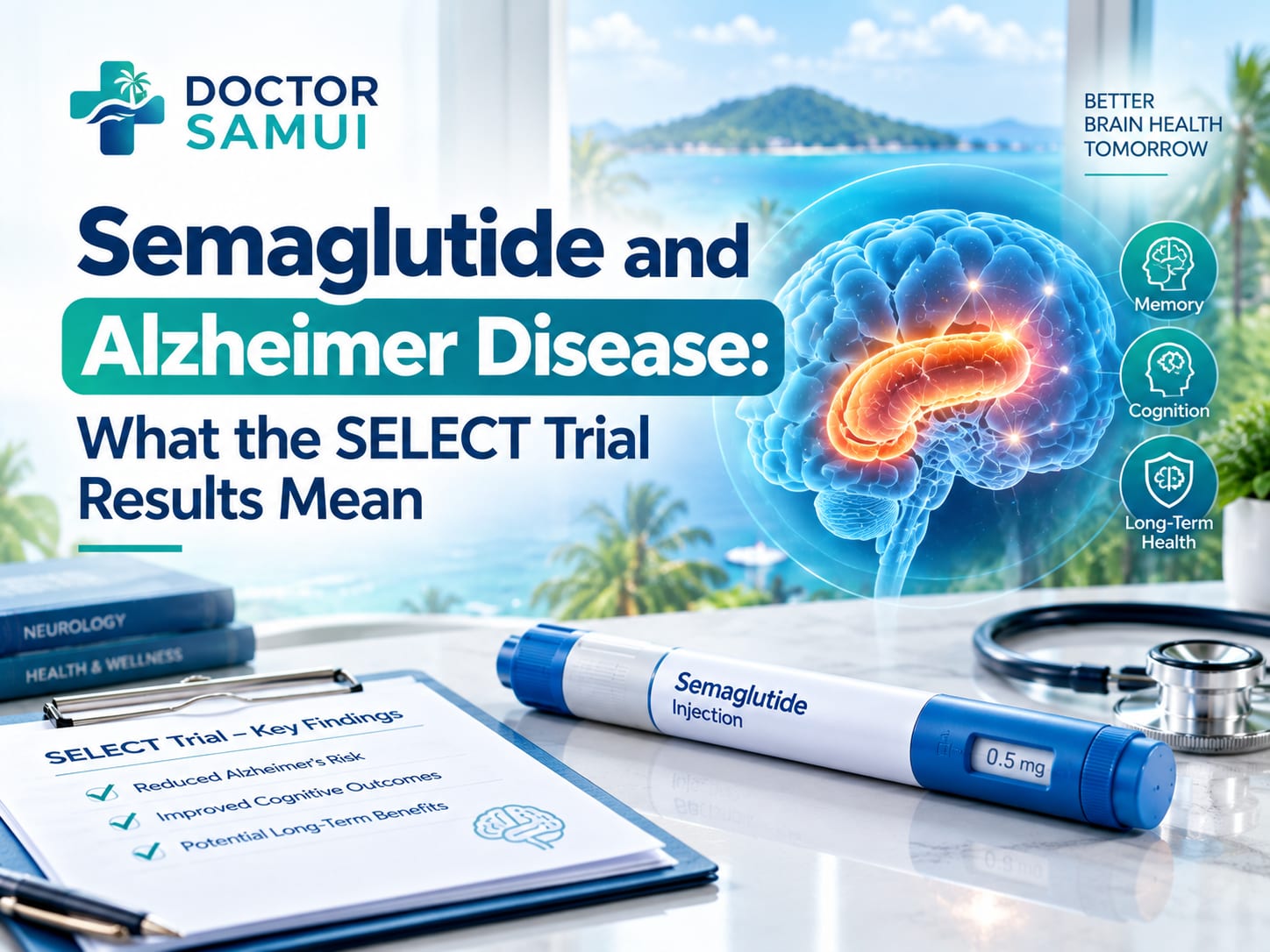
The SELECT trial found that semaglutide significantly reduced a predicted dementia risk score in people with cardiovascular disease over 104 weeks. This came from a post hoc analysis of a cardiovascular trial, not a dedicated Alzheimer’s study. Separately, the EVOKE and EVOKE+ trials tested oral semaglutide in people who already had early Alzheimer’s disease and missed their primary clinical endpoint. These are different studies asking different questions, and mixing them up leads to very different conclusions about what the evidence actually shows.
You are sitting on a hotel terrace in Chaweng, scrolling through headlines about Ozempic and Alzheimer’s. One article says semaglutide protects the brain. Another says the trial failed. Both are describing real data. They are just describing different studies.
This is one of the more genuinely confusing areas in recent medicine, because there are three separate streams of evidence, each pointing in a slightly different direction. Understanding which is which matters, especially if you are already on semaglutide or thinking about starting it for weight or metabolic reasons.

Understanding the SELECT Trial and What It Actually Measured
Most headlines about the semaglutide Alzheimer study cite the SELECT trial. It is worth being precise about what SELECT was. It was a large cardiovascular outcomes trial enrolling over 17,000 adults with overweight or obesity and established cardiovascular disease, most of whom did not have type 2 diabetes and did not have Alzheimer’s disease. Semaglutide is not suitable for everyone: it is contraindicated in people with a personal or family history of medullary thyroid carcinoma or multiple endocrine neoplasia type 2, and should not be used in pregnancy. Anyone who develops severe or persistent abdominal pain, signs of pancreatitis, or a rapid heartbeat while taking it should seek medical advice promptly.
The Alzheimer’s finding came from a post hoc analysis, meaning it was not the trial’s original question. Researchers used a validated score called the dSST, a predicted dementia risk measure based on multiple biomarkers. They found that semaglutide significantly reduced the rise in this score over 104 weeks compared to placebo. This is hypothesis-generating evidence. It suggests a signal worth investigating, not a confirmed treatment effect.
It does not tell us whether semaglutide prevents Alzheimer’s disease. It tells us that in a specific population with cardiovascular risk, something measurable and dementia-related moved in a favourable direction.
The EVOKE Trials: A Different Question Entirely
The EVOKE and EVOKE+ trials were dedicated phase 3 Alzheimer’s trials. They enrolled people who already had early Alzheimer’s disease and tested whether oral semaglutide could slow cognitive decline. The primary endpoint was the CDR-SB, the Clinical Dementia Rating sum of boxes, a direct clinical measure of how much thinking and daily functioning had changed.
Both trials missed that primary endpoint. Oral semaglutide did not demonstrably slow cognitive decline in people who already had established early Alzheimer’s disease.
That is a meaningful result. It means semaglutide is not a treatment for existing Alzheimer’s disease based on current evidence. But it does not close the door on every related question. For more on what the EVOKE trials found, see the GLP-1 Alzheimer’s evidence overview at Doctor Samui.

What the Biomarker Data Showed and Why Researchers Have Not Stopped
Despite missing the CDR-SB endpoint, the EVOKE trials produced some notable biomarker signals. Researchers observed reductions in phosphorylated tau, a protein linked to the neurofibrillary tangles found in Alzheimer’s disease. They also saw changes in GFAP, a marker of astrocyte stress and brain injury, and in neurofilament light chain, a marker of nerve cell damage.
These biomarker shifts did not translate into measurable clinical benefit in those trials. But they suggest semaglutide may be doing something biologically relevant in the brain. The effect may not be strong enough, or may arrive too late in the disease process, to change how people function day to day.
This is why research has continued rather than stopped. Biomarker signals without clinical benefit are not a success, but they are not a null result either.
Why Researchers Think GLP-1 Drugs Could Protect the Brain
The brain has its own insulin signalling system. In Alzheimer’s disease, that system becomes disrupted, a phenomenon sometimes called brain insulin resistance. GLP-1 receptor agonists like semaglutide act on receptors that are present throughout the brain and nervous system. This is one reason researchers hypothesised they might have neuroprotective properties.
There are also proposed effects on neuroinflammation, the chronic low-level brain inflammation associated with Alzheimer’s and other dementias. Cardiovascular risk factor reduction is another pathway: better blood pressure, lower weight, and improved lipid profiles all reduce the vascular burden on the brain over time. Some preclinical research has suggested semaglutide may influence amyloid-beta plaque clearance, though this has not been confirmed in human trials.
None of these pathways are proven to prevent dementia in humans yet. Together they explain why the research question made sense and why it continues.
Real-World Observational Data: The Case Western Cohort
Separate from the clinical trials, a large observational study from Case Western Reserve University analysed electronic health records from type 2 diabetes patients. It found substantially lower rates of Alzheimer’s diagnosis in those taking semaglutide versus those on other diabetes medications. The association was particularly strong for vascular dementia, the type driven by reduced blood flow to the brain.
Observational data like this cannot prove causation. There is a real risk of confounding: people prescribed semaglutide may differ from those on other diabetes drugs in ways that themselves affect dementia risk. The association is consistent and notable, but it is not the same as trial evidence.
What it does is add a third data stream pointing in the same direction, which matters for how seriously researchers treat the question.
What This Means If You Are Already on Semaglutide or Considering It
If you are taking Ozempic or Wegovy for type 2 diabetes, weight management, or cardiovascular risk reduction, the Alzheimer’s trial results do not change your prescribing picture. Those indications remain well-supported. The SELECT biomarker signal is a tentative additional consideration, not a reason to start or stop the medication.
If you have a family history of Alzheimer’s and are wondering whether semaglutide is worth taking specifically for brain protection: the evidence does not yet support that as a primary indication. There are signals across multiple data streams, but no completed trial has shown that semaglutide prevents Alzheimer’s disease in people who do not yet have it.
That conversation belongs with your doctor, with your full medical history on the table, not with a headline.
Accessing a Semaglutide Assessment in Koh Samui
For long-stay expats and health-conscious visitors on the island, the question often becomes practical: where do you go for a proper clinical assessment rather than just reading about it?
Doctor Samui offers consultations for semaglutide prescribing as part of a GLP-1 service at the Chaweng clinic. Prescribing follows a clinical assessment, not simply interest in a potential brain benefit the evidence does not yet fully support. If you are already on semaglutide from your home country and need continuity of care while on the island, that is something we can help with too. The clinic also offers 24/7 hotel and villa visits across Koh Samui if you cannot get in to Chaweng.
If you want a full picture of where your metabolic health stands before any prescribing decision, a health check-up in Koh Samui is a practical first step. The value of coming in is arriving at the decision well-informed rather than over-optimistic or dismissive. The research is genuinely interesting. It is just not where the headlines sometimes suggest it is.
Doctor Samui offers semaglutide consultations and GLP-1 prescribing assessments at the Chaweng clinic and via 24/7 hotel and villa visits across Koh Samui. If you are considering semaglutide for weight management, metabolic health, or want to understand what the current evidence means for you personally, book a consultation. Our English, German, and Hebrew speaking team can walk you through the data and whether it applies to your situation.
Frequently Asked Questions
Dr. Ponlawat Pitsuwan
Physician, Doctor Samui
a walk-in clinic based in Chaweng, Koh Samui, with 24/7 hotel and villa visits across the island. He sees tourists, families, and long-stay expats for metabolic health consultations, GLP-1 prescribing assessments, and general medical care. His focus is straightforward, evidence-based care delivered in plain language.
References
- Belmont-Rausch A, et al. Semaglutide Impacts Proteomic Signatures Related to Dementia Risk in the SELECT Cardiovascular Outcomes Trial. Alzheimer’s & Dementia, 2026. Presented at AAN 2026.
- Alzheimer Europe. Results of EVOKE and EVOKE+ trials show no effect of oral semaglutide on AD progression. Alzheimer Europe News, 2025.
- NeurologyLive. CTAD Presentation Lays Insights Into Disappointing Phase 3 EVOKE Trial of GLP-1 Semaglutide in Alzheimer’s. NeurologyLive, December 2025.
- Case Western Reserve University. Popular diabetes and weight-loss drug may reduce risk of Alzheimer’s disease. CWRU Newsroom, 2024.
- Neth BJ, Craft S. Insulin Resistance and Alzheimer’s Disease: Bioenergetic Linkages. Frontiers in Aging Neuroscience. 2017;9:345.
The information in this article is for educational purposes only and does not constitute medical advice. It should not be used to self-diagnose or replace a consultation with a qualified physician. If you have concerns about your health, contact a licensed medical professional. For appointments at Doctor Samui, visit doctorsamui.com.