Clinically reviewed by Dr. Ponlawat Pitsuwan, Physician, Doctor Samui.
Last reviewed: October 2026
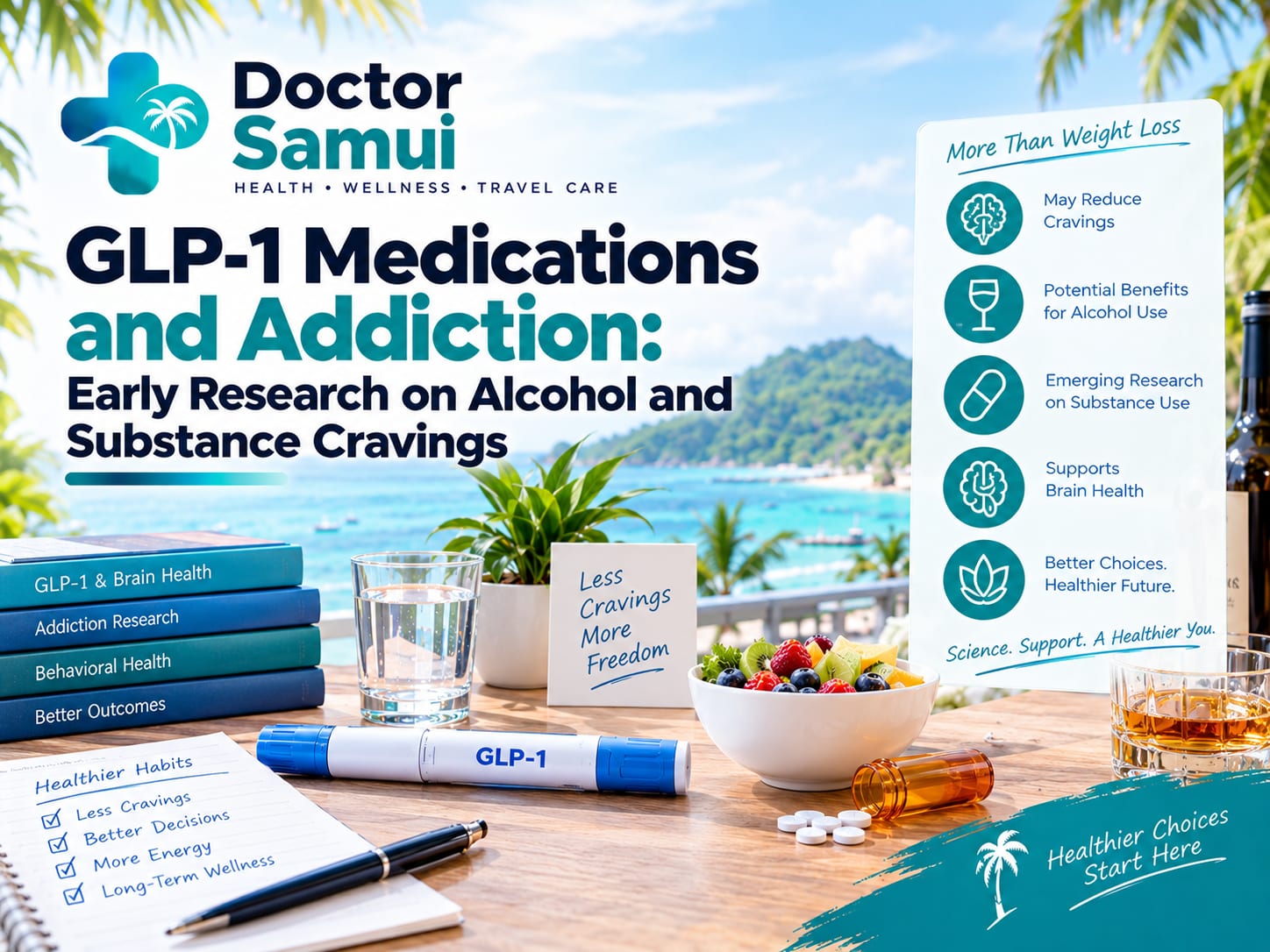
GLP-1 receptor agonists like semaglutide are being studied for their potential to reduce alcohol and substance cravings, but no GLP-1 drug is currently approved for any addiction. The evidence so far is early and promising in places, particularly for alcohol use disorder, but clinical trials are still running and most applications remain investigational. Speak to a doctor before considering GLP-1 therapy for cravings.
You are three weeks into a long stay on Samui, catching sundowners at a Lamai beach bar, and you notice something has quietly shifted. Since starting semaglutide, the pull toward a second or third drink just is not there anymore. You are not alone in noticing this, and researchers are now taking it seriously. GLP-1 medications, originally developed for blood sugar control and weight loss, may also quiet something deeper in the brain’s reward system.
This is still early-stage research. No GLP-1 drug has been approved to treat alcohol or drug addiction anywhere in the world as of late 2026. But the clinical trial pipeline is active, the early results in some areas are genuinely interesting, and if you are a long-stay expat, a wellness traveller, or someone managing substance use while away from your home healthcare system, this is worth understanding clearly.
How GLP-1 Medications May Affect the Brain’s Reward System
GLP-1 receptors exist throughout the brain, not just in your gut and pancreas. They are present in the mesolimbic pathway, the circuit your brain uses to signal reward and motivation. When this pathway gets a dopamine surge, you feel the pull toward something: a drink, a cigarette, a high. That pull is driven by specific chemical signalling, not just habit.
The leading hypothesis is that GLP-1 receptor activation in this reward circuitry dampens dopamine-driven signalling. In plain terms: the drug may reduce how rewarding alcohol or a substance feels, making the urge weaker. This appears to be the same mechanism that makes high-calorie food less appealing to people on these medications. It is not about willpower. It is about chemistry.
A randomised controlled trial using exenatide, an earlier GLP-1 receptor agonist, found reduced reactivity to alcohol-related cues in brain regions involved in reward processing, including the ventral striatum. The trial did not meet its primary endpoint of reducing heavy drinking days overall, but it provided early neurological evidence consistent with what some patients were already reporting.
One concern researchers are actively investigating is anhedonia, a general blunting of pleasure. If GLP-1 drugs dampen dopamine signalling broadly, there is a real question about whether enjoyment of everyday things is also reduced. Current trials are tracking this specifically.
What the Clinical Evidence Shows So Far on Alcohol
The most cited study in this area is a randomised controlled trial published in JAMA Psychiatry, which tested once-weekly semaglutide in adults with alcohol use disorder. Participants who received semaglutide showed a reduction in drinks per drinking day and in weekly alcohol craving compared to placebo, though the trial did not find a significant reduction in the number of drinking days overall. The result was meaningful, but the trial was relatively short and the sample size was limited.
A University of North Carolina phase 2 trial examined similar outcomes and also produced encouraging early results, though again in a controlled setting with careful patient selection. What these trials cannot yet tell us is whether the effect holds over months or years, or what happens when the drug is stopped.
A large observational cohort analysis by Al-Aly and colleagues, published in The BMJ in March 2026, drew from a base population of over 600,000 US veterans with type 2 diabetes and found that those on GLP-1 medications had lower rates of new substance use disorder diagnoses compared to those on SGLT-2 inhibitor treatments. Population-level data like this is not proof of effect, but it adds meaningful signal to the picture.
In July 2026, results from a phase 2 trial of oral semaglutide in alcohol use disorder were published in the American Journal of Psychiatry, adding to the injectable data. The trial reported reductions in heavy drinking days and craving compared to placebo, though it did not meet its primary endpoint of reducing lab-assessed cue-induced craving at week six. The authors described the results as hypothesis-generating.

The Current State of GLP-1 Addiction Research and Regulatory Status
No GLP-1 receptor agonist holds regulatory approval for addiction treatment from the FDA, EMA, or Thai FDA as of late 2026. All current addiction applications are investigational or off-label. That distinction matters.
The furthest along from a regulatory standpoint is pemvidutide, a dual GLP-1 and glucagon receptor agonist being developed specifically for alcohol use disorder. It has received FDA Fast Track designation, which accelerates the review process but does not constitute approval. The RECLAIM trial, a phase 2 study of pemvidutide in alcohol use disorder, reported positive topline results in July 2026 that supported progression to further development.
Phase 3 trials are still running. Until those complete and regulatory submissions are made, no doctor can prescribe any of these drugs for addiction under an approved indication. Off-label prescribing by a physician who knows your full history is a different matter, but it requires genuine clinical judgement, not a self-managed decision.
Beyond Alcohol: Nicotine, Opioids, Cocaine, and Gambling
The observational data from the Al-Aly cohort study also showed associations between GLP-1 use and reduced rates of nicotine dependence, cannabis use disorder, and cocaine use disorder. These are associations, not proof of treatment effect, but they prompted researchers to open dedicated trials.
Active randomised controlled trials for cocaine use disorder are currently registered on ClinicalTrials.gov. A BMJ Open protocol paper has been published for a GLP-1 trial in stimulant use disorder. These trials are at earlier stages than the alcohol work.
For opioids, the research is still largely in animal models. Anyone suggesting GLP-1 therapy as an opioid substitute is well ahead of the evidence. Gambling disorder has appeared in case reports, following the same reward-dampening logic, but there is no trial data to draw on yet.
Important Limitations and Who Should Not Use GLP-1s for Cravings
Several earlier GLP-1 receptor agonists produced disappointing results in addiction trials. Newer and more potent drugs behaving differently does not guarantee efficacy across all substances or all patients. This research is genuinely early.
Malnutrition is a real concern. People with severe alcohol use disorder or active stimulant use disorder are often nutritionally depleted. GLP-1 medications reduce appetite significantly. In a malnourished patient, that effect can worsen an already fragile nutritional status, with serious consequences.
GLP-1 medications are also not suitable for people with a personal or family history of medullary thyroid cancer, or a history of pancreatitis. These are standard prescribing contraindications regardless of indication. The existing approved treatments for alcohol use disorder, including naltrexone, are supported by much stronger and longer-term evidence. GLP-1 therapy does not replace them.
What This Means If You Are Living or Travelling on Koh Samui
Long-stay expats on Samui occupy an unusual position in this conversation. You may already be on a GLP-1 medication for weight management or metabolic health, and noticing changes in your relationship with alcohol. Or you may be exploring whether GLP-1 therapy is something to discuss with a doctor while living away from your home system.
Doctor Samui’s clinicians follow the emerging trial data and can offer a straightforward consultation to review whether GLP-1 therapy fits your individual situation, including your current health, medications, and any contraindications. You can read more about the clinic’s approach at the early research on GLP-1 and alcohol cravings page.
If you are already on a GLP-1 medication and have concerns about nutrition, mood changes, or alcohol interactions, those are exactly the questions worth raising in person. Doctor Samui offers 24-hour consultations including hotel and villa visits across the island, from Chaweng to Maenam, so access is not a barrier. A health check-up is also a sensible starting point if you have not had a full clinical review since arriving on the island.
The research is moving fast. A clinician current with the trial data is the right starting point, not an online forum or a pharmacy counter.
Discussing GLP-1 therapy on Koh Samui? Doctor Samui’s clinic in Chaweng offers in-person consultations, and the team is available 24 hours a day for hotel and villa visits across the island. Whether you are a long-stay expat already on a GLP-1 medication or exploring your options for the first time, a doctor can review your full health picture and give you a clear, evidence-based answer. Contact Doctor Samui to book a consultation.
Frequently Asked Questions
Dr. Ponlawat Pitsuwan
Physician, Doctor Samui
a walk-in clinic based in Chaweng, Koh Samui, with 24-hour hotel and villa visits available across the island. He consults with tourists, families, and long-stay expats on general health, metabolic health, and questions about GLP-1 therapy including its emerging role in addiction research. His focus is evidence-based care delivered in plain language.
References
- Hendershot CS, et al. Once-Weekly Semaglutide in Adults With Alcohol Use Disorder: A Randomized Clinical Trial. JAMA Psychiatry, 2025. doi:10.1001/jamapsychiatry.2024.4789
- Klausen MK, et al. Exenatide once weekly for alcohol use disorder investigated in a randomized, placebo-controlled clinical trial. JCI Insight, 2022.
- Cai A, Choi H, Xie Z, Al-Aly Z. Glucagon-like peptide-1 receptor agonists and risk of substance use disorders among US veterans with type 2 diabetes: cohort study. BMJ, 2026;392:e086886.
- Altimmune. Altimmune Announces Positive Topline Results from RECLAIM Phase 2 Trial of Pemvidutide in Alcohol Use Disorder. Press release, July 2026.
- University of Colorado Anschutz. Can oral semaglutide reduce alcohol use? CU Anschutz clinical trial shows fewer heavy drinking days. News release, July 2026.
The information in this article is for educational purposes only and does not constitute medical advice. It should not be used to self-diagnose or replace a consultation with a qualified physician. If you have concerns about your health, contact a licensed medical professional. For appointments at Doctor Samui, visit doctorsamui.com.