Clinically reviewed by Dr. Ponlawat Pitsuwan, Physician, Doctor Samui.
Last reviewed: October 2026
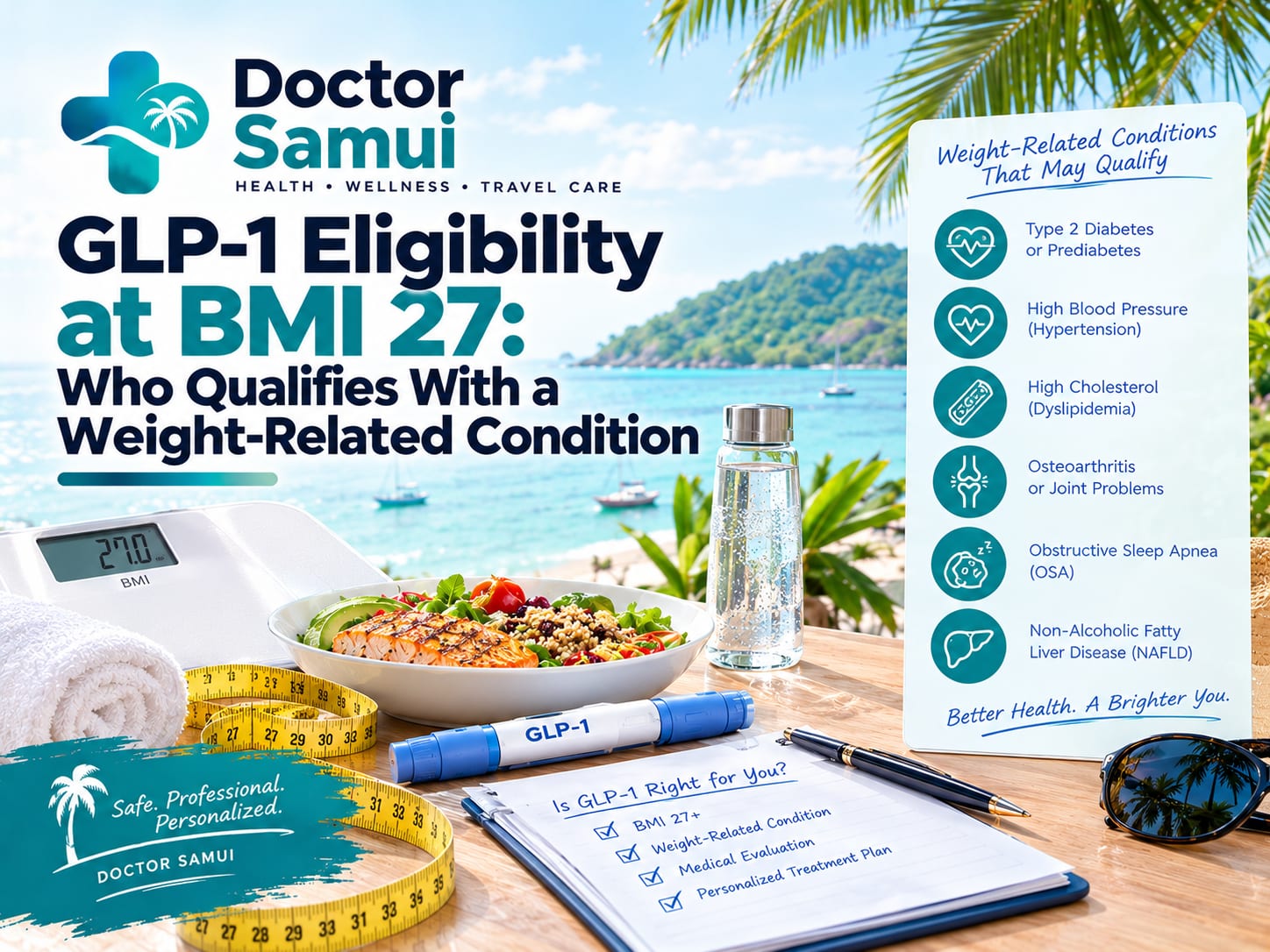
You can qualify for GLP-1 medication at a BMI of 27 if you have at least one weight-related health condition such as high blood pressure, type 2 diabetes, prediabetes, high cholesterol, or obstructive sleep apnoea. A BMI of 30 or above qualifies on its own. Below that, the condition is what makes the difference. A doctor reviews your full picture, not just the number on the scale.
You are two weeks into a longer stay on Samui. The morning walk along Chaweng beach felt harder than it should. Your last blood test flagged something, maybe blood pressure, maybe fasting glucose. You are not obese by the usual definition, but your numbers are not where they should be. You have heard about GLP-1 medications like semaglutide and tirzepatide, and you want to know whether your BMI rules you out.
It does not, not automatically. The threshold most people know is BMI 30. But there is a second route in: BMI 27 or above, combined with at least one weight-related health condition. If that describes you, the question is not whether you are heavy enough. It is whether your health profile supports the case.

Why BMI 27 Matters for GLP-1 Eligibility
BMI 30 is the point where excess weight alone is considered enough reason to consider medication. BMI 27 works differently. FDA prescribing information for semaglutide (Wegovy) and tirzepatide (Zepbound) both recognise that moderate excess weight can carry serious health consequences when combined with a related condition.
The logic is direct. A BMI of 27 with high blood pressure or insulin resistance carries more cardiovascular risk than a BMI of 27 with no complications. The weight is contributing to an active health problem. That is the distinction.
BMI is also an imperfect measure on its own. Two people with the same number can have very different metabolic health. A doctor does not look at the number alone.
Weight-Related Conditions That Count at BMI 27
The four conditions most commonly listed in prescribing guidelines are type 2 diabetes, high blood pressure, abnormal cholesterol or triglycerides, and obstructive sleep apnoea.
The list does not stop there. Prediabetes, where blood sugar is elevated but not yet at diabetic levels, is a recognised qualifying condition. So is insulin resistance, where the body works harder to manage blood sugar before a formal diabetes diagnosis is made. Metabolic syndrome, a cluster of raised blood sugar, high blood pressure, abnormal lipids, and central weight gain, also supports eligibility.
Non-alcoholic fatty liver disease, where fat builds up in the liver without heavy alcohol use, is increasingly accepted as a weight-related condition relevant to GLP-1 eligibility. Polycystic ovary syndrome, strongly linked to insulin resistance, is another condition many people do not realise may be relevant to their case.
Established cardiovascular disease, meaning a history of heart attack, stroke, or documented arterial disease, is separately addressed in FDA labelling for some GLP-1 medications and may provide an independent basis for prescription. A clinician can clarify whether that applies to you.

BMI Thresholds Are Not the Same for Every Ethnic Background
The standard BMI cut-offs were developed using data from predominantly European populations. For people of Asian heritage, metabolic risk including raised blood pressure, insulin resistance, and type 2 diabetes can appear at lower BMI values than the standard thresholds suggest.
Some clinical guidelines, including those used by certain Asian health authorities, apply lower cut-offs for obesity classification in Asian populations. For a patient of Asian descent, the risk profile associated with a BMI of 27 in a Western context may already be present at a lower number. If your BMI sits just below 27 and you have weight-related health concerns, this is worth raising directly with the doctor.
This is not a reason to assume you qualify at any BMI. It is a reason to have the conversation rather than ruling yourself out on a number alone.
Meeting the Criteria Is Not the Same as Getting a Prescription
Qualifying on paper and receiving a prescription are two different things. A clinical assessment looks at your full picture, not a single figure.
At a GLP-1 eligibility consultation, the doctor will measure your BMI and blood pressure, review your medical history and current medications, and ask about previous weight loss attempts. Blood tests matter here: fasting glucose and HbA1c confirm whether prediabetes or diabetes is present, and a lipid panel checks cholesterol and triglycerides. These results support or complicate the eligibility case directly.
The assessment also screens for reasons a GLP-1 would not be appropriate. A personal or family history of medullary thyroid cancer or a condition called MEN2 rules out GLP-1 receptor agonists. Pregnancy is also a reason to stop the medication. A history of pancreatitis is not a formal contraindication in FDA labelling, but it is a reason for careful clinical assessment before any GLP-1 is prescribed. A doctor must work through this before any prescription is written.
GLP-1 medications are not a standalone treatment. Evidence-based prescribing includes discussion of dietary change and physical activity alongside medication, not instead of it.
What About Off-Label Prescribing Below BMI 27?
Off-label prescribing means a doctor prescribes a medication outside its officially approved indications, where clinical judgement supports benefit over risk. For GLP-1 medications, off-label use below BMI 27 is possible but sits outside standard eligibility criteria.
This is a clinical decision, not a shortcut. If your BMI is below 27, a doctor can still review your metabolic health, your cardiovascular risk factors, and your overall clinical picture. Where the case is strong enough, prescribing below the threshold may be clinically defensible. It requires a thorough assessment and a clear clinical rationale, not a straightforward eligibility tick.
A BMI just under 27 does not automatically close the door. Have the conversation.
Getting a GLP-1 Eligibility Assessment on Koh Samui
Thailand does not operate under FDA or MHRA prescribing rules. Licensed Thai physicians prescribe on the basis of clinical judgement and accepted international standards, adapted locally. A same-day assessment and, where clinically appropriate, a same-day prescription is possible on the island.
Doctor Samui’s walk-in clinic in Chaweng can carry out a full GLP-1 eligibility consultation: BMI measurement, blood pressure, fasting glucose, HbA1c, and lipid panel, all on-site. If you have recent blood results from home, bring them. They give the consulting doctor a clearer picture and may reduce what needs to be repeated. You can read more about the full process at the GLP-1 service page.
For long-stay expats and guests across the island, hotel and villa visits are available around the clock. If you are staying in Lamai, a house call doctor in Lamai can bring the initial consultation to you. If you are further north near Bophut or Maenam, the same applies. If you want a broader metabolic picture before or alongside a GLP-1 review, a health check-up in Koh Samui can be arranged at the same visit.
If you have a BMI around 27 and a weight-related health condition, the eligibility question is worth answering properly rather than guessing from a checklist. Doctor Samui offers same-day GLP-1 eligibility consultations at the walk-in clinic in Chaweng, with on-site blood tests and 24-hour hotel and villa visits across Koh Samui. Walk in or call ahead, no referral needed.
Frequently Asked Questions
Dr. Ponlawat Pitsuwan
Physician, Doctor Samui
a walk-in clinic based in Chaweng, Koh Samui, with 24-hour hotel and villa visits across the island. He sees tourists, families, and long-stay expats for medical weight management consultations, GLP-1 eligibility assessments, and metabolic health reviews. His approach is evidence-based care delivered in plain language.
References
- U.S. Food and Drug Administration. Wegovy (semaglutide) Prescribing Information (2024 update). FDA, 2024.
- U.S. Food and Drug Administration. Zepbound (tirzepatide) Prescribing Information (2024 update). FDA, 2024.
- Shi Y, et al. Effects of GLP-1 receptor agonist therapy on resolution of steatohepatitis in non-alcoholic fatty liver disease: a systematic review and meta-analysis. PMC, 2025.
- WHO Expert Consultation. Appropriate body-mass index for Asian populations and its implications for policy and intervention strategies. Lancet, 2004. (Summarised by WHO Expert Consultation 2004.)
- Newsome PN, et al. A placebo-controlled trial of subcutaneous semaglutide in nonalcoholic steatohepatitis. PubMed, 2021.
- American Diabetes Association. Standards of Medical Care in Diabetes — Classification and Diagnosis of Diabetes. Diabetes Care, 2023.
The information in this article is for educational purposes only and does not constitute medical advice. It should not be used to self-diagnose or replace a consultation with a qualified physician. If you have concerns about your health, contact a licensed medical professional. For appointments at Doctor Samui, visit doctorsamui.com.