
Clinically reviewed by Dr. Ponlawat Pitsuwan, Physician, Doctor Samui.
Last reviewed: November 2026
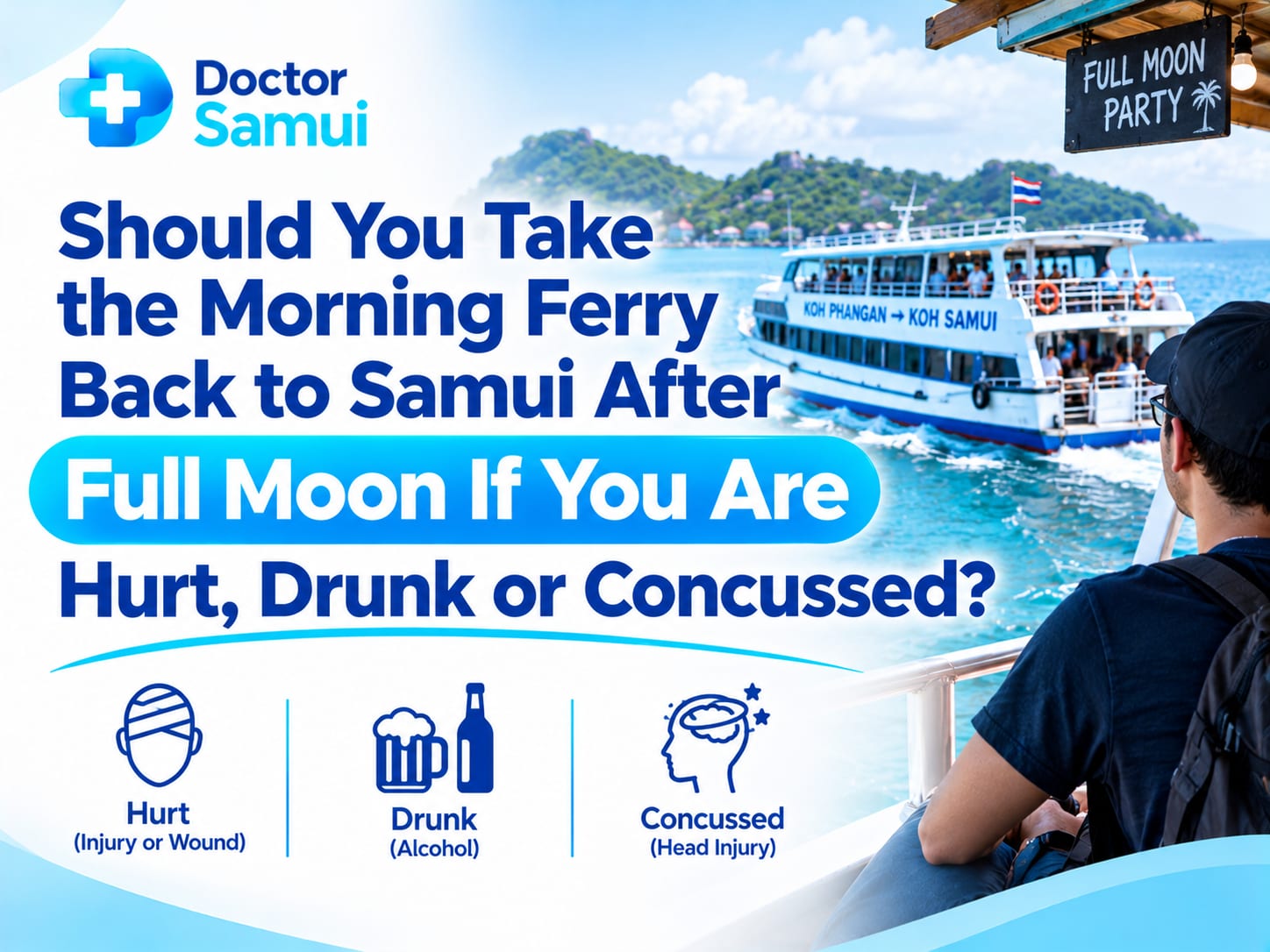
Not every injury from the Full Moon Party is safe to travel with. If there was a head strike with any loss of consciousness, repeated vomiting, or confusion that is not clearly just alcohol, the morning ferry back to Samui may not be the right move. Some injuries need assessment on Koh Phangan before you board. If you do cross, Doctor Samui offers 24/7 assessment the moment your ferry docks.
The sky is getting light over Haad Rin and your friend is sitting on the sand holding their head. The first boat back to Samui leaves in an hour. Everyone just wants to get home. That feeling is completely understandable, and sometimes the ferry is exactly the right call. But sometimes it is not, and the difference matters.
The hardest part of this decision is that the two things you are most likely dealing with, alcohol and a head injury, can look almost identical from the outside. Both cause confusion, slow speech, and unsteady balance. This article gives you a practical framework for making that call, and tells you what to do on the Samui side if you do cross.

Why the First Boat Looks Like the Solution and Sometimes Is Not
Everyone at Haad Rin at dawn has the same instinct: get back to your hotel, get into bed, feel better. For most people, that is exactly what happens. A bruised knee, a sprained ankle, a cut that has stopped bleeding, a bad hangover with no injury at all. These can all safely make the crossing.
The problem is that a 30 to 45-minute boat ride between two islands is not a neutral environment for someone who might have a serious head injury. If something deteriorates on that crossing, the options are limited. The crew on most speedboats and catamarans on this route are not trained paramedics. They can radio ahead, but they cannot assess or treat a head injury.
Head Injury, Vomiting and a Choppy Crossing to Bangrak or Nathon
Vomiting after a night of drinking feels normal. Vomiting because pressure is building inside the skull does not look different from the outside. This is one of the most dangerous overlaps in the whole situation. If your friend is vomiting and you are not sure why, that is a reason to pause before boarding.
There is also a pattern called the lucid interval. Someone takes a hit to the head, seems confused for a few minutes, then appears to recover completely. They are talking, walking, joking. At Haad Rin at 7am, that looks like they are fine. But a small bleed can be building slowly inside the skull the whole time. Feeling better after a head strike does not mean the injury is over.
Seasickness on a choppy crossing will add more vomiting, more disorientation, and more difficulty telling the difference between a person who is just nauseous and a person whose condition is getting worse. If the route to Bangrak or Nathon is rough that morning, factor that in.
Injuries and States That Mean You Should Be Seen on Phangan First
Some situations should not get on the boat. These are not edge cases. Knowing them in advance is worth your time.
Concussion, Uncontrolled Bleeding, Severe Intoxication and Suspected Fractures
If there was any confirmed loss of consciousness, even briefly, do not cross until someone has assessed them. Koh Phangan Hospital is in Thong Sala, about 15 kilometres from Haad Rin. It is the right first stop for anything serious. The ride there is on land, which is controllable.
Uncontrolled bleeding means any wound that has not stopped after 10 to 15 minutes of firm, direct pressure. That needs attention before a boat crossing, not after.
Severe intoxication is a different problem. Someone who cannot be roused, who is not protecting their airway, or who is making no sense at all should not be put on a moving vessel. Keep them on their side in the recovery position and get local help. Do not leave them alone.
A suspected fracture of the leg or arm can wait for the ferry if it is splinted and stable. But if there is any concern about the spine or neck, particularly after a fall or a collision, no movement until someone qualified has assessed them. This is not a ferry-crossing situation.
A bleed inside the skull is not something you can rule out on a beach. If the story involves a significant head strike, any neurological change, or the lucid interval pattern described above, treat it as a possible serious injury until proven otherwise. Phangan Hospital can do an initial assessment. Emergency care in Koh Samui can do more once you cross.
If You Do Cross: Where to Be Met on the Samui Side
If the injury is minor and the person is clearly alert, coherent, and improving, the crossing is reasonable. When you board, tell the crew. Not in detail, just enough: "my friend hit their head a few hours ago, please keep an eye on them." Most crews will note it.
Call ahead before you board. Doctor Samui’s team can receive you at Bangrak pier or coordinate care at Nathon pier, depending on which route you are on. When you call, give them: the time of the injury, whether there was any loss of consciousness and for how long, what symptoms are present now, any medications or allergies, and how alert the person is right now. Awake and talking, confused but responsive, or difficult to wake.
Calling from Thong Sala pier means care starts the moment the boat docks, not 20 minutes later after a taxi ride. The mobile doctor service in Koh Samui can reach most parts of the island quickly once you are off the ferry.
The Day After on Samui: Delayed Head-Injury Symptoms and When to Go to Hospital
You made it back. You slept. You feel rough, but you are awake. Here is what to watch for in the 24 to 48 hours after any head injury.
A worsening headache is a red flag. Not a hangover headache that stays the same, but one that is getting worse over time. Add any new confusion, weakness on one side of the body, one pupil larger than the other, a seizure, or difficulty waking from sleep, and that is an emergency. Go to Bangkok Hospital Samui or call Doctor Samui for an urgent house call.
Post-concussion symptoms, including persistent headache, difficulty concentrating, nausea, and sensitivity to light, can follow even a mild head injury and last days to weeks. They are not dangerous in themselves, but they do need a clinical assessment so you understand what to avoid. Doctor Samui can assess this at the Chaweng clinic or during a hotel visit anywhere on the island.
If you are not sure whether what you are feeling is a hangover or something else, the safest answer is to be seen. A quick assessment, checking your eyes, your coordination, and your alertness, takes less than 15 minutes and either reassures you or catches something that matters. The accident and trauma team at Doctor Samui is available around the clock.
Planning Your Exit Before the Party So You Are Not Forced Onto the Dawn Boat
The best version of this scenario is one you set up the day before. If you are travelling with friends or family, agree on a simple rule before Haad Rin: anyone who takes a significant hit to the head does not get on the morning ferry without being assessed first.
Book a hotel or guesthouse on Phangan for at least the night after, not just the night of. That way, staying an extra day is a choice, not a last-minute scramble for a room. It also means no one is rushing an injured person onto a boat at 7am because check-out is at noon.
Check your travel insurance before you go. Some policies have nightlife exclusion clauses that limit cover for injuries occurring while intoxicated. Knowing this in advance does not change what you should do medically, but it does affect the paperwork. Doctor Samui works with travel insurance providers and can help with documentation if you need it. If you need to confirm coverage before you arrive, the travel insurance clinic page has the details.
Doctor Samui offers 24/7 emergency assessment and house calls across Koh Samui. The team can meet you at Bangrak or Nathon pier, assess you at your hotel, or see you at the Chaweng clinic at any hour. For accident and trauma care in Koh Samui, contact us before you board so we are ready when you arrive.
FAQ
Dr. Ponlawat Pitsuwan
Physician, Doctor Samui
a walk-in clinic based in Chaweng, Koh Samui, with 24/7 hotel and villa visits across the island. He sees tourists, families, and long-stay expats for head injuries, trauma, and post-event medical assessment, including patients arriving from Koh Phangan after the Full Moon Party. His focus is straightforward, evidence-based care delivered in plain language.
References
- National Institute for Health and Care Excellence (NICE). Head injury: assessment and early management. NICE guideline NG232. Published 18 May 2023.
- Centers for Disease Control and Prevention (CDC). Traumatic Brain Injury and Concussion: Symptoms.
- Jagoda AS, et al. Clinical policy: neuroimaging and decision-making in adult mild traumatic brain injury in the acute setting. Annals of Emergency Medicine. 2008;52(6):714-748.
- StatPearls. Lucid Interval. National Library of Medicine.
The information in this article is for educational purposes only and does not constitute medical advice. It should not be used to self-diagnose or replace a consultation with a qualified physician. If you have concerns about your health, contact a licensed medical professional. For appointments at Doctor Samui, visit doctorsamui.com.
