Clinically reviewed by Dr. Ponlawat Pitsuwan, Physician, Doctor Samui. Last reviewed: August 2026
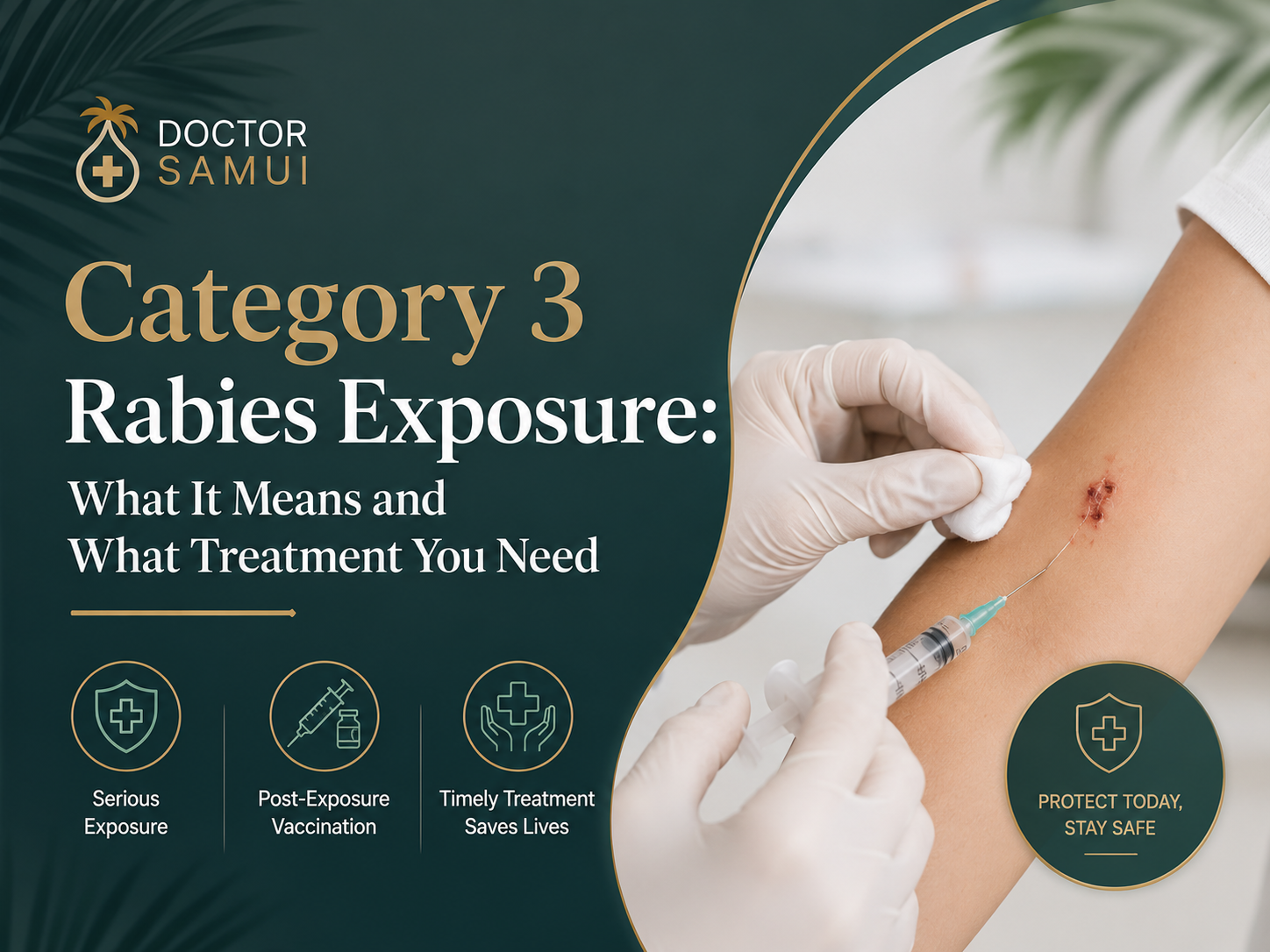
A category 3 rabies exposure means a bite that broke the skin and drew blood, a deep scratch that bled, or contact between an animal’s saliva and your eyes, mouth, or an open wound. It is the highest-risk category under WHO guidelines and requires both rabies immunoglobulin (RIG) and a course of rabies vaccine, starting the same day if possible. Doctor Samui carries RIG in-clinic and can treat you on Koh Samui without a trip to the mainland.
A dog near the temple on the ring road seemed calm until it wasn’t. A monkey at a viewpoint took the food and left a scratch that bled. A resort cat caught you deeper than expected. Now you are staring at the wound and searching your phone. Here is the straight answer: if skin broke and you bled, that is a category 3 rabies exposure, and it needs treatment today.
Thailand is rabies endemic. The virus circulates in animal populations here year-round, and Koh Samui is no exception. Stray dogs on Chaweng and Maenam beaches, monkeys near the Big Buddha and jungle viewpoints, cats at beach resorts, and bats in open-air villas all carry the possibility of exposure. Category 3 is not a reason to panic. It is a reason to move quickly.

What Exactly Qualifies as a Category 3 Exposure
The WHO splits rabies exposures into three categories. Category 1 is touching or feeding an animal with no broken skin. Category 2 is a minor scratch with no blood. Category 3 is anything that broke skin and bled, a lick on an open wound or cut, or saliva contact with your eyes, mouth, or mucous membranes.
The wound does not need to look serious. A small puncture from a dog tooth counts. A monkey scratch that drew even a little blood counts. A cat claw that left a thin red line with bleeding counts. Whether skin was broken and blood appeared is what matters, not the size of the wound.
One scenario people often miss: a bat found in your villa room at night. If you woke up to a bat nearby and cannot be certain you were not bitten while sleeping, WHO guidance treats that as a category 3 exposure. Bat bites are often too small to feel or see.
Common Category 3 Exposures on Koh Samui
The most common category 3 bites and scratches at our Chaweng clinic come from stray dogs near temples and beach roads, monkeys at viewpoints, cats at guesthouses, and occasionally bats in open villas or bungalows at night.
Monkeys deserve a specific mention. Koh Samui’s viewpoint monkeys are used to tourists feeding them, which puts hands very close to teeth and claws. A scratch that draws blood from a monkey is a category 3 exposure, same as a dog bite. Many tourists underestimate this.
The beach dog scenario is the one we see most often. A dog approaches, seems friendly, and bites or scratches when startled. Skin breaks. Blood appears. That is a category 3 rabies exposure, and the animal’s vaccination status is almost always unknown.

Category 3 Treatment: Vaccine Plus Immunoglobulin
This is where category 3 is different from category 2. Category 2 needs only the vaccine. Category 3 needs the vaccine and rabies immunoglobulin, which is also called RIG.
RIG gives your body immediate passive protection while your immune system builds its own response to the vaccine. The vaccine alone takes days to generate that response. RIG fills that gap, and for a bite to the hands, face, or neck, that gap matters.
RIG is injected into and around the wound itself, not into your arm. Your first vaccine dose goes into the upper arm at the same visit. We apply local anaesthetic to the wound site first, and most patients find it very manageable.
The vaccine schedule runs on Day 0, Day 3, Day 7, and Day 14. Day 0 is the first appointment. Some protocols add a Day 28 dose, and we will advise you on that based on your situation.
The RIG Supply Problem on Koh Samui, and Why It Matters
Travel blogs have warned, correctly, that many clinics on Koh Samui and other Thai islands do not reliably carry RIG. The old advice was to start the vaccine locally and travel to the mainland for immunoglobulin. That advice reflected a real gap in island healthcare.
Doctor Samui stocks both equine rabies immunoglobulin and the Verorab rabies vaccine on-site, in cold-chain storage. You do not need to travel to Surat Thani or Bangkok for the full category 3 rabies exposure protocol. You can get RIG and your first vaccine dose at our Chaweng clinic on the same day, or we can come to your hotel or villa if you cannot travel.
RIG has a timing window. It can be given up to seven days after your first vaccine dose, but no later. Delaying treatment to organise a mainland trip is a risk you do not need to take on Koh Samui.
How Long Do You Have to Start Treatment
There is no hard upper time limit for starting post-exposure prophylaxis (PEP), which is the full rabies treatment course after an exposure. PEP works at any point before symptoms appear. Once symptoms appear, outcomes are uniformly fatal. The incubation period can stretch to weeks or longer, which is exactly the window you have to act.
That said, treat this as urgent, not as something to book for next week. Bites to the face, neck, hands, and fingers carry higher risk because of their closeness to nerve pathways. Start treatment the same day for these locations.
The practical rule for RIG: it must be given within seven days of your first vaccine dose. If you started the vaccine at another clinic and have not had RIG yet, come in. There may still be time.
Category 3 Exposure When You Have Already Had Rabies Vaccines
If you completed a full pre-exposure prophylaxis course before coming to Thailand, your protocol after a category 3 bite is different. You do not need RIG. Your immune system already holds a memory of the virus and will respond rapidly to a booster.
Previously vaccinated patients need only two booster doses: Day 0 and Day 3. No immunoglobulin, no extended schedule. This applies even to a category 3 bite.
Bring your vaccination records if you have them. If you are unsure whether your prior course was complete, tell us and we will work through your history. When in doubt, we treat as unvaccinated to be safe.
What Happens When You Come In for a Category 3 Bite
First, we assess the wound and exposure history to confirm the category. Then we wash the wound thoroughly with soap, water, and povidone-iodine. Proper wound washing is one of the single most effective steps in cutting infection risk.
Next, RIG is infiltrated into and around the wound site with local anaesthetic applied first. The first rabies vaccine dose goes into the upper arm. We check your tetanus status and prescribe antibiotics if the wound calls for it.
Before you leave, you get a written schedule for your follow-up doses. If you are leaving Koh Samui before the course is complete, we will advise on continuing treatment at a clinic at your next destination. Follow-up doses can also be done as hotel or villa visits across the island if that is easier than returning to the clinic.
Practical Notes on Cost and Travel Insurance
Category 3 rabies treatment is not cheap. RIG is the main cost driver. Most comprehensive travel insurance policies cover post-exposure prophylaxis for animal bites, including vaccine and immunoglobulin. Keep all receipts from the clinic visit.
If cost is a concern, do not let it delay treatment. Come in and speak with us first. No cost saving justifies the risk of delaying a category 3 rabies exposure protocol.
If you have been bitten or scratched by an animal on Koh Samui and skin broke and bled, come into Doctor Samui’s Chaweng clinic today. We carry rabies immunoglobulin and the Verorab vaccine on-site and can start your full category 3 treatment the same day. If you are at your hotel or villa and cannot travel, call us for a 24/7 house visit across Chaweng, Lamai, Bophut, Maenam, Choeng Mon, and all other areas of Koh Samui.
FAQ
Dr. Ponlawat Pitsuwan
Physician, Doctor Samui
a walk-in and [rabies post-exposure prophylaxis clinic](https://doctorsamui.com/rabies-vaccine-koh-samui/) based in Chaweng, Koh Samui, with 24/7 hotel and villa visits across the island. He treats tourists, families, and long-stay expats for animal bites, wound care, and travel-related illness. His approach is straightforward, evidence-based care delivered in plain language.