
Clinically reviewed by Dr. Ponlawat Pitsuwan, Physician, Doctor Samui.
Last reviewed: November 2026
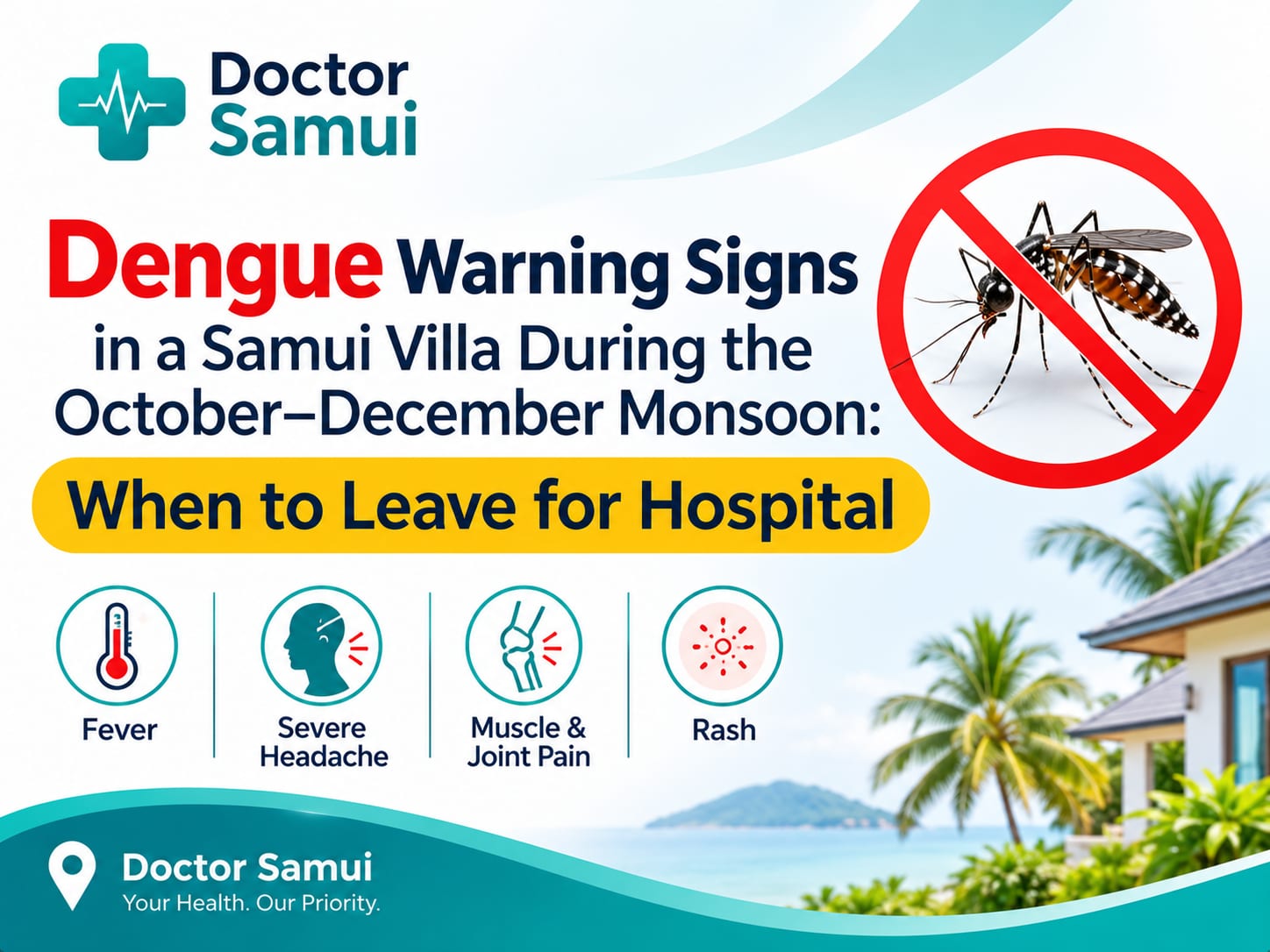
Dengue warning signs during the October, December monsoon include severe abdominal pain, persistent vomiting, any bleeding from the gums or nose, rapid breathing, restlessness, or sudden collapse. If any of these appear in a villa on Koh Samui, transfer to hospital should not wait until morning. The fever dropping does not mean recovery: warning signs most often appear in the 24 to 48 hours after the fever falls, not while it is still high.
The storm has been going since midnight. Your partner’s fever broke around 3am and you both assumed the worst was over. That is exactly the moment when dengue can turn dangerous, and it is the moment most people in a Samui villa get it wrong.
Koh Samui’s monsoon runs from October through December. The island’s Gulf Coast exposure means a November arrival puts you squarely inside peak dengue transmission. If someone in your villa develops a fever in this window, knowing which signs require hospital tonight, not a GP call in the morning, could make a serious difference.

Why the October, December Monsoon Changes the Decision
Most dengue advice online references a June to October peak. That applies to Bangkok and the Andaman coast. Koh Samui runs on a different weather system. The Gulf Coast monsoon hits hardest from October through December, which is exactly when the island fills with tourists expecting dry-season travel.
Heavy rain creates standing water fast. Within days of a significant storm, Aedes aegypti mosquitoes can breed in anything holding water: a garden pot, a pool overflow channel, a tyre beside a villa gate. Biting peaks at dawn and dusk, so hillside garden villas with outdoor seating carry more exposure than sealed hotel rooms.
One more thing matters here. If you have had dengue before, a second infection carries a higher risk of severe disease. That is not a reason to panic, but it is a reason to take warning signs seriously rather than comparing notes with someone who had dengue and recovered fine at home.
Waiting It Out in a Hillside Maenam or Taling Ngam Villa Is Not the Same as Chaweng
A villa in central Chaweng is roughly ten minutes from Bangkok Hospital Samui on a clear road. A hillside villa in Maenam or Taling Ngam is a different situation. During a heavy October or November storm, the access road may be flooded or blocked. Night transport on the south-west side of the island after dark is unreliable. What felt like a manageable wait can become a 45-minute scramble to find a driver willing to go out.
If someone in your villa develops dengue warning signs, the question is not just whether you need a hospital. It is also whether you can get there right now. Doctor Samui’s visiting doctors can reach hillside villas across Maenam and Taling Ngam around the clock, run a rapid dengue NS1 antigen test on site, check hydration status, and advise whether immediate transfer is needed or whether the patient can be safely monitored until morning. That intermediate step matters when roads are uncertain.
Warning Signs That Mean You Should Leave the Villa for Hospital, Not Sleep On It
The WHO lists specific warning signs that separate dengue fever from severe dengue. These are not subtle. They signal that fluid is leaking out of blood vessels faster than it can be replaced, and that process can move quickly once it starts.
Bleeding, Persistent Vomiting, Severe Abdominal Pain, Restlessness, or a Sudden Collapse
Severe abdominal pain or tenderness that does not ease. Vomiting that is persistent, defined as three or more episodes in 24 hours, especially if it prevents any fluids being kept down. Any bleeding from the gums, nose, or in vomit. Rapid breathing. A patient who was alert but becomes confused, restless, or unusually still. Cold or clammy skin. These are signs that require hospital, not observation.
The painkiller in your villa medicine cabinet matters here. Ibuprofen and aspirin are contraindicated in dengue because they affect platelet function and increase bleeding risk. Paracetamol only. If the only thing you packed for fever is Nurofen or Advil, do not use it once dengue is possible. This is one of the most practically important things to know before you are standing in a villa bathroom at 2am.
A sudden drop in fever can feel like relief. It is not. The critical phase of dengue, when plasma leakage is highest, typically follows within 24 to 48 hours of the fever coming down. The patient may feel briefly better, then deteriorate fast. If warning signs appear at any point in this window, leave for hospital.
The 24-to-48-Hour Window After the Fever Falls
This is the part that catches people. The fever has been gone for twelve hours. The patient is sitting up, drinking a little water, saying they feel okay. Everyone relaxes. That is the febrile phase ending and the critical phase beginning.
Plasma leakage does not happen while the fever is high. It tends to begin as the temperature normalises. A rising haematocrit on a blood test, meaning the blood becomes more concentrated as fluid leaks from vessels, is one of the first measurable signs. You cannot see that from a villa, but a doctor can check it quickly with a blood draw.
If you are in this window and no doctor has assessed the patient in the last few hours, do not assume stability means safety. Get eyes on the patient medically. The Doctor Samui emergency care team can be reached around the clock for villa assessments across the island.
Flooded Roads, Night Taxi Access, and Which Hospital to Aim For
Bangkok Hospital Samui and Samui International Hospital are the two main facilities equipped to manage severe dengue with IV fluids and monitoring. Bangkok Hospital Samui is in Chaweng. Samui International Hospital is near Nathon on the west coast. Know which is closer to your villa before you need it. Save the route offline because mobile data can drop during heavy storms.
If you are calling for a taxi or driver at night during a storm, start calling earlier than you think you need to. Some drivers will not go out during serious flooding. The national ambulance number in Thailand is 1669. It is free to call and operates around the clock, but response times to remote hillside locations during a monsoon storm are variable.
If your villa manager or property contact is reachable, ask them directly about road conditions before you get in a car. They will know which sections of the access road flood first. That two-minute call could save you from getting stuck.
Why You Should Not Take the Ferry to Phangan or Tao Once Warning Signs Have Started
If you developed a fever on Koh Samui and you are thinking about catching the ferry to Koh Phangan or Koh Tao, stop. During the October to December monsoon, ferry crossings in the Gulf of Thailand are frequently rough. The journey takes two hours or more. There is no medical care on board. If severe dengue progresses during that crossing, nothing can be done until you reach land.
Severe dengue can move from warning signs to circulatory shock in hours. A patient who is borderline when they board can be in serious trouble before the ferry docks. Koh Samui has two hospitals. Use them.
What Hospital Care Involves, and What You Can Safely Do Overnight If You Are Still Being Monitored
At the hospital, the first step is a blood test. A dengue NS1 antigen test confirms active infection. A full blood count checks the platelet count and haematocrit, the two numbers that tell the treating doctor how far the critical phase has progressed. IV fluids are the core of hospital management for severe dengue: replacing what leaks from vessels keeps blood pressure stable while the immune response runs its course. There is no antiviral treatment for dengue; management is supportive throughout.
If a doctor has assessed the patient in person, confirmed they are in the febrile phase without warning signs, and the patient can keep fluids down, overnight monitoring in a villa can be appropriate. It requires someone awake and checking regularly, oral rehydration salts being used, paracetamol only, and a clear plan for immediate transfer if any warning sign appears. Without that prior in-person clinical assessment, overnight villa monitoring is not safe. A Doctor Samui house call doctor can carry out that assessment, advise on the threshold for transfer, and check back if the situation changes. For villas in Lamai or along the east coast, IV therapy and house call services are also available to support hydration management on site. Villas closer to the north of the island can reach the Maenam house call and IV drip service directly.
If someone in your Samui villa has a fever and the monsoon has set in, do not wait for warning signs to become obvious. Doctor Samui’s visiting doctors are available 24 hours a day for villa and hotel assessments across Koh Samui, including Maenam, Taling Ngam, Lamai, Chaweng, and the hillside areas hardest to reach after dark. We assess dengue risk on site, run a rapid test, check hydration, and tell you clearly whether transfer to hospital is needed tonight. Contact Doctor Samui for a dengue assessment at your villa.
Frequently Asked Questions
Dr. Ponlawat Pitsuwan
Physician, Doctor Samui
a walk-in clinic based in Chaweng, Koh Samui, with 24-hour hotel and villa visits across the island. He sees tourists, families, and long-stay expats for fever assessment, dengue evaluation, emergency care, and monsoon-season illness. His focus is straightforward, evidence-based care delivered in plain language.
References
- Centers for Disease Control and Prevention. Clinical Features of Dengue. CDC, 2024.
- Centers for Disease Control and Prevention. Clinical Care of Dengue. CDC, 2024.
- Centers for Disease Control and Prevention. Dengue: Yellow Book 2024. CDC, 2024.
- World Health Organization. Dengue and severe dengue: fact sheet. WHO, updated 2024.
- Bhatt S, et al. The global distribution and burden of dengue. Nature. 2013;496(7446):504-507.
- Gavi: The Vaccine Alliance. Why a second dengue infection can be deadlier than the first. Gavi, 2024.
The information in this article is for educational purposes only and does not constitute medical advice. It should not be used to self-diagnose or replace a consultation with a qualified physician. If you have concerns about your health, contact a licensed medical professional. For appointments at Doctor Samui, visit doctorsamui.com.
