Clinically reviewed by Dr. Ponlawat Pitsuwan, Physician, Doctor Samui.
Last reviewed: October 2026
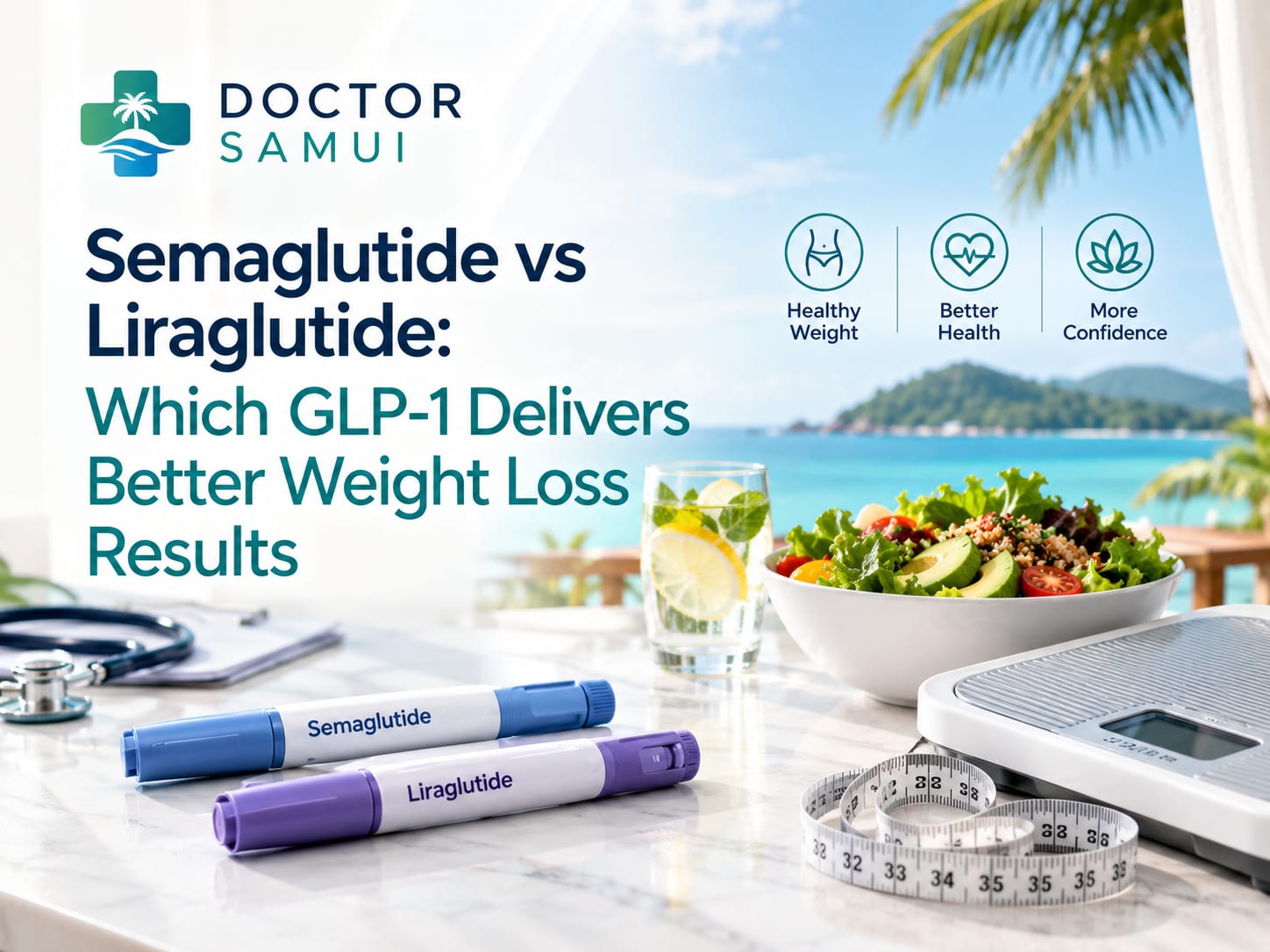
In the only direct head-to-head trial, STEP 8, semaglutide produced around 15.8% body weight loss compared to 6.4% with liraglutide over 68 weeks. Semaglutide is injected once a week; liraglutide is injected once daily. Both are GLP-1 receptor agonists approved for weight management, but they are not equally effective in head-to-head evidence. Liraglutide remains a valid option for some patients depending on cost, tolerance, and medical history.
You are two months into a weight management programme at home, injecting weekly, and then a work posting on Koh Samui stretches from six weeks into four months. You need to know what is available on the island, whether switching makes sense, and whether a friend’s claim that semaglutide is far stronger than liraglutide holds up. That last part is true, by the clinical evidence available right now. The STEP 8 trial compared them directly, and semaglutide came out ahead on every weight-loss measure that mattered. But the full picture is more useful than the headline number. Here is what the data actually shows, and what it means if you are managing this treatment while living on or visiting Samui.

How Semaglutide and Liraglutide Work
Both drugs mimic a hormone your gut releases after eating. That hormone slows digestion, reduces appetite, and signals fullness to your brain. Both drugs bind to the same receptors in the brain and gut to produce those effects.
The key difference is how long each drug stays active in your body. Liraglutide clears your system within roughly 13 hours, which is why you inject it every day. Semaglutide stays active for around one week, which is why a single weekly injection maintains consistent levels throughout. That longer activity likely contributes to the stronger appetite suppression seen in trials.
The STEP 8 Trial: The Only Direct Head-to-Head Comparison
The STEP 8 trial is the only randomised controlled trial that put semaglutide and liraglutide side by side in the same study, in people with obesity or overweight and at least one weight-related condition. After 68 weeks, semaglutide produced an average weight loss of 15.8% of body weight. Liraglutide produced 6.4%.
The gap held across all responder thresholds. More patients on semaglutide lost at least 10%, 15%, and 20% of their starting weight than those on liraglutide. You can review the full STEP 8 results breakdown on the Doctor Samui GLP-1 page. Discontinuation due to adverse events was also lower with semaglutide: around 13.5% stopped treatment compared to 27.6% on liraglutide. More patients were able to stay on semaglutide through the full course.

Dosing, Brand Names, and Titration
Semaglutide for weight management is sold as Wegovy. The diabetes dose, Ozempic, uses the same molecule at a lower dose and is not approved for weight management specifically. Liraglutide for weight management is sold as Saxenda. The diabetes version is Victoza, again at a lower dose.
Both drugs require a gradual dose increase, called titration, to reduce nausea and other gut side effects. Liraglutide starts at a low daily dose and increases every week to reach the maintenance level. Semaglutide starts at a low weekly dose and increases every four weeks. The slower titration schedule with semaglutide may be one reason its discontinuation rate in STEP 8 was lower.
| Feature | Semaglutide (Wegovy/Ozempic) | Liraglutide (Saxenda/Victoza) |
|---|---|---|
| Injection frequency | Once weekly | Once daily |
| Active period | Approx. 1 week | Approx. 13 hours |
| Weight loss (STEP 8) | 15.8% | 6.4% |
| Titration schedule | Increase every 4 weeks | Increase every week |
| Discontinuation rate (STEP 8) | ~13.5% | ~27.6% |
| Weight management brand | Wegovy | Saxenda |
| Diabetes brand | Ozempic | Victoza |
| Route | Subcutaneous injection | Subcutaneous injection |
Side Effects: What to Expect During Dose Escalation
The most common side effects for both drugs are nausea, vomiting, diarrhoea, and constipation. These are most likely during the early weeks when your dose is increasing. They usually ease as your body adjusts.
Eating smaller meals, avoiding fatty food, and staying well hydrated helps most people through this stage. If you experience persistent vomiting, severe abdominal pain, or signs of dehydration, see a doctor rather than waiting it out. On Samui in the heat, dehydration from GI side effects can escalate quickly.
Both drugs carry label warnings for people with a personal or family history of medullary thyroid cancer or multiple endocrine neoplasia type 2. Neither should be used in pregnancy. A doctor needs to review your full medical history before prescribing either one.
Beyond Weight Loss: Additional Health Benefits
Both semaglutide and liraglutide improve blood sugar control and are used to treat type 2 diabetes at lower doses. Semaglutide has shown cardiovascular benefits in dedicated trials, including reduced risk of major cardiac events in people with type 2 diabetes and established cardiovascular disease. Liraglutide showed cardiovascular benefit in the LEADER trial, though the magnitude of effect differs between the two drugs across studies.
For most patients on Koh Samui using these medications for weight management rather than diabetes, the cardiovascular data is useful background, not the deciding factor. What matters more in practice is which drug you can access, afford, and tolerate.
When Liraglutide Is Still the Right Choice
Semaglutide wins on the weight-loss numbers. But liraglutide is not obsolete. Some patients genuinely prefer a daily routine over weekly injections because it keeps them consistent. Some have already responded well to liraglutide and have no reason to switch. Others face cost barriers that make semaglutide inaccessible.
There are also patients whose side-effect profile or medical history makes liraglutide the more appropriate starting point. That is a clinical decision, not a number comparison. If you are already on liraglutide and losing weight steadily, switching is not automatically the right move. Bring that conversation to a doctor who can look at your full picture.
Getting GLP-1 Treatment on Koh Samui
Long-stay expats and tourists who are mid-treatment often assume they need to wait until they get home to manage their GLP-1 medication. You do not. Doctor Samui can assess your suitability for semaglutide or liraglutide, review your history, and discuss continuation or initiation of treatment. If you need blood work to support a prescription decision, that can be arranged on the island.
For visitors staying further from Chaweng, the clinic runs 24-hour hotel and villa visits. If you are in Lamai, a house call doctor visit covers your area. If you are further north near Choeng Mon or Bophut, mobile doctor services reach those areas without you needing to travel to a clinic.
GLP-1 therapy requires ongoing monitoring: weight, blood pressure, blood sugar, and regular check-ins to assess progress and tolerability. That is true whether you are at home or on Samui.
Cost and Availability in Thailand
GLP-1 medications for weight management are not covered by most travel insurance or expat insurance plans when prescribed for obesity rather than diabetes. You will typically be paying privately. Prices in Thailand differ from US and UK benchmarks, and availability of branded Wegovy and Saxenda can vary by supply.
Compounded or generic semaglutide versions exist in some markets, but quality and regulatory oversight vary significantly. In Thailand, Doctor Samui works with approved medications from licensed suppliers. Contact the clinic directly for current availability and pricing before making any assumptions about what is accessible here.
Long-Term Use and What Happens When You Stop
Both semaglutide and liraglutide are long-term tools, not short courses. Research shows significant weight regain after stopping either drug. In randomised trials, people who stopped semaglutide regained around 11 to 12 percentage points of body weight within one year of discontinuation, recovering a large share of what was lost, though not always all of it. This is not a sign of failure. These medications work by actively suppressing appetite, and when they stop, appetite returns.
If you are planning to stop, a supervised process gives better outcomes than an abrupt cut-off. Dietary habits and activity levels built during treatment give the best chance of maintaining some of the loss. Stopping mid-trip while out of contact with your usual doctor is worth planning for in advance, not working out on the fly.
Whether you are mid-treatment and need a prescription review, or considering starting GLP-1 therapy on Koh Samui for the first time, Doctor Samui can help. We offer consultations for semaglutide and liraglutide assessment at our Chaweng walk-in clinic, with 24-hour hotel and villa visits across the island. Speak to us before assuming what is or is not available here.
Frequently Asked Questions
Dr. Ponlawat Pitsuwan
Physician, Doctor Samui
a walk-in clinic based in Chaweng, Koh Samui, with 24-hour hotel and villa visits across the island. He sees tourists, families, and long-stay expats for weight management consultations, GLP-1 medication reviews, and general health check-ups. His focus is straightforward, evidence-based care delivered in plain language.
References
- Marso SP, et al. Liraglutide and Cardiovascular Outcomes in Type 2 Diabetes (LEADER trial). N Engl J Med. 2016;375:311-322.
- Wadden TA, et al. Effect of Subcutaneous Semaglutide vs Placebo as an Adjunct to Intensive Behavioral Therapy on Body Weight in Adults With Overweight or Obesity: The STEP 3 Randomized Clinical Trial. JAMA. 2021;325(14):1403-1413.
- Garvey WT, et al. Two-year effects of semaglutide in adults with overweight or obesity: the STEP 5 trial. Nat Med. 2022;28:2083-2091. (STEP 1 extension regain data referenced in PMC12155999 narrative review.)
The information in this article is for educational purposes only and does not constitute medical advice. It should not be used to self-diagnose or replace a consultation with a qualified physician. If you have concerns about your health, contact a licensed medical professional. For appointments at Doctor Samui, visit doctorsamui.com.