Clinically reviewed by Dr. Ponlawat Pitsuwan, Physician, Doctor Samui.
Last reviewed: October 2026
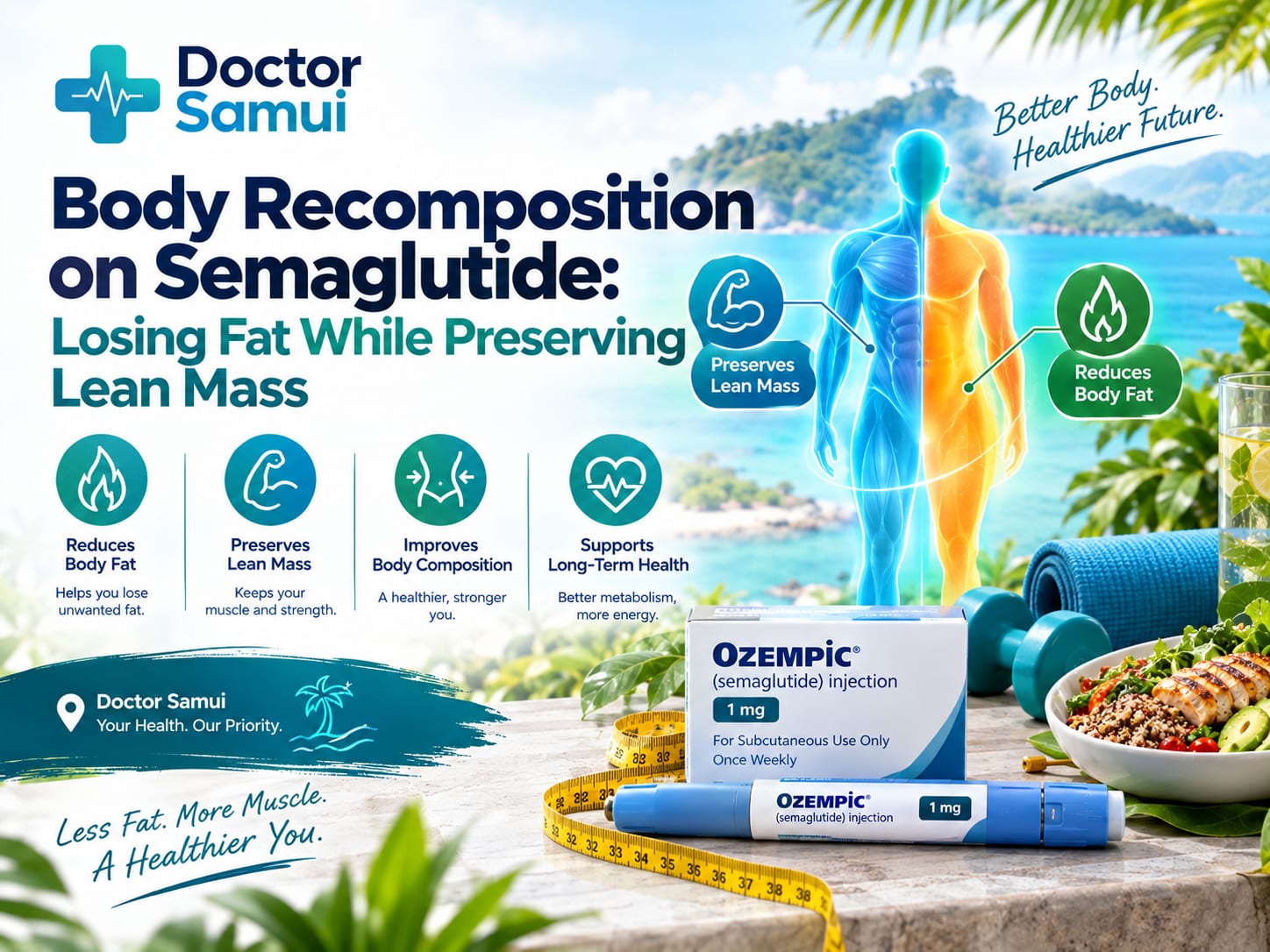
Semaglutide drives meaningful fat loss, but some lean mass loss happens alongside it in most people. Studies suggest that roughly three-quarters of total weight lost on semaglutide comes from fat. The remainder is lean tissue, and how much you lose depends largely on what you do alongside the medication: your protein intake, your training, and how closely your programme is supervised.
You have been on Samui for six months. You are hiking, swimming, maybe diving out of Chaweng or doing morning laps at Lamai. You are not sedentary, and you have earned the muscle you carry. You want to lose body fat, not the strength that comes with actually using your body every day. That concern is exactly right, and it deserves a straight answer before you start semaglutide.
Semaglutide produces fat-dominant weight loss, but lean mass does not fully protect itself. What you do alongside the medication makes a real difference to the ratio. This article covers what the current evidence shows, what you can do about it, and how a supervised programme on Koh Samui is structured to protect lean mass, not just move the number on the scale.

Why Some Lean Mass Loss Happens on Semaglutide
When you eat significantly less, your body burns stored energy from both fat and lean tissue. This is not specific to semaglutide. It happens on any meaningful caloric deficit. Semaglutide reduces appetite strongly, which is its strength, but that same reduction can push your intake low enough that your body starts drawing on muscle protein for fuel.
The critical point is that this is not inevitable. Two people on the same dose can have very different lean mass outcomes depending on how much protein they eat and whether they are doing resistance training. The medication does not cause muscle loss directly. The deficit does, and the deficit is partly manageable.
What the Evidence Actually Shows on Semaglutide Body Recomposition
A French observational study using DXA body composition scanning found that roughly 78% of weight lost on semaglutide came from fat mass. Across semaglutide trials, lean mass loss has been reported to represent between roughly 20% and 40% of total weight lost, with the range varying by exercise habits and protein intake. Studies that included structured resistance training reported outcomes at the lower end of that range.
One finding that directly addresses a common fear: the SEMALEAN 12-month DXA study found lean mass dipped in the first months of treatment but showed stabilisation after month seven in patients who maintained adequate protein and activity. That is not the same as no lean mass loss, but it suggests the trajectory is not a straight downward line throughout treatment.

Functional Muscle vs. Absolute Lean Mass
Lean mass on a DXA scan and functional muscle capacity are not the same thing. The SEMALEAN trial also measured handgrip strength, a reliable marker of functional muscle performance. At 12 months, handgrip strength had increased in participants even where lean mass showed a modest reduction. Skeletal muscle index, another functional measure, remained stable.
What this means practically: your body may carry slightly less lean tissue by weight, but your actual strength and muscle function can hold or improve when you train consistently. For divers, swimmers, and active people on Samui, this is the more clinically meaningful number. You are not necessarily getting weaker even if the scan shows a small lean mass reduction.
Resistance Training and Protein During Semaglutide Treatment
This is where you actually move the needle. A 2025 systematic review identified resistance training and adequate protein intake as the strongest modifiable factors for lean mass preservation during GLP-1 treatment. Neither is optional if body recomposition is your goal.
On protein: current evidence supports a target of 1.2 to 1.6 grams per kilogram of body weight per day during active weight loss. On Samui, this is achievable. Grilled fish, eggs, tofu, chicken, and legumes are all accessible daily. The practical challenge is that semaglutide suppresses hunger, which means patients sometimes skip meals and fall short on protein without noticing.
On training: two to three resistance sessions per week covering major muscle groups is the evidence-supported minimum. This does not require a gym. Bodyweight work at your villa, free weights, or load-bearing movement on the beach all count. The point is signalling to your body that lean tissue is worth keeping.
Who Should Be Especially Careful About Lean Mass Loss
Lean mass loss is not equal across all patients. Adults over 60 face meaningfully higher risk. In the enobosarm QUALITY Phase 2b study, adults over 60 on semaglutide alone lost approximately 4.1% of lean mass, notably more than younger mixed-age populations in other trials. Post-menopausal women face elevated sarcopenia risk for independent reasons, making lean mass monitoring more important during treatment.
If you are an older long-stay expat on Samui, or a post-menopausal woman considering a semaglutide programme, baseline body composition measurement and more frequent follow-up checks are the standard of care for this group, not optional extras.
Semaglutide is also not suitable for everyone. It is contraindicated in people with a personal or family history of medullary thyroid carcinoma or multiple endocrine neoplasia type 2, among other conditions. A history of pancreatitis is a serious warning that requires discussion with a doctor before use. A full medical consultation reviews all of this before anything is prescribed.
How Body Composition Is Tracked During a Supervised Programme
Good oversight means you do not just weigh yourself. It means measuring fat mass percentage, lean body mass, and functional markers at baseline and at regular intervals. Bioelectrical impedance analysis, which estimates lean mass, fat mass, and body water using a painless electrical signal, is a practical monitoring tool. DXA scanning provides greater precision and can be arranged by referral.
Dose titration, the gradual increase in semaglutide dose over the first months of treatment, should follow your response and tolerance, not a fixed calendar. This is what separates a supervised programme from a prescription without follow-up.
Semaglutide Body Recomposition on Koh Samui
Doctor Samui offers semaglutide programmes for long-stay expats and visitors spending several weeks or more on the island. The programme starts with a medical consultation to confirm eligibility: your health history, current medications, and any contraindications are reviewed before anything is prescribed. You can find full details on what the GLP-1 programme at Doctor Samui covers, including supervised body recomposition support, including what studies show on lean mass and fat loss outcomes.
Semaglutide is given as a weekly subcutaneous injection, a small injection just under the skin, typically in the abdomen or thigh. Follow-up checks monitor how your body is responding, not just how much weight you have lost. If you want a health check-up in Koh Samui before starting, baseline labs feed directly into your starting assessment.
The island lifestyle on Samui is genuinely useful for this goal. Daily swimming, hiking, paddleboarding, and consistent access to fresh fish and local produce give you an environment that supports the protein and activity targets the evidence recommends. That is a practical advantage worth using, not background noise.
If you are managing your health while staying elsewhere on the island, house call doctor services across Koh Samui mean follow-up checks can come to your villa or hotel rather than requiring a trip to the clinic.
Doctor Samui offers supervised semaglutide programmes for long-stay expats and visitors on Koh Samui, with baseline assessment, dose titration, and body composition follow-up. If you are considering semaglutide for body recomposition and want a programme focused on fat loss while protecting lean mass, contact Doctor Samui to arrange a consultation at the Chaweng clinic or as a house call across the island.
Frequently Asked Questions
Dr. Ponlawat Pitsuwan
Physician, Doctor Samui
a walk-in clinic based in Chaweng, Koh Samui, with 24-hour hotel and villa visits across the island. He works with tourists, families, and long-stay expats on weight management, metabolic health, and GLP-1 medication programmes including semaglutide body recomposition. His focus is straightforward, evidence-based care delivered in plain language.
References
- Novo Nordisk. Ozempic (semaglutide) US Prescribing Information. FDA, 2026.
- Wilding JPH, et al. Once-Weekly Semaglutide in Adults with Overweight or Obesity. New England Journal of Medicine, 2021.
- SEMALEAN Study. Impact of Semaglutide on fat mass, lean mass and muscle function in patients with obesity. PMC/NCBl, 2025.
- Veru Inc. Veru Announces Positive Topline Data from Phase 2b QUALITY Clinical Study of Enobosarm. Press release, January 2025.
The information in this article is for educational purposes only and does not constitute medical advice. It should not be used to self-diagnose or replace a consultation with a qualified physician. If you have concerns about your health, contact a licensed medical professional. For appointments at Doctor Samui, visit doctorsamui.com.