Clinically reviewed by Dr. Ponlawat Pitsuwan, Physician, Doctor Samui.
Last reviewed: October 2026
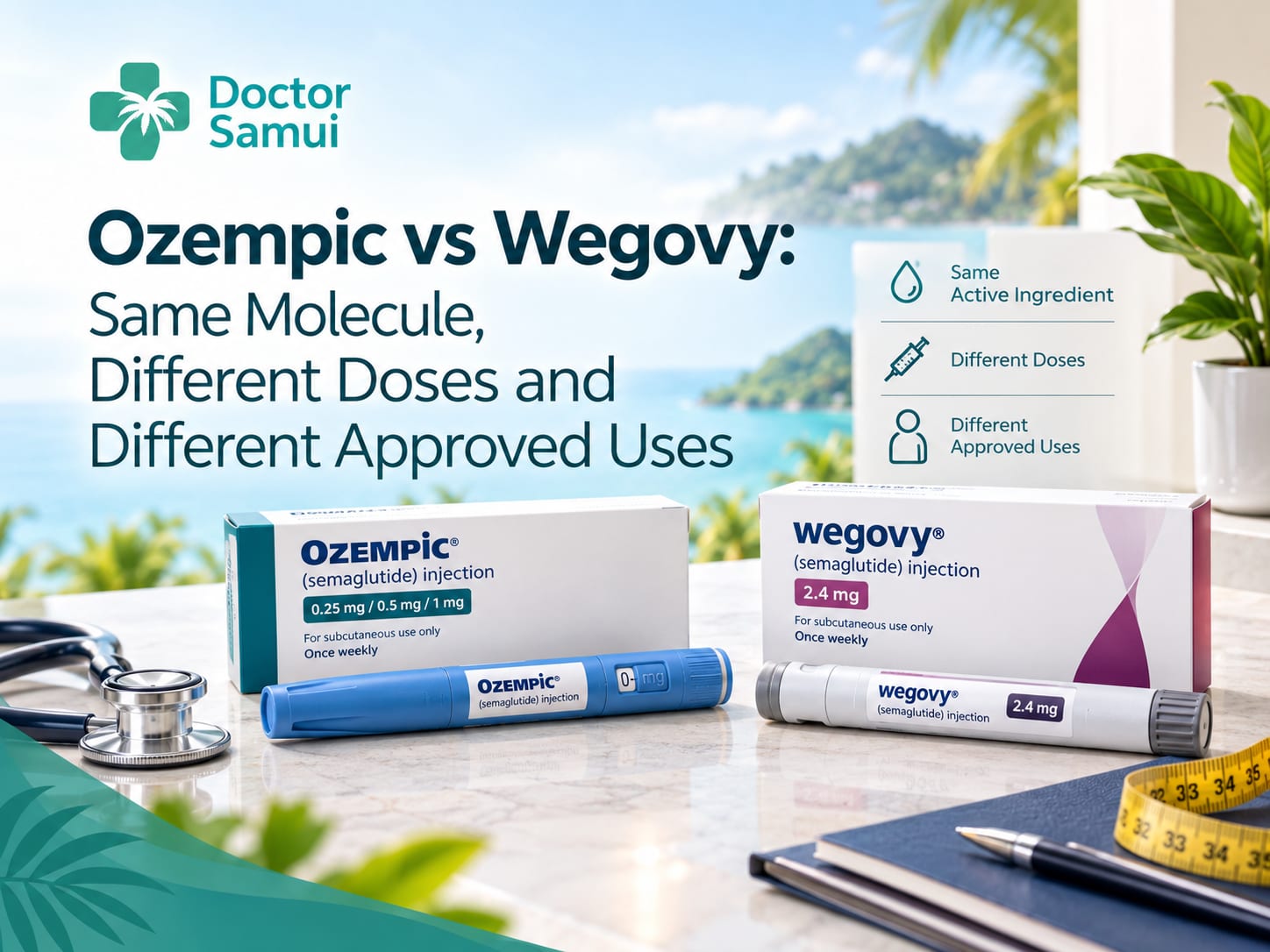
Ozempic and Wegovy both contain semaglutide, a GLP-1 receptor agonist that reduces appetite and slows digestion. The key ozempic vs wegovy difference is the approved dose and the licensed indication. Ozempic is approved for type 2 diabetes management, with a maximum weekly dose of 2 mg. Wegovy is approved for chronic weight management, with a higher maximum weekly dose of 2.4 mg. Both are prescription-only and require a medical assessment before starting.
You are two weeks into a long stay on Samui, settled into a villa near Bophut, and the question has been sitting in the back of your mind: Ozempic or Wegovy? You have read they are the same drug. You do not want to fly to Bangkok for a single consultation.
They are the same molecule, semaglutide, but they are not interchangeable. The approved dose is different. The condition each is licensed for is different. The eligibility criteria your doctor uses to assess you are different. Knowing that gap helps you ask the right questions when you do sit down with a doctor.
One Molecule, Two Approved Purposes
Semaglutide mimics a hormone your body releases after eating. It tells your brain you are full, slows how quickly food leaves your stomach, and helps bring blood sugar down after meals. That single mechanism is useful in two separate clinical situations: controlling blood sugar in type 2 diabetes, and reducing body weight in people with obesity.
Ozempic was approved first, for type 2 diabetes. Wegovy came later, using a higher dose of the same molecule to achieve a greater effect on appetite and body weight. The pen looks different, the dosing schedule differs slightly, and the two products are not substitutable at the pharmacy without a doctor’s instruction.
Doctors sometimes prescribe Ozempic off-label for weight loss. That is a legal practice, but the approved weight-loss evidence, and the higher dose ceiling, belongs to Wegovy. If weight management is the primary goal, Wegovy is the product with the clinical trial data at the doses needed to achieve it.
The Dose Difference and Why It Matters
Both drugs start at 0.25 mg weekly and increase gradually to reduce nausea. With Ozempic, the maximum approved dose for diabetes is 2 mg per week. With Wegovy, the maintenance dose for weight management reaches 2.4 mg per week.
That 0.4 mg difference is not trivial. The STEP 1 trial studied Wegovy at 2.4 mg weekly in adults with obesity and showed an average body weight reduction of around 14.9 percent over 68 weeks compared to placebo. Off-label use of Ozempic at its lower approved ceiling does not replicate those outcomes on average, though individual results vary.
The higher dose also means a slightly higher chance of nausea and loose stools, especially early in treatment. Slow dose escalation under medical supervision manages this risk well for most people.

Who Qualifies for Each Drug
Ozempic is for adults with type 2 diabetes who need better blood sugar control. It also carries an FDA label for reducing cardiovascular risk in adults with type 2 diabetes and established heart disease.
Wegovy is for adults with a BMI of 30 or above, or a BMI of 27 or above if a weight-related health condition such as high blood pressure, high cholesterol, or type 2 diabetes is also present. The FDA extended Wegovy’s approval in 2023 to adolescents aged 12 and older with obesity. That adolescent indication is not shared by Ozempic.
Neither drug is appropriate for people with a personal or family history of medullary thyroid carcinoma or a rare condition called MEN2. Pregnancy is a contraindication. A history of pancreatitis requires careful assessment before starting. These are the questions a doctor works through with you in a consultation, not things to self-screen at home.
Availability in Thailand and What to Expect on Koh Samui
Semaglutide has Thai FDA approval. Wegovy launched in Thailand in April 2025. Both products are available through private clinics on prescription. You do not need a referral from a Thai hospital to access a consultation, but you do need a proper medical assessment before a prescription is issued.
Supply can fluctuate. Global demand for semaglutide has been high, and stock at any given clinic is not guaranteed. If you are already on a dose escalation schedule and running low, contact a clinic early rather than waiting until you miss a dose.
For long-stay expats and tourists on Samui, you do not need to travel off-island for this. The GLP-1 service at Doctor Samui covers everything from a first consultation to ongoing prescription support, at the Chaweng clinic or via a hotel or villa visit. The service page has current detail on what to bring and what the consultation covers.
Side Effects, Storage, and Managing Semaglutide in the Samui Heat
Nausea is the most reported side effect, usually peaking in the first few weeks after each dose increase. Eating smaller meals, avoiding greasy food, and staying hydrated helps. In Samui’s heat, keeping out of direct sun for the first day or two after a dose increase is a practical step that makes a real difference.
Injection site reactions, redness or mild swelling at the injection point, are common and usually short-lived. Rotate your injection site each week to reduce this.
Storage is where the island’s climate becomes a genuine concern. Unopened pens must be kept refrigerated between 2 and 8 degrees Celsius. A hotel mini-fridge works, but never put the pen in the freezer. Ozempic uses a multi-dose pen: once in use, it can be stored at room temperature up to 30 degrees Celsius for up to 56 days. Wegovy uses single-dose pens: each pen can be stored unrefrigerated at up to 30 degrees Celsius for up to 28 days, per the respective product labels. Samui’s ambient temperature regularly exceeds that 30-degree limit outdoors. Do not leave your pen in a beach bag in direct sun, a hot car, or on a windowsill. Indoor storage is the only safe option here.
What a GLP-1 Consultation at Doctor Samui Covers
A GLP-1 consultation is not a five-minute prescription. Before any semaglutide product is prescribed, the doctor reviews your weight history and current BMI, any existing conditions including diabetes, thyroid history, and cardiovascular risk, your current medications for potential interactions, and whether the goal is blood sugar control, weight management, or both.
If you are already on Ozempic from a doctor at home and want to continue while on Samui, or you are considering switching to Wegovy for a higher dose, that requires the same full assessment. Self-switching is not safe. Adjusting the semaglutide dose while managing diabetes can affect your blood sugar control and may require changing other medications alongside it.
Doctor Samui offers walk-in appointments at the Chaweng clinic or house call visits in Lamai, Bophut, Maenam, Choeng Mon, and across the rest of the island. If travel to Chaweng is difficult, mobile doctor services in Nathon and Taling Ngam are also available. Bring any current medications, your most recent blood results if you have them, and a note of your current dose if you are already using semaglutide.
If you are on Koh Samui and want to discuss Ozempic, Wegovy, or semaglutide for weight management or diabetes, Doctor Samui can see you the same day. Walk in to the Chaweng clinic or book a hotel or villa visit anywhere on the island, available 24 hours a day. See doctorsamui.com/glp-1/ for what to bring to a GLP-1 consultation, or contact the clinic directly to arrange an appointment.
FAQ
Dr. Ponlawat Pitsuwan
Physician, Doctor Samui
a walk-in clinic based in Chaweng, Koh Samui, with 24/7 hotel and villa visits across the island. He sees tourists, families, and long-stay expats for GLP-1 weight management consultations, semaglutide prescriptions, and ongoing monitoring for patients already using Ozempic or Wegovy. His approach is evidence-based care delivered in plain language.
References
- Wilding JPH et al. Once-Weekly Semaglutide in Adults with Overweight or Obesity. New England Journal of Medicine, 2021.
- U.S. Food and Drug Administration. Ozempic (semaglutide) Prescribing Information. 2022.
- U.S. Food and Drug Administration. Wegovy (semaglutide) Prescribing Information. 2023.
- Healio. FDA approves once-weekly semaglutide for adolescents with obesity. February 2023.
- Pharmalive / Reuters. Novo Nordisk’s obesity drug Wegovy debuts in Thailand. April 2025.
The information in this article is for educational purposes only and does not constitute medical advice. It should not be used to self-diagnose or replace a consultation with a qualified physician. If you have concerns about your health, contact a licensed medical professional. For appointments at Doctor Samui, visit doctorsamui.com.