Clinically reviewed by Dr. Ponlawat Pitsuwan, Physician, Doctor Samui.
Last reviewed: October 2026
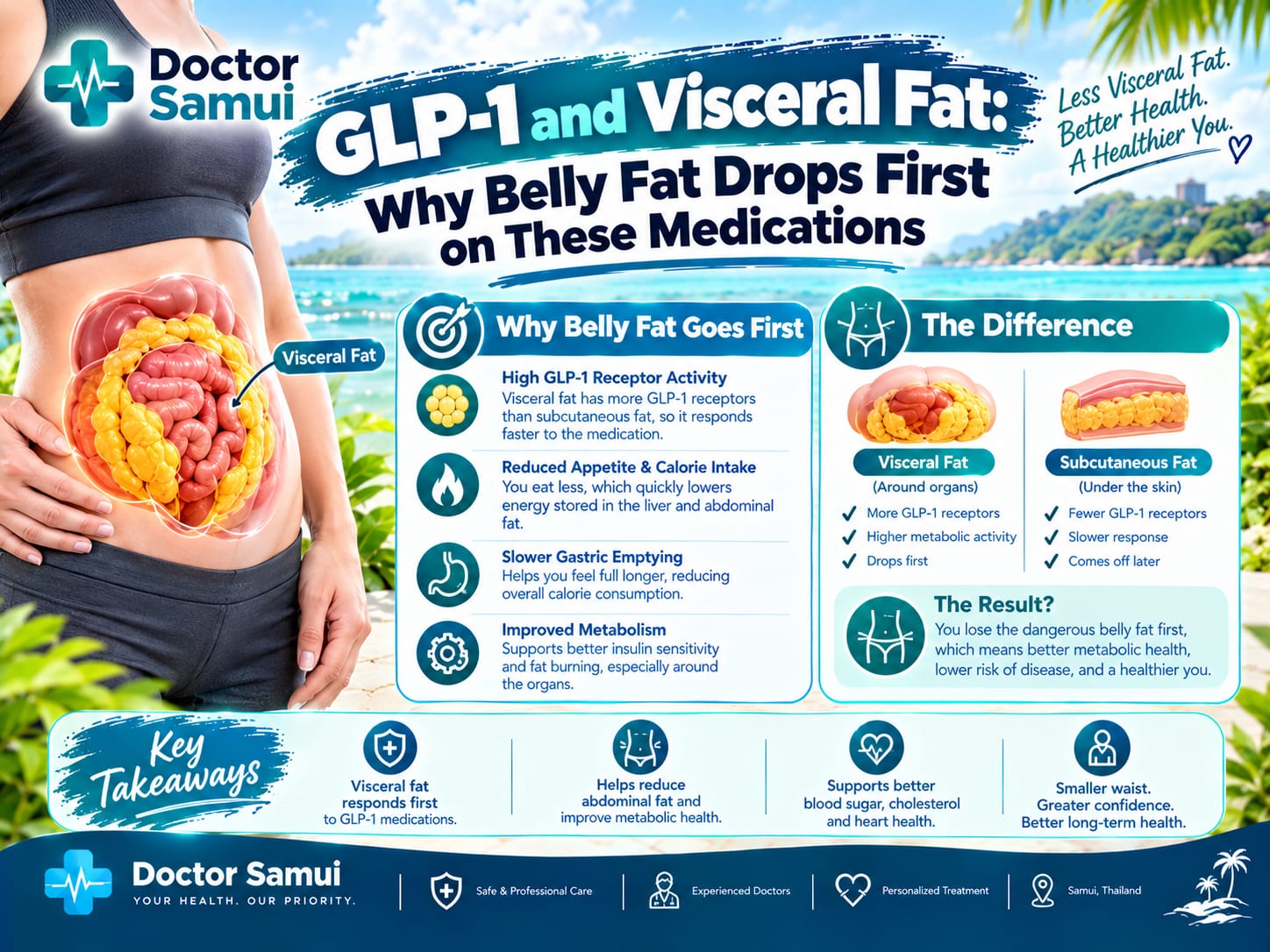
GLP-1 receptor agonists like semaglutide and tirzepatide reduce visceral fat, the deep abdominal fat around your organs, more effectively than subcutaneous fat, the fat you can pinch. This happens because visceral fat is more metabolically active and responds more readily to both the caloric reduction and the direct metabolic effects these medications produce. Clinical trials show meaningful reductions in waist circumference and organ fat, with tirzepatide showing greater reductions than semaglutide in head-to-head trial data.
You have been on Koh Samui for a couple of months. You are walking the beach at Chaweng most mornings, eating reasonably well, and the scale is finally moving. But the change you notice first is not your arms or your legs. It is your waistline. That is not random, and it is not just about eating less.
GLP-1 medications target visceral fat, the fat packed around your organs deep inside the abdomen, faster than any other fat type. That is why the belly shifts before anything else does. Knowing why this happens, and what the trial data actually shows, helps you set realistic expectations and make sound decisions about supervised treatment here on the island.

Visceral Fat vs Subcutaneous Fat: Why the Difference Matters
Not all fat carries the same risk. Subcutaneous fat sits just under the skin. You can pinch it on your thighs, arms, or flanks. It is visible and frustrating, but it is metabolically quiet.
Visceral fat is different. It sits inside the abdominal cavity, wrapped around the liver, pancreas, and intestines. It releases inflammatory signals and hormones that drive insulin resistance, raise blood pressure, and increase cardiovascular risk.
This is why waist circumference matters clinically, not just aesthetically. Two people at the same weight can carry very different amounts of visceral fat. The person carrying more also carries significantly more metabolic risk.
How GLP-1 Medications Target Visceral Fat
The simple explanation is that GLP-1 receptor agonists reduce how much you eat, which creates a caloric deficit, and visceral fat responds faster to that deficit than subcutaneous fat does. That part is accurate, but it is not the whole picture.
Some research suggests GLP-1 receptor expression may be higher in visceral than subcutaneous adipose tissue, which could mean the medication acts more directly on visceral tissue. This area of research is still developing and findings are not yet consistent across studies.
The practical result is that visceral fat is reduced during GLP-1 treatment, and some studies show a proportionally greater reduction compared with subcutaneous fat, though findings vary across trials. MRI imaging shows even more of the change than the mirror does, because much of the fat being lost is deep and around organs.

What the Clinical Evidence Shows on GLP-1 Visceral Fat Reduction
The trial data is specific and worth knowing. A 2023 meta-analysis published in PLOS One, which pooled data from 30 randomised controlled trials, found that GLP-1 receptor agonists produced a clinically meaningful reduction in visceral adipose tissue compared to controls. The same meta-analysis found reductions in hepatic fat content, the fat stored in the liver.
Fatty liver, clinically called metabolic dysfunction-associated steatotic liver disease, is common in people with excess visceral fat. GLP-1 treatment improves it, which matters well beyond how someone looks in a mirror.
Body composition changes measured by MRI and CT scans consistently show visceral fat declining earlier and proportionally more than subcutaneous fat. The scale and clothing size tell part of the story. Imaging tells the rest.
Semaglutide vs Tirzepatide: Which Reduces Visceral Fat More?
There is now head-to-head data to answer this. The SURMOUNT-5 trial directly compared tirzepatide and semaglutide in adults with obesity. Waist circumference, used as a validated proxy for visceral fat reduction, decreased by 18.4 cm in the tirzepatide group versus 13.0 cm in the semaglutide group over 72 weeks.
Tirzepatide is a dual GIP and GLP-1 receptor agonist. The additional GIP receptor activity appears to contribute to greater fat loss, including visceral fat. Whether that difference matters for a given person depends on their baseline, their dose, and how they respond to treatment.
Both medications produce real, meaningful visceral fat reduction. Tirzepatide produces more of it, based on current trial data. The right choice depends on your medical history, not just the numbers in a trial.
Beyond the Waistline: Health Benefits of Reducing Visceral Fat
Reducing visceral fat is not a cosmetic outcome. It is a cardiovascular one. Lower visceral fat is associated with improved insulin sensitivity, reduced blood pressure, and lower inflammatory markers.
The SELECT trial, which studied semaglutide in people with established cardiovascular disease, showed a significant reduction in major cardiovascular events in the treatment group. For people with metabolic syndrome, visceral fat reduction is one of the most direct ways to reduce that risk.
Each centimetre off the waist represents a meaningful change in organ fat and the inflammatory signals it was producing.
Starting GLP-1 Treatment in Koh Samui
GLP-1 medications are available in Thailand by prescription only. They require a clinical assessment, blood work to rule out contraindications, and ongoing monitoring. Self-prescribing or ordering without medical oversight is not safe and not legal.
At Doctor Samui, we assess patients for GLP-1 suitability. That includes reviewing medical history, thyroid history, pancreatitis history, and relevant metabolic markers. People with a personal or family history of medullary thyroid carcinoma or multiple endocrine neoplasia type 2 should not use these medications. Patients with active pancreatitis are also excluded. These are real contraindications, not formalities.
For expats living on the island and tourists on extended stays, supervised weight management is accessible here without flying to Bangkok. If you started GLP-1 treatment elsewhere, whether in Europe, Australia, or another part of Thailand, we can continue and monitor your programme. You can find out more about our GLP-1 service on Koh Samui.
Long-stay residents from Maenam to Lamai do not need to leave the island for this kind of supervised care. Our Chaweng clinic handles assessments, prescriptions, and follow-up monitoring, and we communicate in English, German, and Hebrew. If you are based further around the island, house call services in Nathon and Taling Ngam are also available. For anything that needs same-day attention, our 24-hour walk-in clinic in Chaweng is open around the clock.
If you are considering GLP-1 treatment for visceral fat reduction on Koh Samui, Doctor Samui offers medical assessments, prescriptions, and ongoing monitoring for eligible patients. We see tourists on extended stays and long-stay expats at our Chaweng clinic, with visits available across the island. Use the contact button below to book your assessment or ask a question before your appointment.
Frequently Asked Questions
Dr. Ponlawat Pitsuwan
Physician, Doctor Samui
a walk-in clinic based in Chaweng, Koh Samui, with 24/7 hotel and villa visits across the island. He sees tourists, families, and long-stay expats for metabolic health assessments, GLP-1 treatment and monitoring, and general medical care. His focus is straightforward, evidence-based care delivered in plain language.
References
- Liao Y et al. The effects of GLP-1 receptor agonists on visceral fat and liver ectopic fat in an adult population with or without diabetes and nonalcoholic fatty liver disease: A systematic review and meta-analysis. PLOS One, 2023 Aug 24;18(8):e0289616.
- Aronne LJ et al. (SURMOUNT-5). Tirzepatide vs semaglutide for obesity. New England Journal of Medicine, 2025.
- Cinkajzlova A et al. Role of adipose tissue GLP-1R expression in metabolic improvement after bariatric surgery in patients with type 2 diabetes. Scientific Reports, 2019.
- World Health Organization. Obesity and overweight: key facts. WHO, 2024.
The information in this article is for educational purposes only and does not constitute medical advice. It should not be used to self-diagnose or replace a consultation with a qualified physician. If you have concerns about your health, contact a licensed medical professional. For appointments at Doctor Samui, visit doctorsamui.com.