Clinically reviewed by Dr. Ponlawat Pitsuwan, Physician, Doctor Samui.
Last reviewed: October 2026
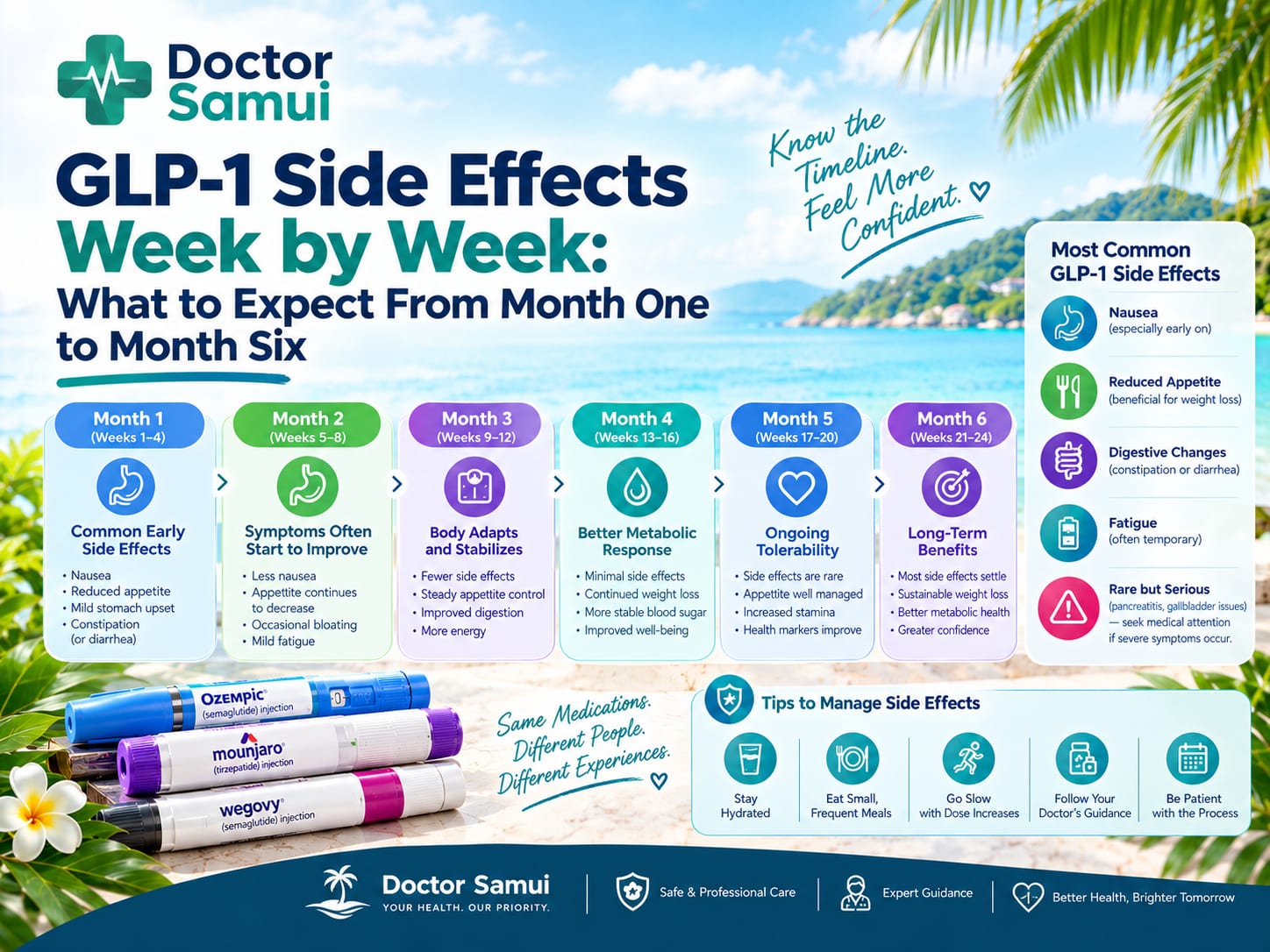
GLP-1 side effects follow a dose-driven pattern, not a simple calendar one. Nausea is usually worst in weeks one and two, settles by weeks four to eight at a stable dose, then briefly returns with each dose increase. Most people find side effects manageable by month three. A few, including hair thinning and reflux, can appear later. Knowing the timeline helps you tell normal adjustment from something that needs a doctor.
You are three days into your first semaglutide injection and you feel sick every time you look at food. Or you are two months in, finally feeling good, your dose goes up, and the nausea is back. Neither means the medication is failing you. Both are exactly what the GLP-1 side effects timeline looks like in practice.
The pattern is not linear. Side effects reset, at least partially, every time your dose increases. What you feel in week one is driven by the dose, not the date. Understanding that single fact makes the whole six months easier to navigate, especially if you are managing your treatment while staying on Koh Samui, away from the clinic or GP who started you on it.
Weeks 1 to 4: Your Body Meets the Starting Dose
The first injection is usually the lowest dose on the titration schedule. For most people, nausea arrives within the first day or two. You do not need to know the mechanism. You just need to know it is real, it is predictable, and for most people it fades.
Eat small amounts. Avoid rich, fatty, or very spicy food. On Samui, that means being cautious with street food and curries in these first weeks, especially in the heat. Staying well hydrated matters more here than it does in a cooler climate. Protein intake is worth protecting at each meal to limit muscle loss alongside fat.
If you cannot keep fluids down, that is no longer a normal adjustment symptom. Constipation is common in these early weeks. Some people get loose stools instead. Both tend to settle. Injection site redness or mild swelling is normal and usually resolves within a day.
How the Injection Cycle Shapes Symptoms Within Each Week
Within any given week on a weekly injection schedule, your symptoms follow a pattern of their own. Days one to three after the injection tend to be the most symptomatic: nausea, reduced appetite, and fatigue are strongest here. Days four and five, symptoms ease. By days six and seven, many people feel noticeably better and appetite begins to return slightly.
People sometimes panic mid-week and assume the medication is making them permanently ill. It is not. The peak-and-taper within each seven-day cycle is expected. Knowing your worst day is likely day two or three, not every day, helps you plan meals, activities, and work around it.
Weeks 5 to 8: The First Dose Escalation
Around week four or five, most titration schedules move the dose up. When that happens, expect a partial reset. The nausea that had softened often returns for a few days. This is not a setback. It usually settles faster than it did the first time around.
Some people notice rebound hunger just before the dose increase, in days five to seven of the old dose. This is normal. It does not mean you need to eat more: it means your next dose is due. Keep your meal pattern consistent rather than eating larger portions to compensate.
Months 2 to 3: Moving Toward Target Dose
By month two, most people are at an intermediate dose and the adjustment curve is becoming familiar. Nausea is less frequent, though it can still appear with fatty meals or overeating. Acid reflux, or worsening of existing reflux, sometimes appears at this stage. Lying flat after eating makes it worse. Eating smaller amounts and staying upright for an hour after meals helps.
Constipation can persist into this phase even when other symptoms have eased. Adequate water intake and fibre in the diet are the practical fixes. If constipation becomes painful or goes more than a week without resolution, speak to a clinician. For a detailed breakdown of when side effects typically start and stop, the Doctor Samui GLP-1 page covers what to expect at each phase.
Months 3 to 6: Target Dose and Later-Onset Effects
By month three, most people on a stable dose find the GI side effects are largely settled. This is when two less-discussed effects can appear: hair thinning and changes in facial appearance sometimes called Ozempic face.
Hair thinning at this stage is almost always a temporary shift in the hair growth cycle triggered by rapid weight loss rather than by the medication directly. It typically begins around months three to four and resolves on its own as weight loss rate slows. Keeping protein intake adequate is the most useful practical measure. If the thinning is severe, a blood test to check nutritional levels is a sensible step.
Ozempic face refers to the gaunt or hollowed appearance some people notice as fat is lost from the face. This is a consequence of rapid weight loss, not a separate drug effect. There is no clinical intervention that prevents it while continuing the medication.
Semaglutide vs Tirzepatide: Does the GLP-1 Side Effects Timeline Differ?
Both semaglutide (Ozempic, Wegovy) and tirzepatide (Mounjaro) cause similar GI side effects. The core timeline is comparable: nausea peaking early, settling at stable doses, and partially resetting with each escalation.
| Feature | Semaglutide | Tirzepatide |
|---|---|---|
| Main GI side effects | Nausea, vomiting, constipation | Nausea, vomiting, diarrhea |
| Nausea onset | Days 1 to 3 post-injection | Days 1 to 3 post-injection |
| Diarrhea frequency | Less common | More commonly reported |
| Constipation | Common | Common |
| Dose escalation resets | Yes | Yes |
| Later-onset effects | Hair thinning, reflux | Hair thinning, reflux |
Tirzepatide trials reported diarrhea somewhat more frequently than semaglutide trials. Both share the same overall adjustment curve. Switching between them does not eliminate the adjustment period: expect a fresh round of early symptoms when changing medications.
Side Effects That Do Not Go Away
Most GLP-1 side effects ease as your body adjusts. But some symptoms signal something different.
Persistent nausea beyond two weeks at a stable dose, severe enough to prevent normal eating or drinking, is not a normal adjustment symptom. Ongoing reflux that does not respond to meal timing changes may need treatment. Constipation that causes pain or goes more than a week without resolution needs clinical attention.
The question to ask is whether symptoms are improving week on week at a stable dose. If they are, you are in the adjustment curve. If they are not moving, or are getting worse, speak to a clinician rather than wait it out.
Red Flag Symptoms at Every Phase
Some symptoms are not adjustment side effects. They need same-day or emergency attention regardless of which month you are in.
Sharp pain in the upper abdomen, particularly pain that radiates to the back, can indicate pancreatitis. Do not wait on this. Severe or persistent vomiting that prevents you from keeping any fluid down is a dehydration emergency. Rapid heart rate, chest discomfort, or signs of a severe allergic reaction all require urgent care.
Gallbladder problems, including pain in the right upper abdomen after eating, are a known risk with GLP-1 medications and can appear at any phase. Significant vision changes are rare but have been reported and warrant same-day review. If you are on Samui and need urgent assessment, Doctor Samui’s clinic in Chaweng handles emergency walk-ins and can reach you at your hotel or villa around the clock.
Managing GLP-1 Side Effects on Koh Samui
Being on GLP-1 treatment on a tropical island adds practical challenges. Samui’s heat and humidity increase fluid losses. If the medication is already slowing your appetite and causing nausea, it is easy to underdrink on a hot day at the beach or out on a boat trip. Dehydration compounds every GI side effect and makes constipation worse.
Drink consistently, not just when you feel thirsty. Do not wait until you feel dizzy or your mouth is dry. If you are starting a new dose or escalating while on Samui, choose your timing carefully: not a long day in direct sun, and not a day with something physically demanding planned.
Local food can also be a factor. Thai food, especially spicy dishes and high-fat options, can trigger nausea more strongly in weeks one to four of any dose. Blander options are available and there is no shame in choosing them until your adjustment is complete. If you need IV rehydration, electrolyte support, or a same-day review while on the island, Doctor Samui provides hotel and villa visits across Chaweng, Lamai, Bophut, Maenam, and Choeng Mon. IV therapy in Chaweng is available when oral hydration is not enough. For visitors staying further out, mobile doctor services in Taling Ngam and house calls in Nathon reach areas across the west coast of the island.
Managing GLP-1 side effects on Koh Samui, whether you are at a hotel in Chaweng, a villa in Lamai, or anywhere else on the island? Doctor Samui’s walk-in clinic and 24-hour house-call service covers the full island. We see patients managing weight loss treatment who need clinical review, IV rehydration support, or help navigating a dose escalation without their home GP. Walk in or call us to arrange a hotel or villa visit.
Frequently Asked Questions
Dr. Ponlawat Pitsuwan
Physician, Doctor Samui
a walk-in clinic based in Chaweng, Koh Samui, with 24-hour hotel and villa visits across the island. He sees tourists, long-stay expats, and patients managing GLP-1 weight loss treatment on Koh Samui, providing clinical review, side effect assessment, and IV support where needed. His focus is straightforward, evidence-based care delivered in plain language.
References
- Wilding JPH et al. "Once-Weekly Semaglutide in Adults with Overweight or Obesity." New England Journal of Medicine, 2021
- Jastreboff AM et al. "Tirzepatide Once Weekly for the Treatment of Obesity." New England Journal of Medicine, 2022
- Rubino DM et al. "Effect of Continued Weekly Subcutaneous Semaglutide vs Placebo on Weight Loss Maintenance in Adults With Overweight or Obesity." JAMA, 2021
The information in this article is for educational purposes only and does not constitute medical advice. It should not be used to self-diagnose or replace a consultation with a qualified physician. If you have concerns about your health, contact a licensed medical professional. For appointments at Doctor Samui, visit doctorsamui.com.