Clinically reviewed by Dr. Ponlawat Pitsuwan, Physician, Doctor Samui.
Last reviewed: October 2026
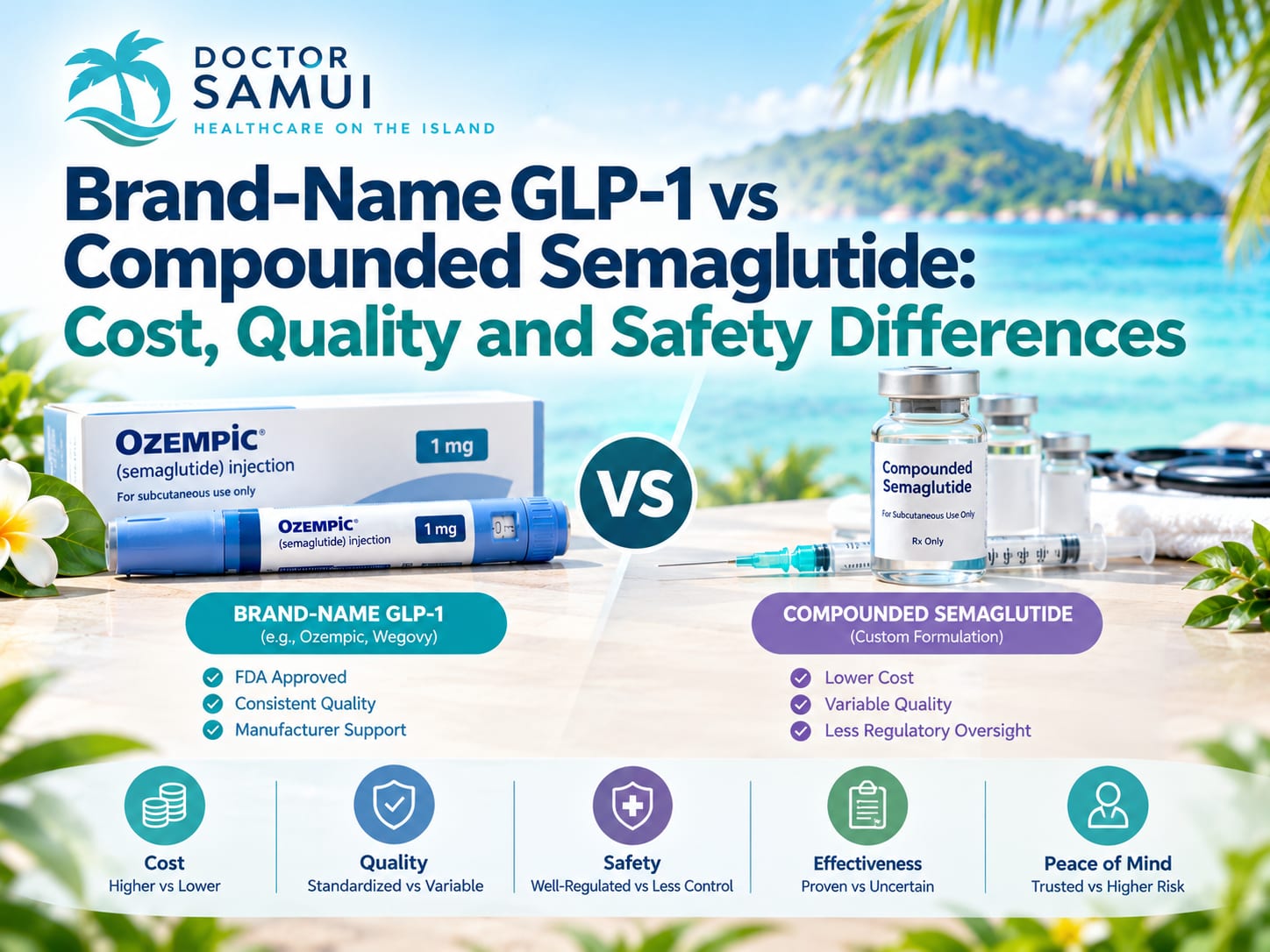
Branded GLP-1 medications like Ozempic and Wegovy are FDA-approved and manufacturer-tested. Compounded semaglutide costs significantly less, but quality depends entirely on the compounding pharmacy’s standards and API sourcing. True generic semaglutide now exists in some markets outside the US. Whichever version you choose, physician supervision matters for dosing, monitoring, and safety.
Your Ozempic pen runs out on day nine of a three-week Koh Samui stay. A quick search pulls up a dozen sellers offering "semaglutide" at prices that seem almost too good. Some are a fraction of what you paid at home. The question is not just cost. It is whether what is in that vial is actually what it says.
The gap between branded and compounded GLP-1 cost is real and significant. So is the gap in what you know about what you are injecting. Here is what each category actually means, where the safety risks sit, and what tourists and long-stay expats on Koh Samui need to know before making a decision.

What ‘Branded,’ ‘Generic,’ and ‘Compounded’ Actually Mean
These three terms are used interchangeably online. They are not the same thing.
Branded GLP-1 medications, Ozempic and Wegovy, are produced by Novo Nordisk to a consistent standard. They are reviewed and approved by regulatory bodies such as the FDA and EMA, and backed by the clinical trial data used to establish dosing and safety. Every pen contains the same active molecule: semaglutide base.
A true generic is the same molecule made by a different licensed manufacturer, approved by a national regulatory authority. As of 2026, true generic semaglutide is approved in Canada and India, where Dr. Reddy’s Laboratories markets a licensed version. It is not yet approved in the United States. If someone in the US tells you they have "generic semaglutide," they almost certainly mean compounded semaglutide, which is a different category entirely.
Compounded semaglutide is prepared by a pharmacy from raw active pharmaceutical ingredient, or API, sourced from a chemical supplier. It is not individually reviewed or approved by the FDA. Quality depends entirely on the pharmacy that makes it: the API source, the sterile preparation process, and whether the product has been independently tested.
The Global GLP-1 Branded Generic Cost Picture
In the United States, branded Wegovy has a list price above one thousand dollars per month without insurance. Ozempic, prescribed off-label for weight loss, sits in a similar range. Compounded semaglutide from a US-based 503A or 503B pharmacy typically costs significantly less, though prices vary widely.
Outside the US, the picture shifts. UK private clinic pricing for branded semaglutide injections is substantially lower than US list prices. In India, licensed generic semaglutide sits in a different pricing bracket given local manufacturing and market structure. Across Southeast Asia, including Thailand, physician-supervised GLP-1 treatment is considerably more accessible than Western list prices while still using legitimately sourced products under medical oversight.
The cheapest option is not always the safest. The question is what is backing the low price: a licensed manufacturer, a certified compounding pharmacy, or an unknown supplier with no accountability chain.

The Salt-Form Problem, A Safety Risk Most People Miss
Beach wisdom gets this one wrong, and it can make things worse. So does a lot of online advice about cheap semaglutide.
In 2023, the FDA issued a specific warning about compounded products labelled as semaglutide that actually contain semaglutide sodium or semaglutide acetate. These are salt forms of the molecule. They are not the same as the semaglutide base used in Ozempic and Wegovy. The FDA stated that their safety and effectiveness have not been established.
When you buy compounded semaglutide from an unverified source, including online sellers or clinics that cannot tell you their API supplier, you have no reliable way to confirm which form of the molecule is in the product. A certificate of analysis from a third-party lab is the only way to verify this. If a supplier cannot provide one, that is your answer.
How to Evaluate Any GLP-1 Source Before You Inject It
Ask these questions before committing to any product, whether from an online pharmacy, a clinic abroad, or a compounding supplier.
First, is the product semaglutide base, not a salt form? Ask for a certificate of analysis from an independent third-party laboratory confirming the molecular form and purity. Second, if it is compounded, what is the pharmacy’s accreditation? In the US, look for PCAB accreditation or USP 797 compliance. Third, how is the product stored and transported? Semaglutide requires cold-chain handling. A product stored incorrectly loses potency or becomes unsafe. Fourth, is a physician reviewing your dose? GLP-1 dosing is escalated gradually for a reason. A fixed-dose approach without clinical oversight raises the risk of side effects.
If a seller cannot answer these questions, do not buy from them.
Getting GLP-1 Treatment on Koh Samui
Running out of your GLP-1 medication mid-trip can happen, especially during longer stays. So is arriving on the island as a long-stay expat wanting to start or continue treatment without flying back to a Western clinic.
At Doctor Samui’s walk-in clinic in Chaweng, GLP-1 treatment is available under physician supervision. If you are continuing an existing regimen, bring your prescription or a clear record of your current dose and how long you have been on it. A brief clinical assessment confirms your current dose is appropriate and that no new contraindications apply. If you are considering starting for the first time, the same assessment applies: GLP-1 therapy is not right for everyone, and a doctor needs to review your history before prescribing.
For long-stay expats, continuity of care matters. Stopping and restarting GLP-1 therapy without guidance can affect tolerability and dosing. A clinic that knows your history is safer than ordering online and hoping for the best. You can find more detail on what is involved, including what to ask about sourcing and safety, at Doctor Samui’s GLP-1 service page.
Why Supervision Matters Regardless of Which Version You Choose
GLP-1 receptor agonists are effective for weight management and blood sugar control in type 2 diabetes, but they carry real contraindications. They should not be used by people with a personal or family history of medullary thyroid carcinoma or multiple endocrine neoplasia type 2. Pancreatitis is a known adverse effect requiring clinical monitoring. Nausea, vomiting, and gallbladder problems are common enough that gradual dose escalation is standard practice.
None of this changes based on whether you are using a branded pen or a compounded vial. The clinical oversight requirement stays the same. Cheaper semaglutide without a prescriber is not a bargain. It is an unmonitored use of a prescription medication with a real risk profile.
A health check-up at Doctor Samui before starting or resuming GLP-1 therapy takes less time than most people expect. It can catch the issues that make the therapy unsafe for some patients. If you are already managing a condition like type 2 diabetes alongside weight treatment, a broader review matters too. For general health and travel assessments on the island, Doctor Samui also offers walk-in services at the Chaweng clinic.
If you are on Koh Samui and need to continue, start, or review your GLP-1 treatment, Doctor Samui’s walk-in clinic in Chaweng offers physician-supervised GLP-1 prescribing. Hotel and villa visits are available 24/7 across the island. Contact Doctor Samui to book an assessment or ask about the GLP-1 service before your next injection.
Frequently Asked Questions
Dr. Ponlawat Pitsuwan
Physician, Doctor Samui
a walk-in clinic based in Chaweng, Koh Samui, with 24/7 hotel and villa visits across the island. He sees tourists, families, and long-stay expats for weight management consultations, GLP-1 prescribing and monitoring, and general health assessments. His focus is straightforward, evidence-based care delivered in plain language.
References
- Wilding JPH, et al. Once-Weekly Semaglutide in Adults with Overweight or Obesity. New England Journal of Medicine, 2021;384:989-1002.
- U.S. Food and Drug Administration. Ozempic (semaglutide) Prescribing Information (label revision 2026). FDA, 2026.
- Health Canada. Canada approves first generic semaglutide for weight loss. Health Canada news release, June 2026.
- Drucker DJ. Mechanisms of action and therapeutic application of glucagon-like peptide-1. Cell Metabolism, 2018;27(4):740-756.
- U.S. Pharmacopeia. USP General Chapter 797: Pharmaceutical Compounding — Sterile Preparations. USP, 2023.
The information in this article is for educational purposes only and does not constitute medical advice. It should not be used to self-diagnose or replace a consultation with a qualified physician. If you have concerns about your health, contact a licensed medical professional. For appointments at Doctor Samui, visit doctorsamui.com.