
Clinically reviewed by Dr. Ponlawat Pitsuwan, Physician, Doctor Samui.
Last reviewed: November 2026
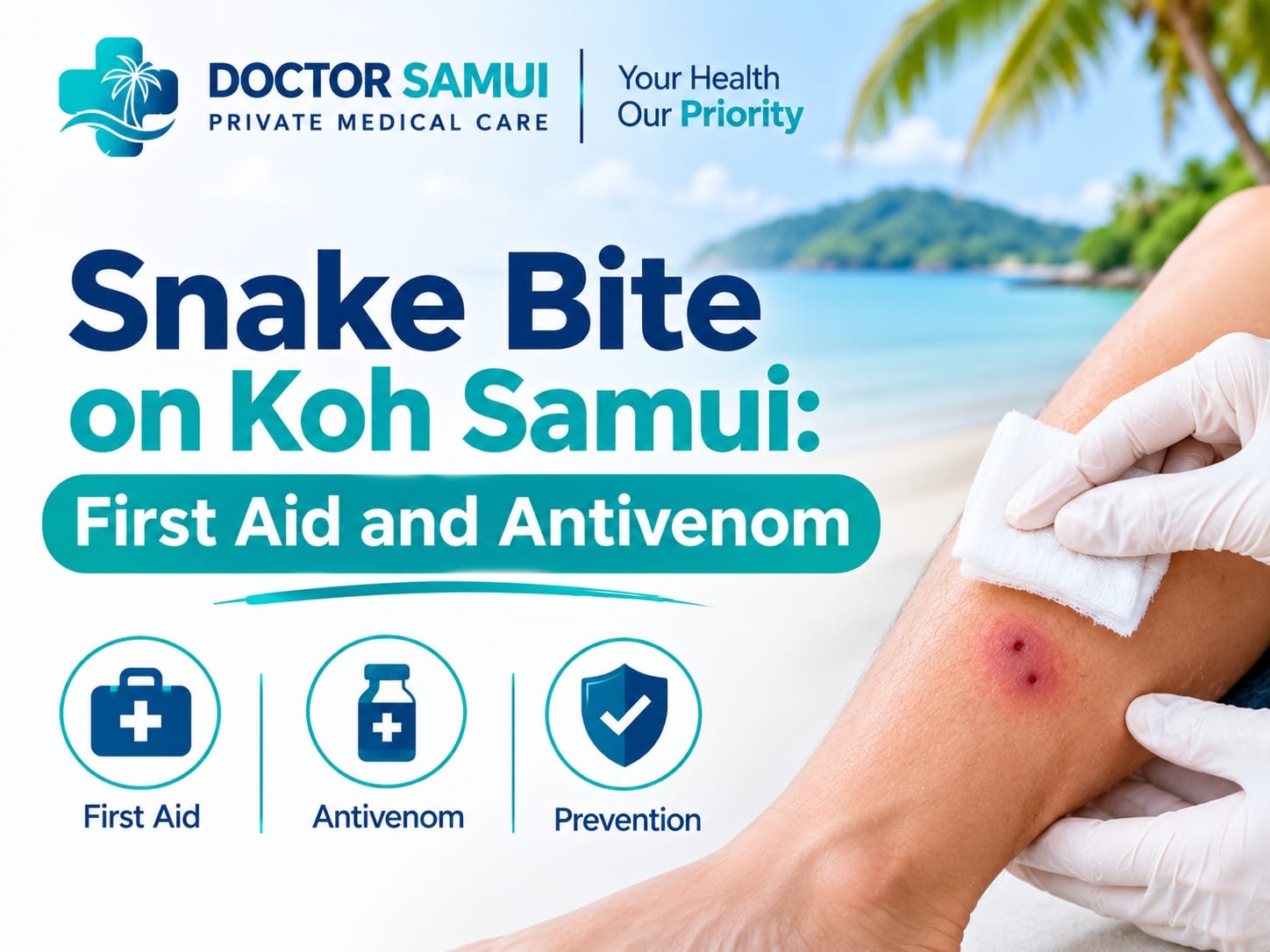
Koh Samui has several venomous snakes, including the monocled cobra and Malayan pit viper. If you or someone with you is bitten, keep the person still, immobilise the bitten limb at or below heart level, and get to Bangkok Hospital Samui as quickly as possible. Do not cut the wound, suck out venom, or apply a tourniquet. Not every bite delivers venom, but every bite from an unknown snake must be treated as potentially serious.
You are walking the trail back from Na Mueang waterfall, stepping over a root in the half-light, and something strikes the side of your ankle. It happens that fast. In that moment, most people do two things wrong: they panic, and they go back for a closer look at the snake. Neither helps.
Samui is a jungle island. Venomous snakes are here, they are real, and some are genuinely dangerous. Deaths are rare when people reach hospital promptly. This guide covers the snakes you might encounter, what to do in the first ten minutes, when antivenom is needed, and how to get clinical help if you are far from town.

Venomous Snakes on Koh Samui
Samui’s interior is dense secondary jungle, with rubber plantations and overgrown gardens meeting the coast in places like Hua Thanon and Taling Ngam. That habitat suits several venomous species.
The monocled cobra (Naja kaouthia) is the most medically important snake in Thailand. It delivers neurotoxic venom that affects the nervous system, and it can also cause severe tissue destruction at the bite site. It is the species behind the most serious envenomations in the country.
The king cobra is the largest venomous snake in the world. Encounters near Samui’s jungle trails are uncommon but not impossible. Its venom is neurotoxic and fast-acting. Never approach one.
The Malayan pit viper (Calloselasma rhodostoma) is a heavy-bodied snake that blends almost perfectly into leaf litter on the jungle floor. It is most active at night. Its venom is haemotoxic, meaning it stops blood from clotting properly, causing swelling, bruising, and in serious cases, internal bleeding.
The red-necked keelback looks unremarkable but causes serious envenomation. There is no commercially available antivenom for this species. A small, ordinary-looking snake is not a safe one.
Kraits, both banded and Malayan, are also present across Thailand. They are nocturnal and not aggressive, but their neurotoxic venom is potent. Bites may cause little initial pain, which is exactly what delays people from getting help.
Most snakes you see on Samui will be non-venomous: rat snakes, pythons, and paradise tree snakes are all common. But reliable visual identification by a non-expert is not possible in the field.
Snake Bite First Aid: What to Do and What Not to Do
Get away from the snake. That is step one. Do not try to catch it, kill it, or photograph it while you are still near it. Move the person to safety and call for help.
Keep the person as still as possible. Movement speeds venom absorption through the lymphatic system. Immobilise the bitten limb and keep it at or below heart level. Splint it loosely if you have materials. Pressure immobilisation bandaging is appropriate for neurotoxic bites (cobra, krait). For pit viper bites, tight bandaging directly over the wound area is not recommended, though limb immobilisation still helps.
Do not cut the wound. Do not suck out venom. Do not apply a tourniquet. Do not use ice or heat. Do not give alcohol. None of these help, and most cause harm.
Remove rings, watches, or tight clothing near the bite before swelling starts. Note the time. If someone photographed the snake from a safe distance, that image is genuinely useful at hospital. If not, do not go back.
A dry bite means a venomous snake struck but injected little or no venom. This happens in a meaningful proportion of venomous bites. You cannot confirm a dry bite without hospital observation. No symptoms in the first hour does not mean the bite was harmless.
Symptoms to Watch During Transport
This matters most when you are far from hospital: a villa near Bang Rak, a trail south of Na Mueang, a resort in Maenam.
For cobra or krait bites, watch for drooping eyelids, blurred vision, difficulty swallowing, slurred speech, or muscle weakness. These are signs the venom is affecting the nervous system. For cobra bites, they can appear within thirty minutes to a couple of hours. For krait bites, onset may be delayed up to eight hours, with a median of around three hours in Thai clinical studies. Do not wait for them to progress before moving.
For pit viper bites, the first signs are local: rapid swelling, bruising, and pain spreading up the limb. Systemic effects such as bleeding gums, blood in urine, or signs of shock tend to develop more slowly over hours. Both types require hospital observation regardless of how the person feels initially.
What Happens at Hospital
Every bite from a potentially venomous snake needs at least several hours of observation in a hospital setting. This applies even if the person feels completely fine on arrival.
Bangkok Hospital Samui is the main private hospital on the island and the most likely facility to hold antivenom stock. If you are coming from the south or west, the distance is real: Taling Ngam to Chaweng is over thirty kilometres by road. Call ahead while you are in transit.
If someone is bitten at a remote villa and transport is the immediate problem, Doctor Samui’s 24/7 mobile service can reach you while you arrange transfer. The team can assess the wound, monitor early symptoms, and help coordinate hospital admission. This is not a substitute for antivenom, but getting clinical eyes on the patient early has clear value. The service covers the whole island, including Taling Ngam, Hua Thanon, and Nathon. You can also read about our full approach to animal bites in Koh Samui to understand what an initial assessment involves.
Move to hospital urgently if you see any neurological symptoms, rapid limb swelling, bleeding from the gums or nose, difficulty breathing, or loss of consciousness.
Antivenom on Koh Samui
Antivenom for the major Thai terrestrial snakes is produced by the Thai Red Cross Queen Saovabha Memorial Institute in Bangkok. Each antivenom targets a specific snake species, which is why identifying the type of bite matters clinically.
Antivenom is not something a walk-in clinic can give safely. It is delivered by IV under close observation because allergic reactions, including anaphylaxis, are a known risk. It requires a hospital with resuscitation equipment on hand.
Bangkok Hospital Samui is the most likely source of antivenom on the island. Small clinics and pharmacies do not carry it.
There is no available antivenom for the red-necked keelback. Care for that bite focuses on managing the effects rather than neutralising the venom directly.
Not every venomous bite needs antivenom. The decision is made by a doctor based on clinical signs: how much venom was delivered, which system is affected, and how quickly things are progressing. That call is made at hospital, not in the field.
Snakes in Villa Gardens and Pool Areas
This is more common than most visitors expect. Snakes move into villa gardens, pool areas, and even indoor spaces, particularly during wet season from around May through October, when rain pushes them out of dense vegetation.
If you find a snake in your garden, leave it alone. Keep children and pets well clear. Do not corner it or try to push it out with a broom. A threatened snake is far more likely to strike.
Call your villa manager. Many properties on Samui have contact details for a local snake catcher. This is faster and safer than improvising. Most snakes in gardens here are non-venomous: the Indo-Chinese rat snake and reticulated python are both common. But nocturnal activity around water features and garden lighting can bring species you would not want to identify in poor light.
If someone is bitten during a villa encounter, the steps are the same as above. For accident and trauma care at your villa or hotel, Doctor Samui’s team is available around the clock across the island.
If you are staying somewhere in Lamai or Choeng Mon and need a doctor to come to you while you arrange hospital transport, both IV Therapy Lamai house call services and IV Therapy Choeng Mon house call services operate 24 hours a day.
If you or someone in your group has been bitten by a snake on Koh Samui, do not wait to see what happens. Doctor Samui offers 24/7 house calls and villa visits across the island, including remote areas in the south and west. The team can assess the wound, monitor early signs, and arrange hospital transfer if antivenom is needed. Walk in to the Chaweng clinic or call now for a mobile doctor visit anywhere on the island.
Frequently Asked Questions
Dr. Ponlawat Pitsuwan
Physician, Doctor Samui
a walk-in clinic based in Chaweng, Koh Samui, with 24/7 hotel and villa visits across the island. He sees tourists, families, and long-stay expats for animal bites, wound care, and urgent travel health concerns, including snake bite first assessment and coordination of hospital transfer. His focus is straightforward, evidence-based care delivered in plain language.
References
The information in this article is for educational purposes only and does not constitute medical advice. It should not be used to self-diagnose or replace a consultation with a qualified physician. If you have concerns about your health, contact a licensed medical professional. For appointments at Doctor Samui, visit doctorsamui.com.
