
Clinically reviewed by Dr. Ponlawat Pitsuwan, Physician, Doctor Samui.
Last reviewed: November 2026
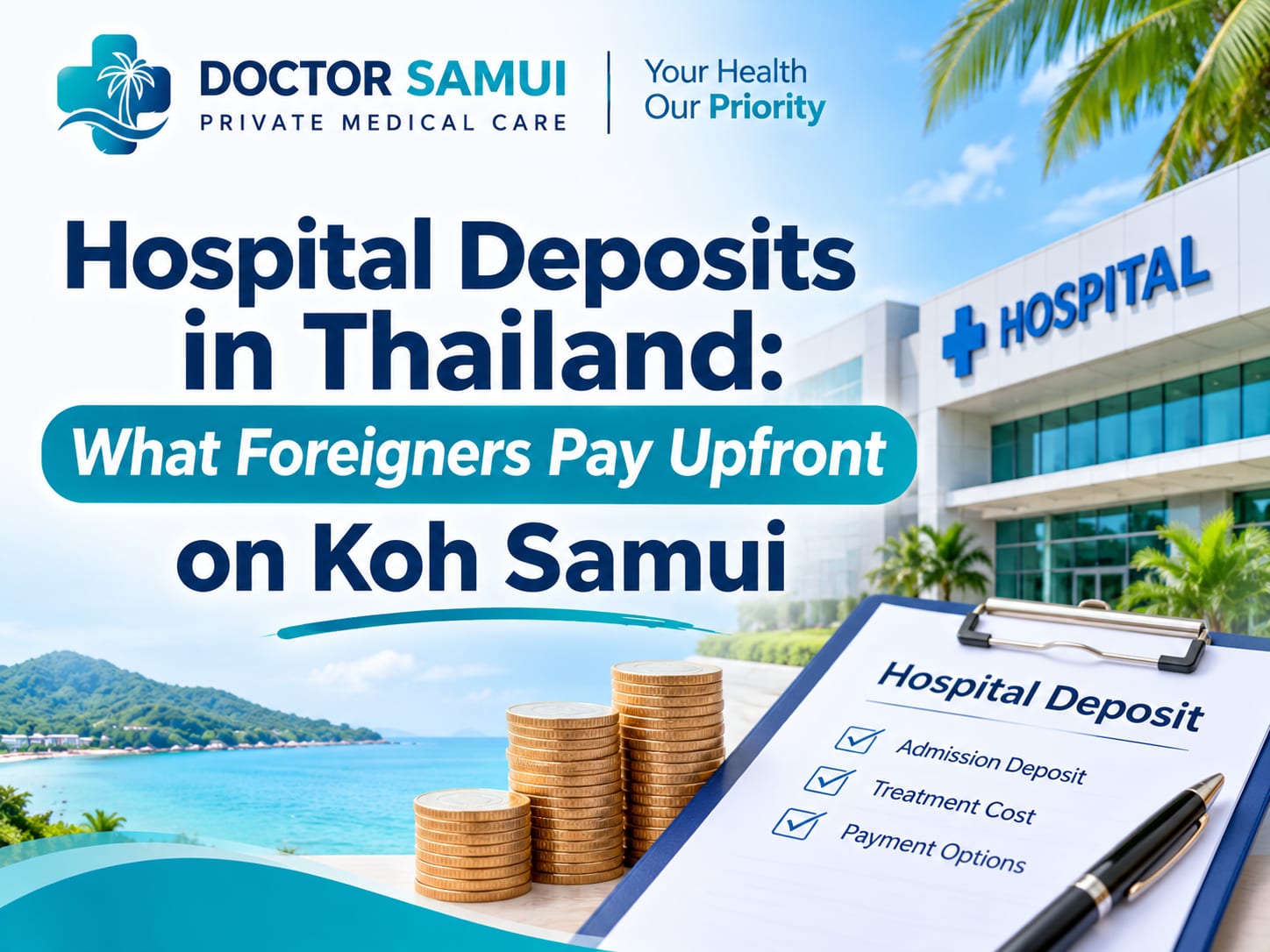
Private hospitals on Koh Samui require an upfront deposit before admission, based on an estimate of your total treatment cost. For uninsured foreign visitors, this can reach tens of thousands of baht. If your insurer has a direct billing agreement with the hospital, they may issue a guarantee of payment letter and waive the deposit. For non-emergency care, a walk-in clinic or hotel doctor visit has no admission deposit at all.
Your scooter goes down on the ring road near Lamai, or your child spikes a 40-degree fever at your villa in Bophut, and suddenly you are facing the Thai private hospital system for the first time. Before anyone examines you, someone from the international patient office hands you a form and asks for a deposit. It is not unusual. It is not punitive. It is just how private hospitals here work, and knowing that in advance saves a very stressful conversation at the admissions desk.
The deposit is an estimate of what your treatment will cost. You pay it upfront, they treat you, and the balance is settled on discharge. If your bill comes in lower, you get the difference back. If you have travel insurance with direct billing, your insurer may cover the deposit entirely. The gap between knowing this before you need it and finding out at 11pm in a hospital lobby is significant.
Why Private Hospitals Ask for Deposits
Thai private hospitals cannot bill you from home after you have flown out. They have no way to enforce payment once you leave the country. The deposit is their cost estimate for your admission, held against your final bill.
This applies at Bangkok Hospital Samui, Bandon International Hospital, and Samui International Hospital. All three operate as private facilities and all three follow this practice for foreign patients without confirmed insurance coverage. You pay on admission and settle the remainder on departure.
The amount is not a fixed fee. It is an estimate of your care. A one-night observation will generate a lower deposit request than a surgical admission or a multi-day stay with imaging and IV treatment.
Public Hospital vs Private Hospital Deposits on Koh Samui
Koh Samui Hospital, on the north edge of town, is the island’s public hospital. It charges significantly lower rates than the private facilities. For uninsured foreign visitors, you will still be asked to pay, but the sums involved are generally lower than at a private hospital. The trade-off is limited English-language support and longer wait times.
The three private hospitals, Bangkok Hospital Samui, Bandon International, and Samui International, have dedicated international patient offices, English-speaking staff, and direct billing relationships with major travel insurers. Most tourists and expats end up at one of these three, which means deposit requirements are a practical reality for anyone arriving without confirmed insurance coverage.
If your condition is stable and non-urgent, neither hospital is your only option. Many situations that feel like hospital emergencies are not admissions at all.

Typical Hospital Deposit Amounts in Thailand
Figures change, and any specific baht amount quoted here could be outdated by the time you read this. What matters is the shape of it. A minor admission for monitoring or basic treatment will typically generate a deposit request in the range of tens of thousands of baht. A surgical case, a diving injury requiring recompression, or a multi-day admission with imaging can push this considerably higher.
The hospital gives you a cost estimate, and the deposit is based on that estimate. You also receive a receipt. If your final bill is lower, the difference is refunded. If costs run higher than the estimate, a top-up deposit request may follow mid-stay.
Card deposits can take several weeks to appear as a refund on your statement after discharge. If you are near your credit card limit, factor that in before travel.
What Happens to Your Deposit Mid-Stay
This is the part most tourists do not expect. Some private hospitals review running costs every few days during a longer admission. If your treatment is exceeding the original estimate, the hospital may ask for an additional deposit before continuing non-emergency care.
Keep a card with headroom on it. Tell a family member which hospital you are in and what your insurer’s emergency line is. If a top-up request arrives and you cannot cover it, ask the international patient office to contact your insurer directly.
Guarantee of Payment From Insurers
If your travel or international health insurance has a direct billing agreement with the hospital, the process is different. Your insurer issues a guarantee of payment letter to the hospital. The hospital accepts this in place of your cash or card deposit, and you are admitted without paying upfront.
Not every insurer has this arrangement with every Samui hospital. Call your insurer’s emergency line before you arrive at admissions, not while you are standing at the desk. Ask specifically whether they have a direct billing agreement with that hospital, and ask them to contact the hospital directly.
If your insurer does not have a direct billing relationship, you pay the deposit yourself and claim reimbursement later. Keep every receipt and photograph every document. The process works, but it requires complete paperwork. For clinic visits and what documentation supports a claim, see how cashless treatment with your travel insurance works at Doctor Samui’s Chaweng clinic.
The UCEP Rule and Its Real Limits for Tourists
UCEP is a Thai government scheme guaranteeing 72 hours of emergency care at the nearest hospital without upfront payment. It exists to prevent patients from being turned away in genuine life-threatening emergencies.
The honest position for foreign tourists is this: UCEP was designed primarily for Thai nationals within the Thai public insurance system. Enforcement for foreign visitors has been inconsistent. There are documented cases of foreign patients being asked for deposits during genuine emergencies at private hospitals, even where UCEP should have applied. Do not treat UCEP as a reliable safety net if you are uninsured.
For true emergencies, Bangkok Hospital Samui and Bandon International will stabilise you. But if you are uninsured and conscious enough to be having a deposit conversation, expect the payment question to arise quickly.
If You Cannot Pay the Hospital Deposit in Thailand
If you genuinely cannot pay, tell the international patient office immediately. Most hospitals have a patient finance team. Options may include a payment plan, a reduced initial deposit for less complex cases, or a direct contact with your embassy in a serious situation.
Your country’s embassy or consulate can sometimes assist with emergency travel referrals, though they cannot pay your bills. Be direct about your situation early, not after care has been provided. Waiting creates a harder conversation.
If you have travel insurance but cannot get through to your insurer quickly, ask the hospital to try. They deal with insurers regularly and often have faster contact routes than you do.
How a Clinic Visit Avoids the Hospital Deposit System
For the large majority of conditions tourists and expats deal with on Samui, hospital admission is not needed. Fever, diarrhoea, infected cuts, sore throat, UTI, mild dive ear, allergic reactions, minor injuries after a scooter fall: all of these can be assessed and treated at a walk-in clinic or through a hotel or villa doctor visit, with no admission process and no deposit.
At Doctor Samui’s Chaweng clinic, you pay a fixed consultation fee at the time of the visit, the same way you would at a GP at home. There is no cost estimate, no deposit hold, and no mid-stay top-up. If your condition needs hospital-level care, we will tell you and help you get there. But a significant number of situations that land people in a hospital lobby at midnight do not need to be there.
Doctor Samui covers hotel and villa visits across the island, including Chaweng, Lamai, Bophut, Maenam, and Choeng Mon. For post-accident care such as wound cleaning after a ring-road fall, you can also book accident and trauma treatment in Koh Samui without going near a hospital. A doctor hotel visit in Koh Samui costs a known fee, paid on the visit, with no deposit and no queue.
Not sure whether you need a hospital or a clinic visit? Doctor Samui’s walk-in clinic in Chaweng is open 24 hours, and we offer doctor and nurse visits to hotels and villas across Koh Samui at any time of day or night. For non-emergency care, there is no deposit, no admission process, and no queue. Contact us before you head to a hospital, and we can tell you whether you need to.
Frequently Asked Questions
Dr. Ponlawat Pitsuwan
Physician, Doctor Samui
a walk-in clinic based in Chaweng, Koh Samui, with 24/7 hotel and villa visits across the island. He sees tourists, families, and long-stay expats on Koh Samui for common travel illnesses, minor injuries, post-accident care, and situations that would otherwise require a private hospital visit. His focus is straightforward, evidence-based care delivered in plain language.
References
- Chiang Mai City Life. 72 Hours of Emergency Treatment in All Hospitals in Thailand Under New UCEP Plan. 2017.
- Bumrungrad International Hospital. Patient Finance and Insurance Information. Bumrungrad.com.
- FV Hospital. What You Should Know About Deposit. FVHospital.com.
- Pattaya Mail. NIEMS prepares for festive season, ensures universal emergency coverage. PattayaMail.com.
- Centers for Disease Control and Prevention. Travel Insurance, Travel Health Insurance, and Medical Evacuation Insurance. CDC.gov.
- Radio Free Asia. No deposit, no treatment: More patients from Myanmar shut out from Thai hospitals. RFA.org, 2025.
The information in this article is for educational purposes only and does not constitute medical advice. It should not be used to self-diagnose or replace a consultation with a qualified physician. If you have concerns about your health, contact a licensed medical professional. For appointments at Doctor Samui, visit doctorsamui.com.
