
Clinically reviewed by Dr. Ponlawat Pitsuwan, Physician, Doctor Samui. Last reviewed: September 2026
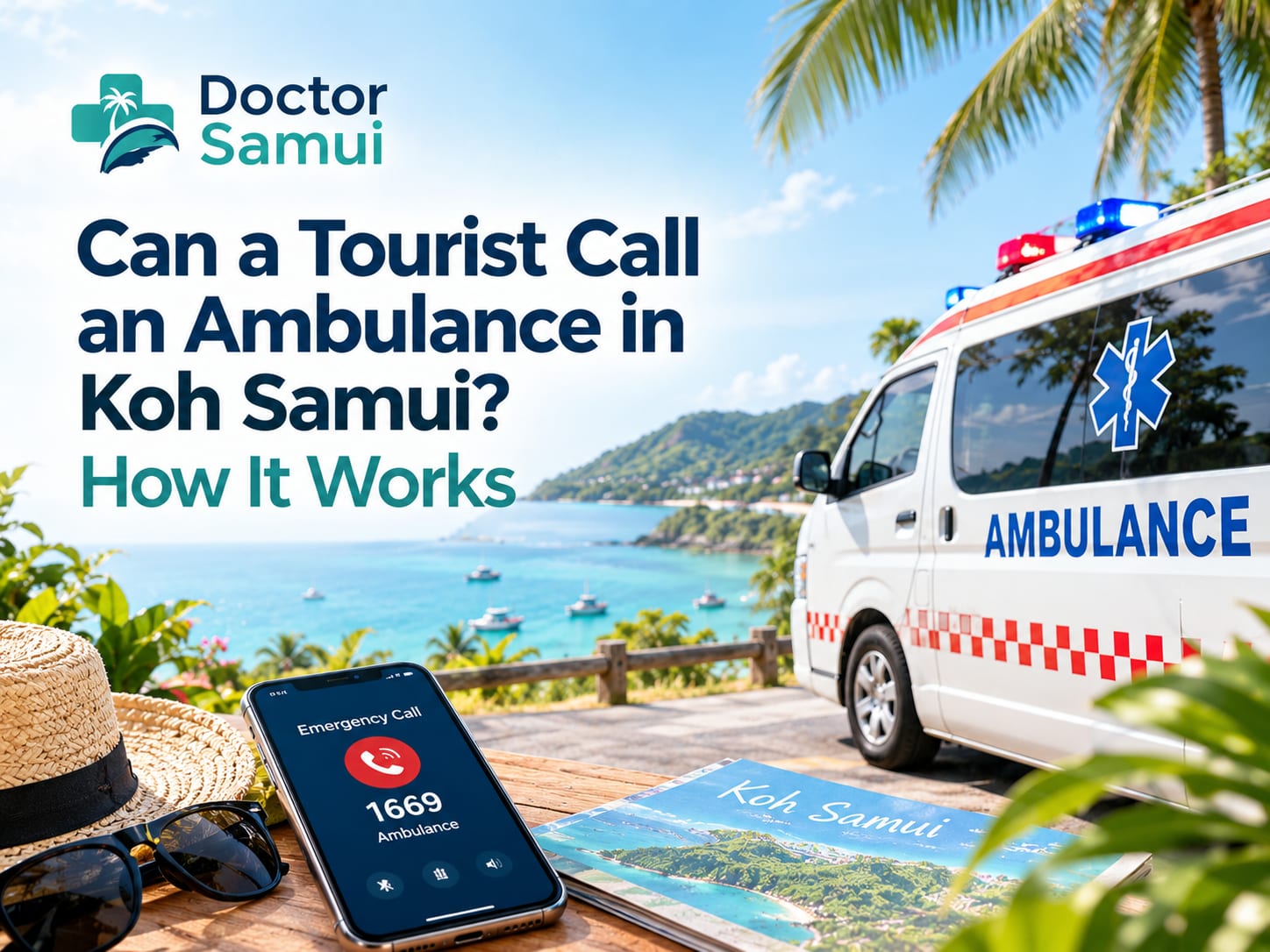
Yes, any tourist can call an ambulance in Koh Samui. Dial 1669 for the national emergency line or 077 421 444 for the Samui Rescue Foundation directly. Response times and English capability vary, and for many urgent but non-life-threatening situations, a doctor coming to your hotel or villa is faster and easier to coordinate than waiting for an ambulance.
You are on the ring road near Lamai. Your travel companion has come off a scooter, she is conscious and road-rashed and shaking, and you have your phone in your hand. Do you call an ambulance? Which number? Will anyone speak English? Will they find the guesthouse down that unmarked side road? You have about thirty seconds before you need to act.
This guide answers those questions before you need them. It covers who responds when you call, how long they take to reach different parts of the island, what they can and cannot do on arrival, and when a doctor coming directly to you is the smarter move.
The Emergency Numbers Every Tourist Should Save Now
Save these before anything goes wrong.
1669 is the national emergency line. It works anywhere in Thailand, including Koh Samui. English operators are available but not guaranteed. If you cannot get through in English, call Tourist Police on 1155 at the same time. They speak English, they can translate, and they can coordinate with local emergency services on your behalf.
077 421 444 is the direct line for the Samui Rescue Foundation. On this island, this is often who actually responds to a 1669 call anyway.
For a cardiac arrest, unconscious person, or severe trauma, call 1669 first. Do not wait. Do not drive to the hospital yourself unless you have no other option.
Who Actually Responds to an Ambulance Call on Koh Samui
This is what no one tells tourists, and it matters. When you call 1669 on Koh Samui, the response often comes from the Samui Rescue Foundation, a volunteer rescue organisation, rather than a hospital-dispatched paramedic team. They know the island well and they respond quickly. But they are volunteers, not hospital paramedics.
Equipment levels and training vary. English is not guaranteed. You may get a highly capable team or a more basic one, depending on who is on shift and where you are on the island.
Private hospital ambulances do exist. Bangkok Hospital Samui dispatches its own unit for registered patients or direct calls. That service carries a fee, typically 1,500 to 5,000 THB or more depending on distance and care provided, but you get English-speaking staff and transport to your chosen facility.
For a genuine life-threatening emergency, call 1669 and take whoever comes. For everything below that threshold, you have better options.

How Long an Ambulance Takes to Reach You in Koh Samui
Honestly, it depends heavily on where you are.
Koh Samui has one ring road and no internal grid. A villa in the hills above Bophut or a property on the west coast near Taling Ngam can take significantly longer to reach than a hotel in central Chaweng. Afternoon traffic through Chaweng and Nathon adds time. Hillside access roads around Choeng Mon and the north shore can slow any vehicle.
If you are at a well-known resort with a clear address, response is generally reasonable. If you are at a private villa accessed by a GPS coordinate and a dirt track, arrival time is genuinely unpredictable.
This is one reason our team at Doctor Samui gets called directly for urgent but stable situations. A doctor who knows the island’s geography is sometimes on scene faster than an emergency vehicle fighting ring-road traffic from the other side of the island.
How to Tell Emergency Services Where You Are
Koh Samui has limited formal street addressing. Many villas, guesthouses, and rental properties do not have a standard address that a dispatcher can find on a map. This is a real problem in a real emergency.
Do this first: open Google Maps, drop a pin on your exact location, and copy the coordinates or the sharing link. Read those coordinates over the phone to any dispatcher. If you are at a resort, get the full Thai address from reception the moment you check in and save it in your phone.
If you are at a waterfall or on a beach with no address, describe the nearest landmark clearly. "Na Muang waterfall car park, main road side" gets help to you faster than "somewhere near a waterfall." Stay on the line and keep talking.
What an Ambulance in Koh Samui Will and Will Not Do
Set your expectations now. Pre-hospital care on Koh Samui is not the same as a Western paramedic service. You will get transport and basic stabilisation. You will not necessarily get IV pain relief, advanced airway management, or a cardiac monitor on every call.
The ambulance will take you to the nearest or most appropriate hospital, which may not be your preferred facility. If you want Bangkok Hospital Samui or another specific private hospital, say so clearly and repeatedly. Public ambulances are not obligated to honour that request, though most will try.
English is not guaranteed on a public ambulance. Call Tourist Police on 1155 in parallel if you need a translator.
When Calling an Ambulance Is Not the Right Move
Most of what we see at our Chaweng clinic is not an ambulance situation. These cases are urgent, they need a doctor, but they do not need a stretcher and a siren.
Motorbike road rash that needs proper cleaning and dressing. A coral cut from the reef near Chaweng that will not close on its own. A child with a high fever on night two of a family holiday. Dehydration after a day trip to Angthong Marine Park. A sprained ankle from the trail at Na Muang waterfall. These all need medical attention, but calling 1669 means waiting, a language barrier, a busy hospital ER, and an ambulance bill your insurer may dispute.
For situations like these, Doctor Samui’s 24-hour hotel and villa visit service is built exactly for this. An English-speaking doctor comes to you, assesses you properly, treats what can be handled on site, and arranges referral if anything more serious turns up. Our accidents and injuries service covers wound cleaning, suturing, dressing, and the documentation you need for a travel insurance claim. It is faster than an ambulance for this tier of emergency, and far less disorienting than an ER.
Diving Emergencies: A Different Call Entirely
If someone in your group shows symptoms of decompression sickness after a dive, do not call a standard ambulance first. Symptoms include joint pain, skin mottling, dizziness, numbness, or confusion after surfacing.
Call the recompression chamber directly: 077 427 427. This is the hyperbaric facility used for diving emergencies on the island. Standard ambulances are not equipped for decompression sickness, and going to a general ER first wastes critical time.
Keep the diver lying flat, give oxygen if available, and do not allow them to dive again or fly until a doctor has cleared them. Doctor Samui can assess marine-related injuries, coordinate referral for hyperbaric treatment, and provide documentation if evacuation becomes necessary.
Ambulance Costs and Travel Insurance on Koh Samui
Calling 1669 is free, and the public response carries no charge, but it may not transport you to your preferred private hospital. Private hospital ambulances charge a fee that rises with distance and care level.
Travel insurance almost always covers emergency ambulance transport, but the paperwork matters. Keep every receipt. Get a written report from whoever treated or transported you. Doctor Samui provides full documentation for insurance claims, including diagnosis, treatment notes, and referral letters, which makes the claims process straightforward.
If your insurer offers direct billing to a private hospital on the island, contact them before you travel, not from the back of an ambulance.
When You Need More Than Koh Samui Can Provide
For the most serious cases, a stroke, major trauma, or a complex cardiac event, Koh Samui’s hospitals will stabilise you and then coordinate air ambulance transfer to Bangkok. This is how the system is designed to work, not a shortcoming.
If air evacuation becomes a possibility, call your travel insurance provider immediately. Most policies require pre-authorisation for evacuation, and that call needs to happen as early as possible.
If you or someone with you needs urgent medical attention on Koh Samui, Doctor Samui’s English-speaking team is available 24 hours a day. We offer walk-in appointments at our Chaweng clinic and doctor visits to hotels and villas across the island, including Bophut, Lamai, Maenam, Choeng Mon, and beyond. We treat accidents and injuries, provide wound care and suturing, manage IV therapy for dehydration, and produce full documentation for travel insurance claims. Contact us directly on WhatsApp to reach a doctor fast.
Frequently Asked Questions
Dr. Ponlawat Pitsuwan
Physician, Doctor Samui
a walk-in clinic based in Chaweng, Koh Samui, with 24-hour hotel and villa visits across the island. He sees tourists, families, and long-stay expats for [accident and injury care](https://doctorsamui.com/accidents-injuries/), emergency assessment, wound management, and referral coordination when hospital-level care is needed. His focus is straightforward, evidence-based care delivered in plain language.
