Clinically reviewed by Dr. Ponlawat Pitsuwan, Physician, Doctor Samui.
Last reviewed: November 2026
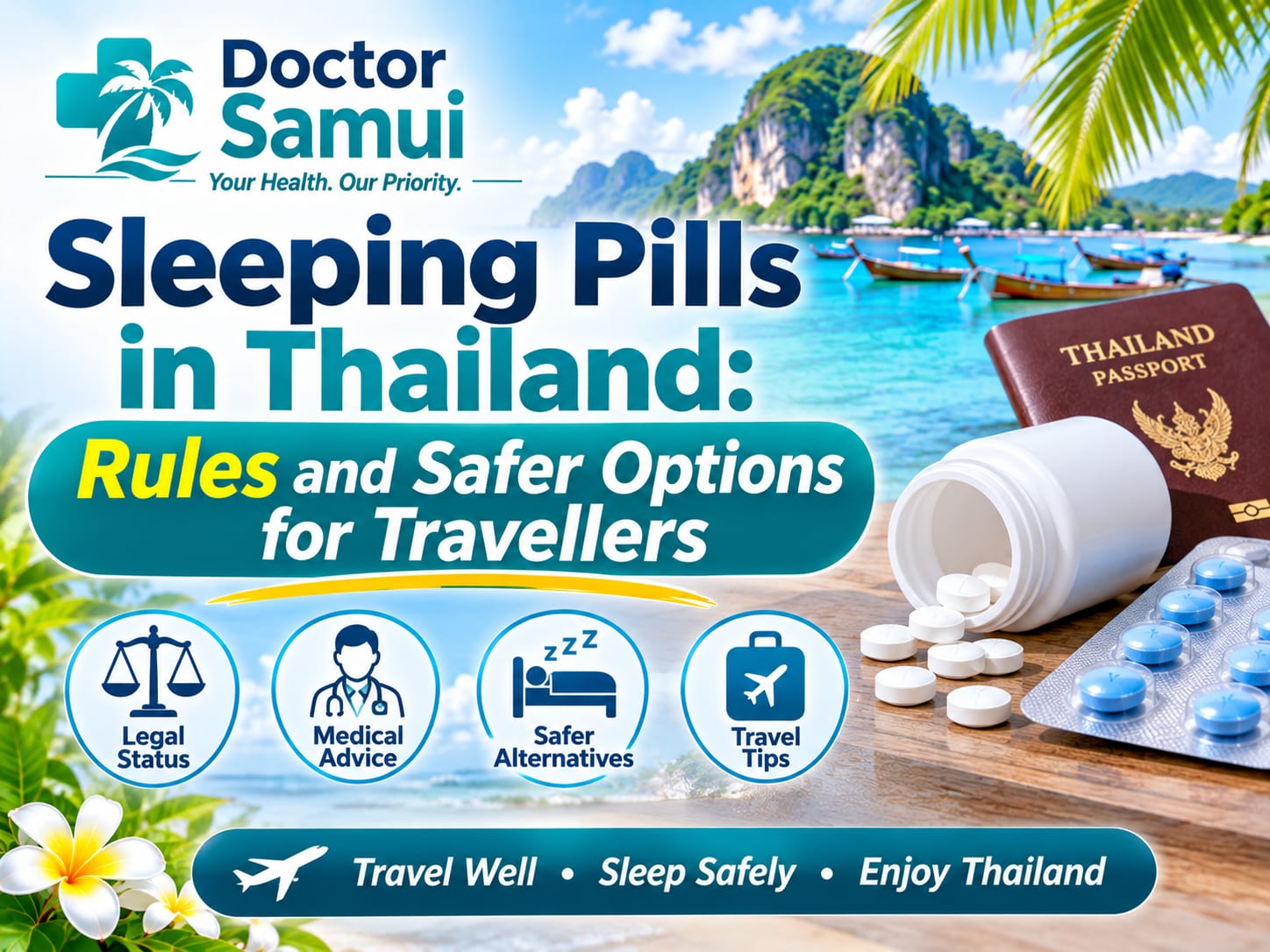
Prescription sleeping pills, including benzodiazepines and z-drugs such as zolpidem, are controlled substances in Thailand and cannot be bought over the counter. You can bring a personal supply of up to 30 days without a formal permit, but it must be in original packaging with a doctor’s letter. Quantities above 30 days require a Thai FDA import permit applied for before you fly. On Koh Samui, a doctor can assess you and prescribe appropriately at our Chaweng clinic or at your hotel or villa.
It is 2 a.m. Your villa air-con is cycling on and off, the beach bars along Chaweng strip are still going, and your body thinks it is early morning back home. You reach for the sleeping pills you packed, then stop. Are these even legal here?
That question matters, and the answer is more specific than most travel advice makes it sound. Thailand treats prescription sleeping pills as controlled drugs, the rules at customs are real, and losing your supply on the island means a clinic visit, not a pharmacy counter. Here is what you need to know before that becomes a problem.

Why Travellers Struggle to Sleep on Koh Samui
The island works against sleep in ways that have nothing to do with stress. Koh Samui sits at UTC+7. If you have flown in from Europe, you have crossed six to eight time zones, and eastward travel hits the body’s circadian rhythm harder than travelling west. Australian travellers face a smaller shift but still land into tropical heat that most bodies are not ready for.
Even with air-conditioning, a humid tropical night feels different from home. Villa units cycle on and off and can be surprisingly loud. If your room faces the main road through Chaweng or sits near the beach strip, nightlife noise runs until at least 2 a.m. on weekends.
Add dehydration from a full day of sun and sea, a stomach adjusting to spicier food, and the adrenaline of a first few days on holiday. For families travelling with young children, disrupted kids mean disrupted parents. These are specific, fixable triggers. Identifying them matters before reaching for medication.
Prescription Sleeping Pills and Thai Rules
Thailand classifies prescription sleeping pills as controlled psychotropic substances under the Psychotropic Substances Act B.E. 2518. They are listed across Schedules II to IV. That includes benzodiazepines such as diazepam and temazepam, and z-drugs such as zolpidem and zopiclone. No pharmacy in Thailand will dispense them without a prescription from a licensed Thai physician.
If you are bringing sleeping pills into Thailand, the rules set by the Thai Food and Drug Administration are clear. A supply of 30 days or fewer does not require a formal import permit. You must carry the medication in its original packaging with a letter from your prescribing doctor confirming the drug, the dose, and that it is for personal use. Keep this with your passport, not in checked luggage.
A supply of 31 to 90 days requires a Thai FDA import permit, specifically Form IC-2, applied for at least 15 days before arrival. Quantities above 90 days are generally not permitted for personal import. When in doubt, declare at the customs red channel. Undeclared controlled substances found at Thai customs carry serious penalties.
One thing that often catches travellers off guard: if you lose your medication on the island, or did not bring enough, you cannot buy more at a pharmacy. You need a prescription from a licensed Thai physician. That means a clinic visit. For anyone staying in Chaweng, Lamai, or further afield, it is worth knowing that before you arrive. If you need guidance on bringing sleeping pills into Thailand, a doctor can walk you through the process.

Melatonin and Antihistamines on Koh Samui
Melatonin sits in a grey area in Thailand. It is not listed as a controlled psychotropic substance, but it is also not consistently available as an over-the-counter supplement the way it is in the US or Australia. On Koh Samui, availability is inconsistent. Some pharmacies in Chaweng stock it; many do not. Bringing your own supply from home is the more reliable option, and Thai customs generally treats it as a supplement rather than a controlled drug.
Sedating antihistamines such as diphenhydramine are available at some Thai pharmacies and are sometimes used for short-term sleep. They are not ideal for ongoing insomnia. They cause next-day drowsiness, dry mouth, and can impair driving and other activities requiring alertness. Using them for a day or two to ease jet lag is reasonable for most adults, but not every night.
Neither melatonin nor antihistamines are suitable for everyone. If you are on any regular prescription drugs, check interactions before combining them with any sleep aid, however mild it seems.
Mixing Sleeping Pills With Alcohol
Beach wisdom gets this one badly wrong. The idea that you can take half a tablet after a couple of drinks is not a grey area, and it is not a "drink less first" caution.
Alcohol and sedative-hypnotic sleeping pills both suppress the respiratory drive, the automatic reflex that keeps you breathing steadily during sleep. Together, even at doses that would be individually safe, they can cause breathing to slow dangerously overnight. Heat and dehydration from a Samui beach day make this worse. You may fall asleep quickly and feel fine at first. The danger comes during deep sleep, when your body is no longer compensating.
If you have had any alcohol, do not take a prescription sleep sedative that night. This applies to anything brought from home and to anything prescribed here.
Getting Help for Sleep Problems on the Island
If you have run out of medication, lost your supply, or are dealing with insomnia that is affecting your trip, a clinical assessment is the right next step, not a pharmacy visit.
Doctor Samui’s Chaweng walk-in clinic can see you the same day. A doctor will ask what you have been taking, what you have already tried, and rule out other causes: pain, anxiety, dehydration, or something environmental. Where a short prescription is clinically appropriate, we can issue one from a licensed Thai physician.
For guests staying at a hotel or villa, our 24/7 house call service in Chaweng covers the whole island. If getting to Chaweng at 11 p.m. is not practical, a doctor can come to you. This is particularly useful for families with young children, guests recovering from illness, or anyone staying in Maenam, Lamai, or the quieter southern bays. If you have travel insurance, you can check whether the consultation is covered through our travel insurance clinic service before the visit.
Good sleep hygiene in a tropical environment also helps more than most people expect. Blackout curtains, a cooler room, limiting screens after dark, and eating lighter at night all make a real difference. If jet lag is the core issue, timed light exposure and melatonin taken at the right point in your new time zone can help re-anchor your body clock within a few days. For anything more persistent, a same-day health check-up in Koh Samui can rule out other causes before they ruin the rest of your trip.
Struggling to sleep on Koh Samui, or not sure whether your medication is covered by Thai rules? Doctor Samui’s Chaweng clinic is open for walk-in consultations, and our doctors are available 24/7 for hotel and villa visits across the island, including Chaweng, Lamai, Maenam, Bophut, and beyond. We can assess the cause of your sleep disruption and prescribe where it is clinically appropriate. Contact us through doctorsamui.com.
Frequently Asked Questions
Dr. Ponlawat Pitsuwan
Physician, Doctor Samui
a walk-in clinic based in Chaweng, Koh Samui, with 24/7 hotel and villa visits across the island. He sees tourists, families, and long-stay expats for sleep-related concerns, medication queries, jet lag, and general travel medicine. His focus is straightforward, evidence-based care delivered in plain language.
References
- Thai Food and Drug Administration. Guidance for Travelers who travel into Thailand (Version 5, 21 September 2024). Thai FDA Permit for Travellers portal.
- Thai Food and Drug Administration. Knowledge on Narcotics in Thailand in Terms of Import for Personal Use. Thai FDA Permit for Travellers portal.
- Thai Food and Drug Administration. Restrictions on Psychotropic Substances (Version 4, 21 September 2024). Thai FDA Permit for Travellers portal.
- Thai Food and Drug Administration. Bringing of Health Products: Passenger belongings related to health products. Thai FDA official English site.
- Chulalongkorn University, Faculty of Pharmaceutical Sciences. Dietary Supplements Should Be Free of Melatonin. Pharm.chula.ac.th.
- Centers for Disease Control and Prevention. Travelers’ Health: Jet Lag. CDC Travel Health.
The information in this article is for educational purposes only and does not constitute medical advice. It should not be used to self-diagnose or replace a consultation with a qualified physician. If you have concerns about your health, contact a licensed medical professional. For appointments at Doctor Samui, visit doctorsamui.com.