Clinically reviewed by Dr. Ponlawat Pitsuwan, Physician, Doctor Samui.
Last reviewed: November 2026
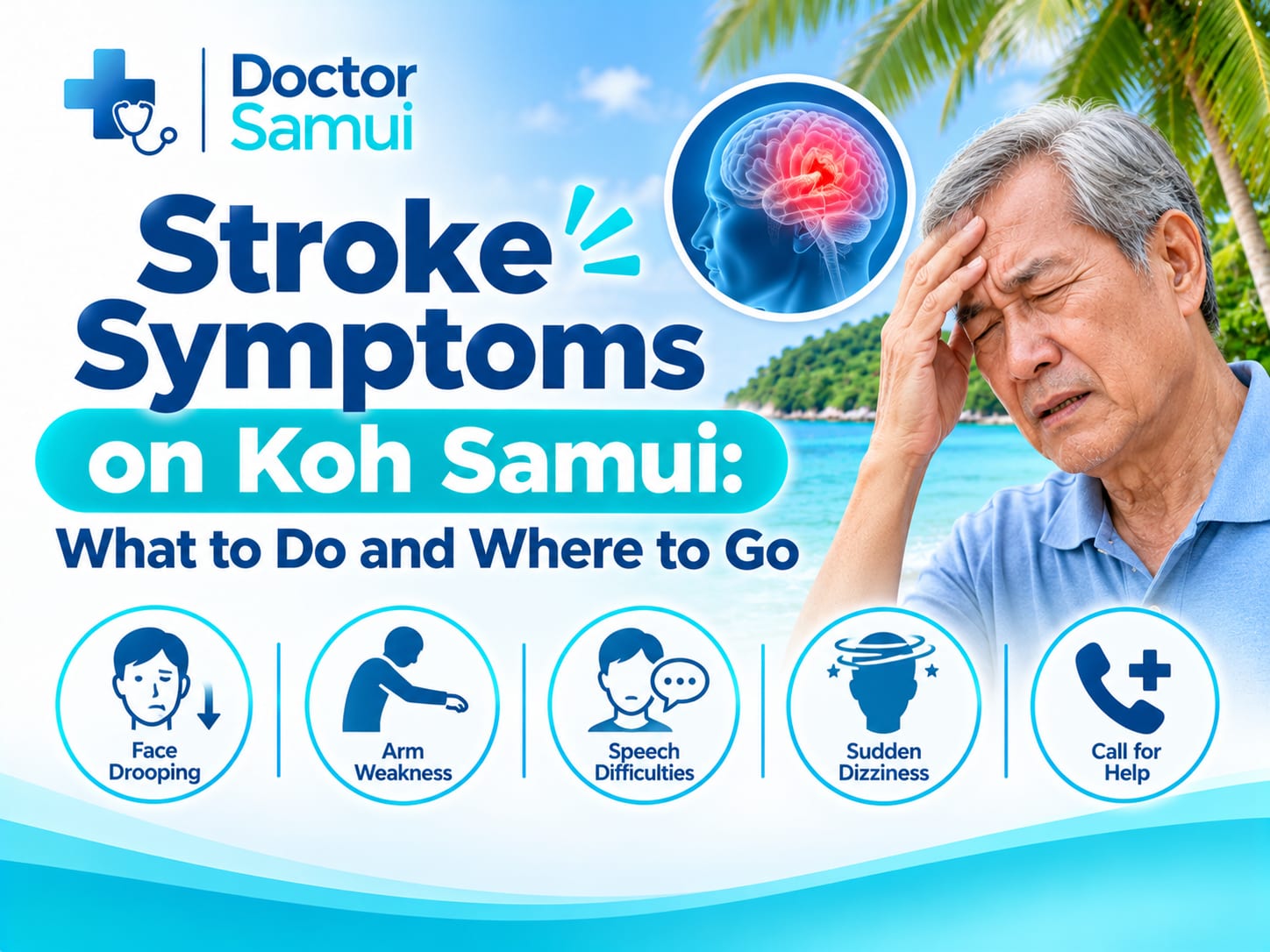
If someone near you shows sudden face drooping, arm weakness, or slurred speech, call 1669 immediately. Do not drive to the hospital yourself. On Koh Samui, the roads between Chaweng, Lamai, and the main hospital can add critical minutes to treatment time. Every minute without treatment damages more brain tissue, so the ambulance call comes first.
You are three days into a family trip. Your partner is sitting on the villa terrace after a long day at the beach. Suddenly their words come out wrong. Their mouth looks uneven. They say they feel fine, just tired. They are not fine.
Stroke symptoms on Koh Samui are easy to blame on the heat, a long swim, or too much sun. That confusion costs lives. This article tells you exactly what to look for, what to do first, who to call, and how the island’s geography affects your options.

Recognising Stroke Symptoms With BE FAST
BE FAST is the fastest way to check. Each letter stands for one warning sign.
B is for Balance. Sudden loss of coordination, difficulty walking, or sharp unexplained dizziness. After a day of snorkelling near Chaweng reef, sudden vertigo is easy to blame on water in the ears. If it comes on sharply and pairs with any other sign below, treat it as urgent.
E is for Eyes. Sudden blurred or double vision, or vision loss in one or both eyes. This is not a sunstroke squint. It comes on fast, without warning.
F is for Face. Ask the person to smile. Does one side droop or look uneven? That asymmetry is a red flag.
A is for Arms. Ask them to raise both arms. Does one drift downward or feel weak? One-sided arm weakness is a key warning sign.
S is for Speech. Ask them to repeat a simple sentence. Is the speech slurred, confused, or absent? Are they using the wrong words?
T is for Time. If any single one of those signs is present, call 1669 now. Do not wait for a second sign. Do not wait for it to pass.
One sign that trips people up on Samui is the difference between heat illness and brain stroke. Heat illness, caused by overheating in Samui’s tropical temperatures, can cause confusion and collapse. It does not cause sudden one-sided weakness, face drooping, or speech loss. If the person is hot and confused but without those one-sided signs, heat illness is more likely. If you see face drooping or arm weakness, treat it as a brain stroke until a doctor says otherwise. Both are emergencies.
Why Minutes Matter on an Island
Stroke treatment has a strict time limit. For the most common type, caused by a blood clot blocking a vessel in the brain, a clot-dissolving drug called tPA can be given within a defined window from when symptoms first start. Miss that window and that treatment option is gone.
On Koh Samui, the roads matter more than most people realise. Depending on where you are staying, the drive from a villa in Maenam, a resort in Lamai, or a beach club near Bophut to Bangkok Hospital Samui can take 20 to 40 minutes in normal traffic. Longer during peak hours or Songkran. That travel time comes directly out of the treatment window.
Do not drive the person yourself. You do not know the fastest route, you are not equipped to manage a deteriorating patient in a car, and parking delays at the hospital add more time. Call 1669, describe the symptoms clearly, give your exact address, and let trained paramedics handle the transfer.
Who to Call for a Stroke Emergency on Koh Samui
Call 1669 first. That is Thailand’s national ambulance number and it works from any phone on the island. Tell the dispatcher the symptoms you observed, the person’s age, and your exact location including the villa number, resort name, or nearest landmark. Do not guess at a cross-street. Use Google Maps to find your coordinates and read them out if needed.
If you are staying in a resort or hotel, call reception at the same time. They know the address better than you do and can guide the ambulance directly to your room.
Doctor Samui’s 24-hour hotel and villa visit service covers the whole island, from Chaweng to Angthong. When someone is showing stroke symptoms at a remote villa and the ambulance is on its way, having a doctor present to monitor the airway, check vital signs, and communicate with the hospital in English makes a real difference. This is especially true when the patient or family does not speak Thai. For 24-hour support while emergency services are en route, contact Doctor Samui via the emergency care page.
Hospitals With Stroke Care on Koh Samui
Bangkok Hospital Samui is the main private hospital on the island with neurological services. It sits near the airport in Bophut, north of Chaweng. For acute stroke, this is where you need to go.
Samui International Hospital in Chaweng provides emergency care and stabilisation. For a confirmed or strongly suspected stroke, transfer to a facility with CT scanning and neurological specialist cover is the priority.
If you are further south, in Lamai, Hua Thanon, or Taling Ngam, the drive to Bangkok Hospital Samui is longer. This is exactly why calling the ambulance rather than driving yourself matters: paramedics can alert the hospital in advance so the team is ready when you arrive.
Medical facilities on the island can stabilise stroke patients and perform initial imaging, but for advanced procedures such as mechanical thrombectomy, transfer to the mainland may be required. Call your travel insurance provider as soon as the patient is stable. Doctor Samui can assist with communication and documentation if you need support navigating that process. For visitors who have cashless travel cover, the travel insurance clinic service can help coordinate directly with insurers.
What Not to Do While Waiting for Help
Do not give the person food, water, or any medication. Swallowing is often affected during a stroke, and anything by mouth can enter the airway.
Do not let them sleep it off. Stroke symptoms that seem to ease are not improving. This matters especially when symptoms appear on a boat or at a dive site and the person insists they are just dehydrated.
Do not drive to the hospital unless there is absolutely no other option. Keep the person calm, lay them on their side if they are not fully conscious, and stay on the phone with the emergency dispatcher until help arrives. Do not leave them alone.
Mini-Strokes and What to Do After on Samui
A TIA, or transient ischaemic attack, is what most people call a mini-stroke. The symptoms are identical to a full stroke. The difference is that they resolve, usually within minutes to an hour, with no lasting deficit.
That resolution is not a reason to relax. A TIA is a warning that a full stroke may follow, and the risk is highest in the days immediately after. Anyone whose symptoms resolved completely still needs hospital evaluation the same day. Do not wait until you are back home.
If your flight is in two days, the question of whether it is safe to fly needs a medical answer. That answer requires an in-person assessment, blood pressure monitoring, and sometimes imaging. It is not a decision to make on your own. A fit-to-fly certificate from Doctor Samui covers exactly this kind of post-event review, and the team can advise whether flying is clinically appropriate before you board.
Stroke risk factors that are elevated on a Samui holiday include dehydration from heat and outdoor activity, alcohol, and exertion during diving or water sports. If you or a travelling companion have known cardiovascular risk factors, high blood pressure, or a history of TIA, that context matters during any post-episode assessment. For baseline monitoring before concerns become a problem, a health check-up at the Chaweng clinic can flag underlying issues early.
If someone is showing stroke symptoms right now, call 1669 immediately. For 24-hour medical support at your hotel or villa anywhere on Koh Samui, Doctor Samui can send a doctor to your location while emergency services are in transit. We cover Chaweng, Lamai, Maenam, Bophut, Choeng Mon, Bang Rak, Nathon, Taling Ngam, Angthong, and everywhere in between. For post-TIA assessment, fit-to-fly review, or any follow-up care after a stroke emergency, contact Doctor Samui. Walk-in clinic in Chaweng, available 24 hours.
FAQ
Dr. Ponlawat Pitsuwan
Physician, Doctor Samui
a walk-in clinic based in Chaweng, Koh Samui, with 24-hour hotel and villa visits across the island. He sees tourists, families, and long-stay expats for emergency triage, neurological concerns, post-event follow-up, and fit-to-fly assessments. His focus is straightforward, evidence-based care delivered in plain language.
References
- American Stroke Association. Stroke Symptoms. stroke.org, 2024.
- AHA/ASA. Top Things to Know: 2026 Guideline for the Early Management of Patients With Acute Ischemic Stroke. American Heart Association, 2026.
- Johnston SC, Gress DR, Browner WS, Sidney S. Short-term prognosis after emergency department diagnosis of TIA. JAMA. 2000;284(22):2901-2906.
- Rothwell PM, Giles MF, Chandratheva A, et al. Effect of urgent treatment of transient ischaemic attack and minor stroke on early recurrent stroke (EXPRESS study). Lancet. 2007;370(9596):1432-1442.
- National Institute of Neurological Disorders and Stroke. Stroke: Hope Through Research. NINDS, NIH.
The information in this article is for educational purposes only and does not constitute medical advice. It should not be used to self-diagnose or replace a consultation with a qualified physician. If you have concerns about your health, contact a licensed medical professional. For appointments at Doctor Samui, visit doctorsamui.com.