Clinically reviewed by Dr. Ponlawat Pitsuwan, Physician, Doctor Samui.
Last reviewed: October 2026
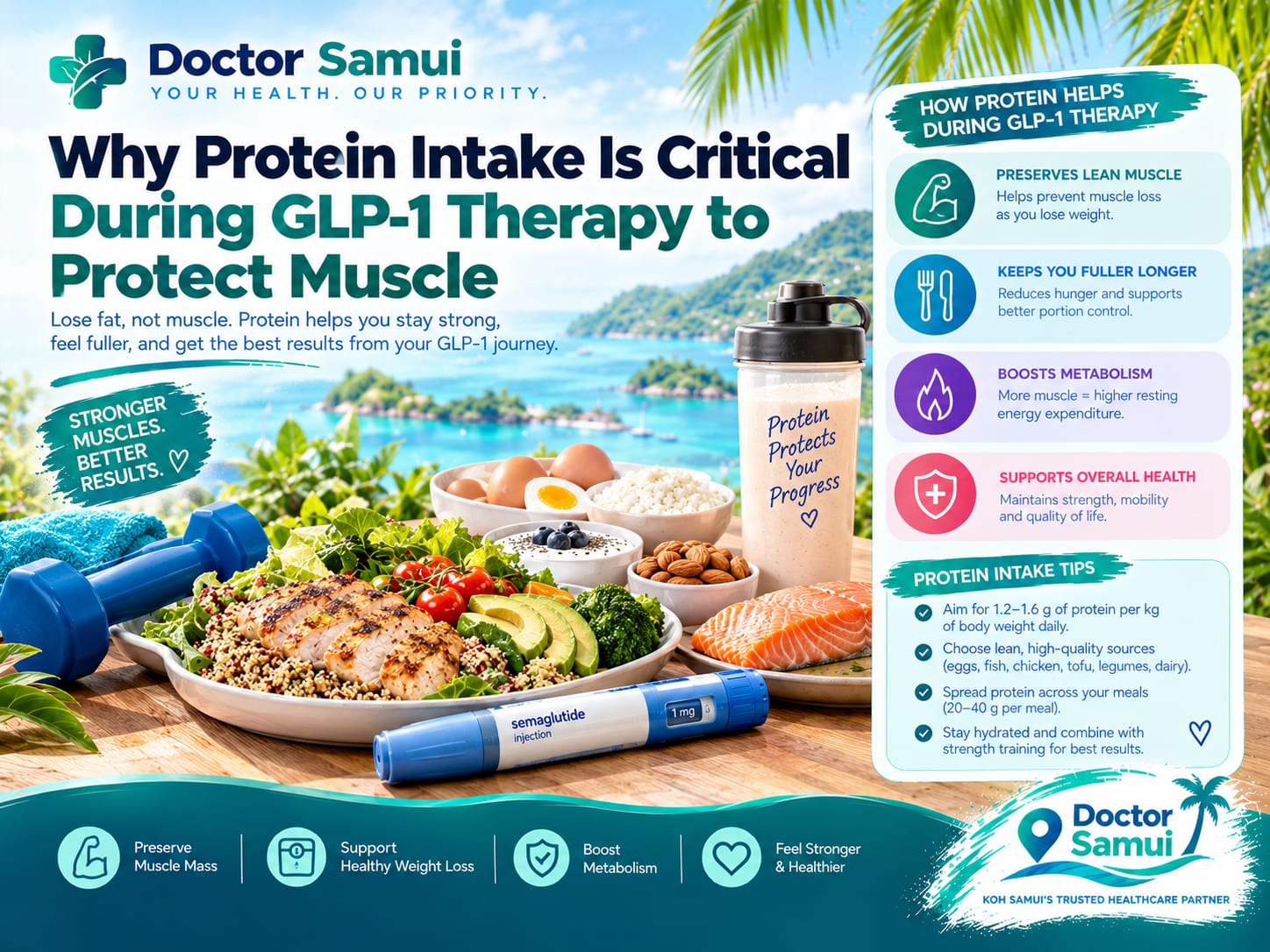
GLP-1 receptor agonists like semaglutide and tirzepatide suppress appetite sharply, and when total food intake drops, muscle is often lost alongside fat. Clinical evidence supports a protein intake of roughly 1.2 to 2.0 g per kg of adjusted body weight daily to protect lean mass during GLP-1 therapy. Spreading that protein across three or more meals matters as much as hitting the daily total. If you are on GLP-1 medication and not actively managing protein intake, you may be losing more muscle than you realise.
You have been on semaglutide for two months, the scale is moving, and your clothes fit better. But somewhere between the beach at Chaweng and the walk back up to your villa, you notice your legs feel weaker than they should. You tire faster. Your arms look thinner. That is not just fat leaving. That is muscle.
GLP-1 receptor agonists work by making you feel full on very little food. That is their effect, and it is also their risk. When total calories drop sharply, the body does not burn fat and spare muscle cleanly. It takes both, especially when protein intake falls short. Managing protein intake during GLP-1 therapy is the most important nutrition decision you can make on this medication. GLP-1 therapy is not suitable for everyone. People with a personal or family history of medullary thyroid carcinoma, multiple endocrine neoplasia syndrome type 2, or a history of pancreatitis should not use these medications. If you develop severe abdominal pain, persistent vomiting, or signs of an allergic reaction, seek medical attention promptly.

Why GLP-1 Users Lose More Muscle Than Other Dieters
Most people losing weight through calorie restriction lose some lean mass. People on GLP-1 therapy face a steeper risk, and the reason is appetite suppression itself. When you are genuinely not hungry, you eat less of everything, including protein. That drop in total intake can leave you well below what your muscles need to stay intact.
The risk is higher with age. Adults over 50 already need more protein per meal to trigger the same muscle-maintenance signal that younger people get from less. Women are also more vulnerable, particularly after menopause. If you are on GLP-1 medication and fall into either group, the risk of losing lean mass is real and worth taking seriously.
Muscle loss during weight loss matters beyond appearance. Muscle supports your metabolism, protects your joints, and keeps you physically capable. Weight lost as muscle is far harder to rebuild than weight lost as fat.
How Much Protein Do You Actually Need on GLP-1 Therapy
The standard dietary reference intake for protein is 0.8 g per kg of body weight per day. That figure was set to prevent deficiency in sedentary adults, not to preserve muscle during a significant caloric deficit. For protein intake on GLP-1 therapy, it is not enough.
Current clinical guidance supports a target of 1.2 to 2.0 g per kg of adjusted body weight daily for people on hypocaloric diets. Adjusted body weight matters here. If you are significantly overweight, basing your calculation on actual weight overestimates your needs. Using goal weight alone underestimates them. Adjusted body weight sits roughly midway between your ideal weight and your current weight. A physician can calculate this in a few minutes.
As a rough guide, a person with an adjusted body weight of 70 kg would aim for roughly 84 to 140 g of protein per day. That is a wide range deliberately. Age, activity level, and rate of weight loss all shift where within that range you should land.

Spreading Protein Across Meals Is Just as Important as the Daily Total
Most people focus only on hitting a daily protein number. That is a start, but it misses something clinically important.
Keeping muscle intact requires a signal triggered by leucine, an amino acid found in animal proteins, legumes, and soy. Each meal needs to provide roughly 25 to 40 g of protein to reliably trigger that signal. Spreading your intake across three or more meals does more for muscle preservation than eating the same total in one or two large sittings.
This is a direct problem for GLP-1 users who skip breakfast or eat only one main meal a day. If your protein per meal is too low, your muscles may not be getting the signal they need to stay, even if your daily total looks reasonable on paper. Consistent distribution matters as much as the number itself.
Other Nutritional Gaps to Watch on GLP-1 Therapy
Protein gets the most attention, but clinical evidence shows GLP-1 users commonly fall short on several other nutrients. Calcium, vitamin D, iron, and B12 are the most frequent gaps.
Vitamin D and calcium work together to maintain bone density, which is already under pressure during rapid weight loss. Iron deficiency causes fatigue that is easily mistaken for tiredness from eating less. B12 deficiency, which can also occur with metformin use, affects energy and nerve function. A standard blood panel checks all of these in one visit.
If you have been on GLP-1 therapy for more than a few months without a micronutrient check, that is worth doing. Doctor Samui offers same-day blood panels at the Chaweng clinic, and testing can be arranged through a house call if you are staying in Lamai, Maenam, or elsewhere on the island.
High-Protein Foods You Can Find on Koh Samui
Being on GLP-1 therapy while travelling on Samui does not mean you are stuck. The island has excellent protein sources at almost every beach restaurant and market.
Grilled fish, prawns, squid, and crab are on menus from Chaweng to Lamai to Bophut, naturally high in protein and low in saturated fat. Eggs are cheap and available everywhere. Gai yang, the grilled chicken dish found at roadside stalls all over the island, is one of the best-value protein options you will find. Tofu appears in many Thai dishes and is a reliable plant-based option. Fresh tuna steaks are widely available at seafood restaurants in Chaweng and Bophut.
Protein supplements are sold at gyms and health shops in Chaweng. On very low-appetite days, a whey or plant protein shake mixed with water is an easier way to hit your targets than forcing a full meal. The practical rule is to eat protein first at every meal, before rice, noodles, or anything else on the plate.
Managing Your Protein Intake on GLP-1 Therapy in Koh Samui
Being on GLP-1 therapy while travelling or living abroad brings one specific challenge: you may not have easy access to the GP or specialist who started you on the medication. Nutrition management does not pause because you are away from home.
The GLP-1 therapy service at Doctor Samui covers more than prescribing. A physician review can assess whether your current protein intake is adequate, calculate your adjusted body weight target, and check your blood work for micronutrient gaps. If you want to understand how much protein on GLP-1 therapy is right for your specific situation, that is exactly the kind of question a clinic visit is designed to answer.
A doctor can also come to you. If you are staying in a villa in Choeng Mon, Maenam, or further afield, a mobile doctor visit can bring the review to your door. A health check-up at the clinic is another straightforward option if you want a full picture before continuing your medication.
If you are on semaglutide, tirzepatide, or another GLP-1 receptor agonist and want to make sure you are protecting your muscle mass, Doctor Samui can help. We offer physician-supervised GLP-1 therapy at our Chaweng walk-in clinic, with same-day blood panels to check protein status and micronutrient levels. Our doctors are available 24 hours a day for hotel and villa visits across Koh Samui, including Lamai, Bophut, Maenam, Choeng Mon, and Chaweng. Contact us to book a review or arrange a house call.
FAQ
Dr. Ponlawat Pitsuwan
Physician, Doctor Samui
a walk-in clinic based in Chaweng, Koh Samui, with 24/7 hotel and villa visits across the island. He sees tourists, families, and long-stay expats for GLP-1 therapy, weight management support, nutritional assessment, and general medical care. His focus is straightforward, evidence-based care delivered in plain language.
References
- Wilding JPH, et al. Once-Weekly Semaglutide in Adults with Overweight or Obesity. New England Journal of Medicine. 2021;384(11):989-1002.
- Jastreboff AM, et al. Tirzepatide Once Weekly for the Treatment of Obesity. New England Journal of Medicine. 2022;387(3):205-216.
- Johnson EC, et al. Nutrient Intake in Adults Using GLP-1 Receptor Agonists: A Cross-Sectional Study. Frontiers in Nutrition. 2025; doi:10.3389/fnut.2025.1566498.
- Sibal AK, et al. Nutritional Deficiencies Associated with GLP-1 Receptor Agonist Use: A Systematic Review. Nutrients. 2025;17(3659).
- Phillips SM, Van Loon LJC. Dietary protein for athletes: From requirements to optimum adaptation. Journal of Sports Sciences. 2011;29(S1):S29-38.
The information in this article is for educational purposes only and does not constitute medical advice. It should not be used to self-diagnose or replace a consultation with a qualified physician. If you have concerns about your health, contact a licensed medical professional. For appointments at Doctor Samui, visit doctorsamui.com.