Clinically reviewed by Dr. Ponlawat Pitsuwan, Physician, Doctor Samui.
Last reviewed: October 2026
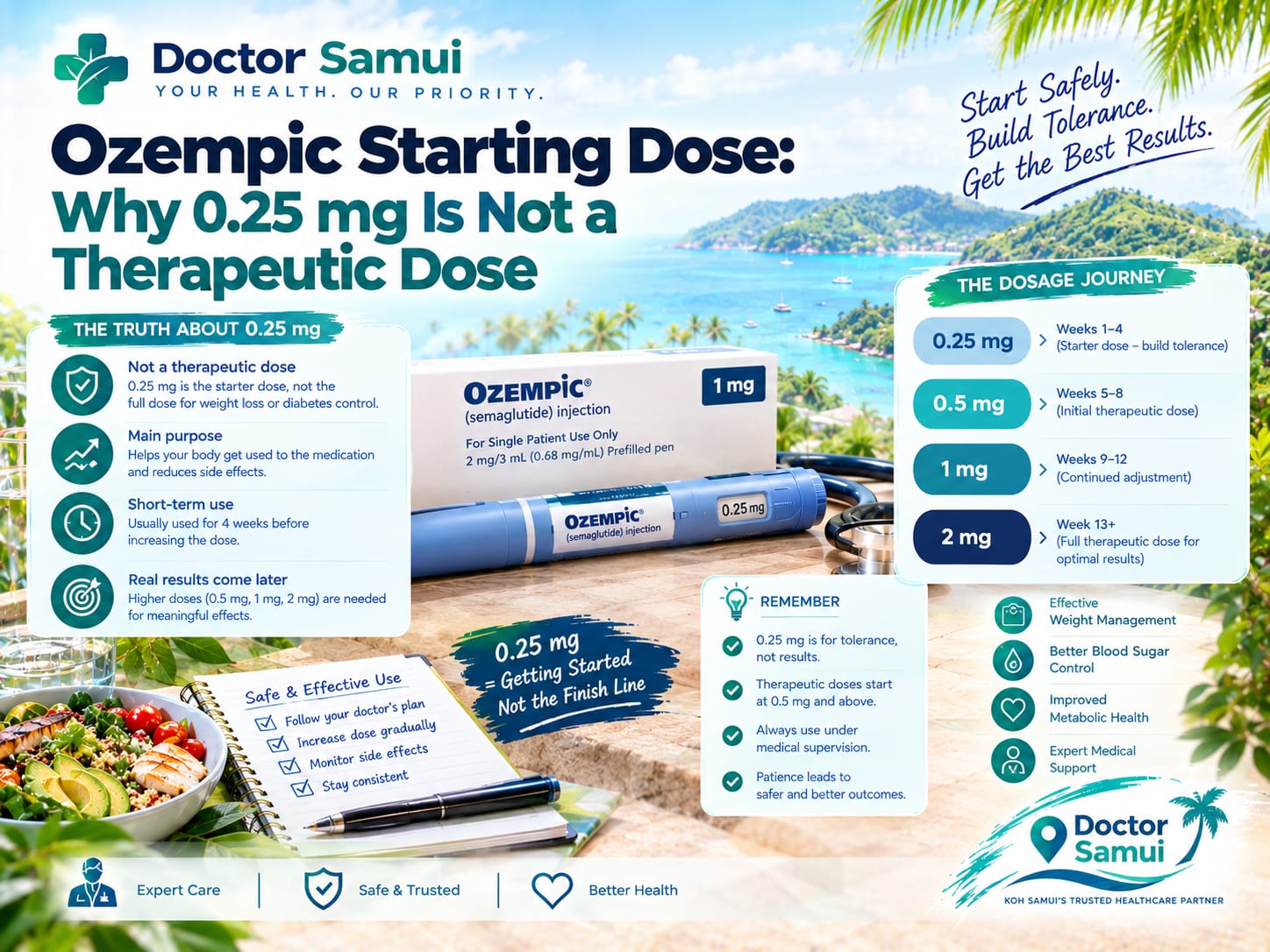
The 0.25 mg Ozempic starting dose is not designed to lower blood sugar or cause weight loss. It is a four-week acclimation phase that lets your body adjust to semaglutide before the dose increases to 0.5 mg, where therapeutic effects begin. Expecting results at 0.25 mg leads some people to give up on Ozempic before reaching a dose that works.
You have been injecting on schedule for a month. You felt a little off after each dose, your appetite shifted slightly, and the scale has not moved. You are sitting on your villa balcony in Chaweng wondering if this medication is actually doing anything.
It is. Just not what you think yet.
The 0.25 mg starting dose is not a treatment dose. The Novo Nordisk prescribing information states this clearly: 0.25 mg is intended to improve tolerability, not to achieve glycemic control or weight reduction. Everything happening in those first four weeks is preparation. Once you understand that, the frustration makes sense, and what comes next becomes much clearer.

What the Ozempic Starting Dose Actually Does
Semaglutide, the active ingredient in Ozempic, is a GLP-1 receptor agonist. It mimics a hormone your gut releases after eating, slowing digestion and signalling to your brain that you are full. At therapeutic doses, it meaningfully changes how much you eat and how your body handles blood sugar.
At 0.25 mg, the dose sits below the threshold where those effects are clinically significant. Your body is simply getting used to the drug. The goal is to avoid the nausea, vomiting, and stomach upset that would otherwise push most people to stop before they ever reach a dose that works.
Think of it as a controlled introduction. Skipping it to get results faster almost always backfires.
Why 0.25 mg Is Not a Therapeutic Ozempic Starting Dose
Semaglutide has a half-life of approximately seven days. That means it takes roughly four to five weeks of weekly injections before levels stabilise in your blood, a point called steady state. Until you reach steady state at a given dose, you cannot fully assess how that dose is affecting you.
At 0.25 mg, steady state produces drug levels that are intentionally low. They are low enough to be tolerated but too low to drive the appetite suppression and blood sugar effects the medication is prescribed for.
This is not an arbitrary choice by the manufacturer. Starting at a therapeutic dose immediately results in a much higher rate of people stopping treatment due to severe nausea. The four-week acclimation period exists because the clinical data supported it.

The Titration Ladder: From 0.25 mg to 2 mg
The standard Ozempic titration schedule, per the prescribing information, works like this. You start at 0.25 mg once weekly for four weeks. You then move to 0.5 mg once weekly, which is the first therapeutic dose. If you tolerate 0.5 mg well after at least four weeks, your doctor may increase to 1 mg. If further glycemic control is needed, the dose can be raised to 2 mg.
One point worth clarifying: the maximum approved dose of Ozempic is 2 mg. The 2.4 mg figure applies to Wegovy, a different brand of semaglutide approved specifically for weight management. Ozempic and Wegovy are not the same product, and their approved dose ranges differ. Mixing them up is a common error in what you will find online.
For people using Ozempic off-label for weight loss rather than type 2 diabetes, a doctor still follows the same titration steps. The difference is in the prescribing indication, not the dose ladder.
When Will You Actually Start Losing Weight on Ozempic?
Not at 0.25 mg. That is the honest answer. Appetite suppression becomes noticeable for most people at 0.5 mg or higher, once semaglutide levels reach a genuinely therapeutic range.
A weight loss plateau at the starting dose is not a sign the medication is not working. It is a sign you are not at a therapeutic dose yet. For a fuller breakdown of what to expect as doses increase, the Doctor Samui GLP-1 programme page covers this in detail.
Patience at this stage matters clinically, not just psychologically. Rushing to a higher dose before your body tolerates the current one increases the risk of side effects severe enough to make you stop altogether.
Side Effects at the Starting Dose: What Is Normal and What Is Not
Some nausea, mild loose stools, reduced appetite, and a general sense of queasiness after injecting are expected at 0.25 mg. These are signs the medication is active, and they usually ease as your body adjusts over the four weeks.
What is not normal: persistent vomiting that prevents you from keeping fluids down, severe upper abdominal pain that radiates to your back, or symptoms of low blood sugar if you are taking other diabetes medications alongside semaglutide. Severe abdominal pain radiating to the back can be a sign of pancreatitis and needs urgent assessment. Ozempic should not be used by people with a personal or family history of medullary thyroid carcinoma or multiple endocrine neoplasia syndrome type 2, and it is not recommended during pregnancy.
If you develop any of those warning signs, do not wait for your next scheduled check-in. Doctor Samui’s Chaweng clinic handles these assessments directly, and 24-hour hotel and villa visits are available across Koh Samui.
Staying on 0.25 mg Longer Than Four Weeks
If side effects at the starting dose are significant, you do not have to move to 0.5 mg at exactly four weeks. The prescribing information sets four weeks as the minimum before increasing, not a firm deadline. A doctor can advise you to stay on 0.25 mg for additional weeks if tolerability is poor.
This decision should involve a clinician, not just your own judgment. Moving up too early when you are still struggling with the starting dose often leads to dropout. Staying on 0.25 mg longer, when guided by a doctor, is the safer path to reaching the doses where results actually happen.
Getting Ozempic Safely in Koh Samui
Semaglutide is prescription-only in Thailand. You cannot legally obtain it over the counter, and sourcing it without a valid prescription from a licensed Thai doctor carries real risk. Counterfeit semaglutide products have been documented globally, including in the UK, US, Brazil, and the EU, following a WHO alert in 2024, and they present both safety and efficacy concerns.
If you are a long-stay expat or spending extended time on Koh Samui and want to start or continue a GLP-1 programme, the right path is through a licensed clinic. Doctor Samui’s GLP-1 programme includes an initial consultation, appropriate prescribing, and structured follow-up so your titration is supervised and your dose changes happen at the right time.
Do not source semaglutide from unverified online pharmacies or local sellers who do not require a prescription. The risk of receiving an underdosed, misdosed, or contaminated product is real and documented.
Starting or continuing Ozempic on Koh Samui? Doctor Samui offers supervised GLP-1 consultations at the Chaweng clinic and through 24-hour hotel and villa visits across the island. Walk in or contact us to arrange an assessment.
Frequently Asked Questions
Dr. Ponlawat Pitsuwan
Physician, Doctor Samui
a walk-in clinic based in Chaweng, Koh Samui, with 24-hour hotel and villa visits across the island. He sees tourists, families, and long-stay expats for GLP-1 consultations, weight management assessments, and ongoing semaglutide supervision. His focus is straightforward, evidence-based care delivered in plain language.
References
- Novo Nordisk. Ozempic (semaglutide) Summary of Product Characteristics. European Medicines Agency, 2024.
- Marso SP, et al. Semaglutide and Cardiovascular Outcomes in Patients with Type 2 Diabetes. New England Journal of Medicine. 2016;375(19):1834-1844.
- Davies M, et al. Semaglutide 2.4 mg once a week in adults with overweight or obesity, and type 2 diabetes (STEP 2): a randomised, double-blind, placebo-controlled, phase 3 trial. The Lancet. 2021;397(10278):971-984.
- Overgaard RV, et al. Pharmacokinetics of Semaglutide. Clinical Pharmacokinetics. 2021;60(3):335-348. (Reviews half-life of ~7 days and steady state at 4–5 weeks for subcutaneous semaglutide.)
- World Health Organization. Substandard and falsified medical products. WHO Fact Sheet, 2023.
The information in this article is for educational purposes only and does not constitute medical advice. It should not be used to self-diagnose or replace a consultation with a qualified physician. If you have concerns about your health, contact a licensed medical professional. For appointments at Doctor Samui, visit doctorsamui.com.