Clinically reviewed by Dr. Ponlawat Pitsuwan, Physician, Doctor Samui.
Last reviewed: October 2026
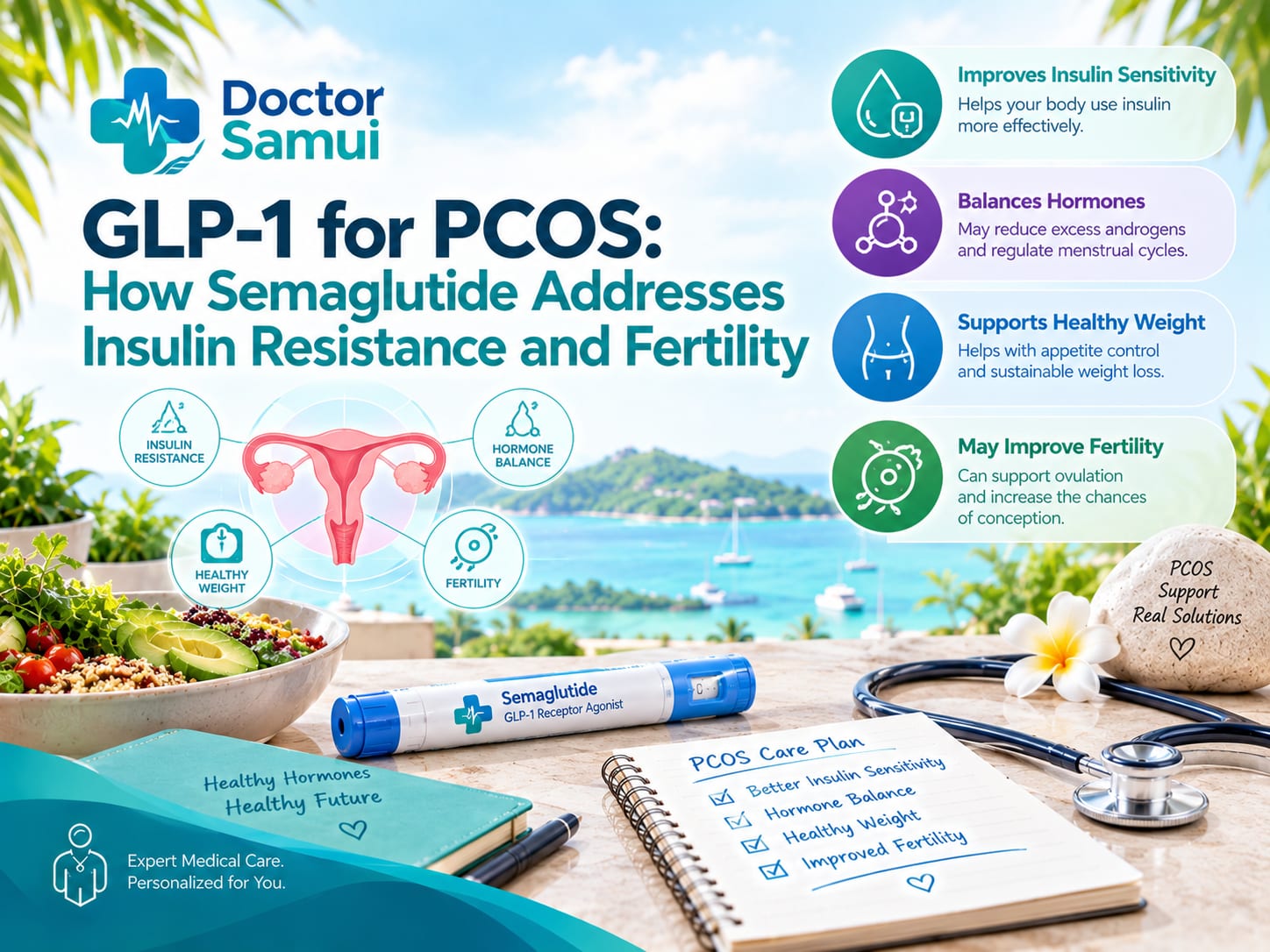
GLP-1 receptor agonists like semaglutide work directly on the insulin resistance that drives polycystic ovary syndrome. For women with PCOS who have not responded well to diet or metformin alone, semaglutide can produce meaningful weight loss and hormonal improvements. It is prescribed off-label for PCOS and requires a physician assessment before starting. A 2025 real-world cohort found median weight loss of 11.5% at one year in women with PCOS on GLP-1 therapy, compared to 1.9% for metformin.
You have been eating carefully, exercising in the Samui heat, doing everything right, and watching your weight barely shift. That is not a willpower problem. PCOS changes the metabolic rules in a specific way: the same hormonal pattern that makes your periods unpredictable also makes your body hold onto weight far more stubbornly than someone without the condition. It comes down to insulin resistance.
GLP-1 receptor agonists, particularly semaglutide, target that mechanism directly. They are not a PCOS cure and do not work the same for every woman. But the evidence is clearer now than it was three years ago. For the right patient, the benefits go beyond weight. Periods become more regular. Androgen levels drop. Fertility improves. If you are living on Koh Samui as an expat, or spending time here and wondering whether you can access this treatment, you can, and you do not need to fly home to start.

Why PCOS Makes GLP-1 Weight Loss So Relevant
PCOS is not simply a hormone problem or simply a metabolic one. It is both at once, and they feed each other.
When your cells resist insulin, your pancreas produces more to compensate. High circulating insulin then signals your ovaries to produce more androgens, the hormone group that includes testosterone. Those elevated androgens disrupt ovulation and push fat storage toward the abdomen. Fat stored deep around the organs, rather than under the skin, is particularly resistant to diet-only approaches.
Appetite signals are disrupted too. Women with PCOS often feel less full after eating than someone without insulin resistance. Caloric restriction alone runs into a hormonal wall, not just a motivational one. That is why standard advice falls short so often.
How GLP-1 Receptor Agonists Work in PCOS
GLP-1, glucagon-like peptide-1, is a hormone your gut releases when you eat. It tells your pancreas to release insulin, suppresses glucagon to prevent unnecessary glucose release, and signals your brain that you are full. In PCOS, this system is partially disrupted.
GLP-1 receptor agonists mimic and amplify that effect. Semaglutide slows stomach emptying, reduces appetite, and improves how well your cells respond to insulin. That last part matters most for PCOS. When insulin sensitivity improves, your ovaries do not receive the same constant androgen-producing signal. The whole hormonal pattern starts to shift.
This is not blunt appetite suppression. It is targeted correction of a specific dysfunction at the root of the condition. You can read more about how this works on the GLP-1 service page at Doctor Samui.

What the Clinical Evidence Shows
The evidence is still building, but what exists is encouraging. A 2025 real-world cohort study by Epic Research followed women with PCOS on GLP-1 receptor agonists for one year. Median weight loss was 11.5%, compared to 1.9% for women on metformin alone. That is a meaningful difference.
A 2024 scoping review in Cureus examined GLP-1 use in PCOS across multiple agents including liraglutide, exenatide, and semaglutide. It found consistent improvements in body weight, fasting insulin, and HOMA-IR, a standard measure of insulin resistance. A small open-label randomised trial comparing semaglutide plus metformin to metformin alone showed improvements in menstrual regularity and fasting insulin that favoured the combination, though findings from a single small trial should be interpreted with caution.
Most studies in this area are small or retrospective. Large phase-three trials designed specifically for PCOS have not yet been completed. That is worth knowing. But the biological rationale is solid, and the direction across studies is consistent.
Hormonal and Menstrual Benefits Beyond Weight
Weight loss by itself improves PCOS. Even modest reductions can restore ovulation and lower androgen levels. GLP-1 medications appear to offer hormonal benefits beyond what the weight loss alone would predict, though this needs more research to confirm fully.
The semaglutide-plus-metformin trial noted above showed improved menstrual regularity in participants. Testosterone reduction has been documented in liraglutide trials. Ovulatory function improves in some women as insulin resistance falls.
For women who have been told PCOS is making it harder to conceive, these are not small findings. If fertility is your goal, however, the picture requires a careful conversation. GLP-1 medications are not approved for use during pregnancy, and the current recommendation is to stop treatment before attempting conception. The weight loss and hormonal improvements you achieve on treatment can improve ovulatory function and IVF outcomes before you make that switch.
Which GLP-1 Medications Are Used for PCOS
Semaglutide is the most studied option for PCOS and the one most commonly prescribed in this context. It is available as a weekly subcutaneous injection or as a daily oral tablet, though injectable semaglutide has more trial data behind it.
Liraglutide, a daily injection, has been used in PCOS research for longer and has its own evidence base showing weight and hormonal benefits. Tirzepatide, which targets both GLP-1 and GIP receptors, is producing strong results in general obesity trials, and early interest in its use for PCOS is growing. Head-to-head evidence comparing these agents specifically in PCOS is limited, so choosing between them depends on individual clinical factors.
All of these are prescribed off-label for PCOS. None currently holds regulatory approval specifically for this condition. Physician assessment and ongoing monitoring are not optional extras. They are part of how this treatment works safely.
Side Effects, Safety, and Who Should Not Use GLP-1 for PCOS
The most common side effects are gastrointestinal: nausea, vomiting, diarrhoea, and constipation. These are most likely during dose escalation and usually ease as your body adjusts. Starting at a low dose and titrating slowly reduces them significantly.
More serious events are less common but real. GLP-1 medications should not be used by anyone with a personal or family history of medullary thyroid carcinoma or multiple endocrine neoplasia syndrome type 2. They require caution in patients with a history of pancreatitis or gallbladder disease.
Women who are pregnant should not use GLP-1 medications. If you become pregnant while taking semaglutide, stop immediately and speak to a doctor. For women breastfeeding, the safety data is not sufficient to recommend use. Contraindication checks are exactly why a physician assessment comes first. This is a prescription medication with a specific clinical profile, not a supplement.
Starting GLP-1 Treatment for PCOS on Koh Samui
Whether you are a long-stay expat on the island or spending a few months here and cannot easily reach your home GP, you do not need to put this off. Semaglutide is available in Thailand on prescription. Doctor Samui can assess your eligibility at the Chaweng clinic or through a villa or hotel visit anywhere on the island.
The assessment covers your weight, medical history, current medications, and any contraindications. If you have existing blood results, bring them. Fasting glucose, fasting insulin, and androgen levels are all useful. If you need those tests first, we can run them as part of a health check-up at the Chaweng clinic. If you are staying in Lamai, Bophut, or further out, a house call doctor visit means you do not need to travel.
If you are an existing semaglutide patient who has run out while travelling, come in to the clinic or request a hotel visit. Bring whatever documentation you have from your prescribing doctor at home and we can discuss continuity from there.
Thinking about GLP-1 treatment for PCOS on Koh Samui? Doctor Samui offers consultations at the Chaweng clinic and 24-hour villa and hotel visits across the island. We can assess your eligibility, review your bloodwork, and discuss semaglutide as part of a practical, evidence-based plan. Walk in or book a visit wherever you are staying.
Frequently Asked Questions
Dr. Ponlawat Pitsuwan
Physician, Doctor Samui
a walk-in clinic based in Chaweng, Koh Samui, with 24-hour hotel and villa visits across the island. He sees tourists, families, and long-stay expats for hormonal health, metabolic conditions, and weight management including GLP-1 therapy assessments. His focus is straightforward, evidence-based care delivered in plain language.
References
- Epic Research. GLP-1s Lead to Greater Weight Loss and A1C Improvement Than Metformin in Patients with PCOS. Epic Research, 2025.
- Jensterle M, et al. Efficacy of GLP-1 RA Approved for Obesity Management in Patients with Polycystic Ovary Syndrome: A Systematic Review. Journal of Clinical Medicine. 2023;12(8):2961.
- Frangie Machado A, et al. Clinical Effects of Glucagon-Like Peptide-1 Agonist Use for Weight Loss in Women with Polycystic Ovary Syndrome: A Scoping Review. Cureus. 2024;16(8):e66691.
- Han Y, Li Y, He B. GLP-1 receptor agonists versus metformin in PCOS: a systematic review and meta-analysis. Reproductive BioMedicine Online. 2019;39(2):332-342.
- Cena H, et al. Obesity, Polycystic Ovary Syndrome, and Metabolic Syndrome. Frontiers in Endocrinology. 2020;11:178.
The information in this article is for educational purposes only and does not constitute medical advice. It should not be used to self-diagnose or replace a consultation with a qualified physician. If you have concerns about your health, contact a licensed medical professional. For appointments at Doctor Samui, visit doctorsamui.com.