Clinically reviewed by Dr. Ponlawat Pitsuwan, Physician, Doctor Samui. Last reviewed: September 2026
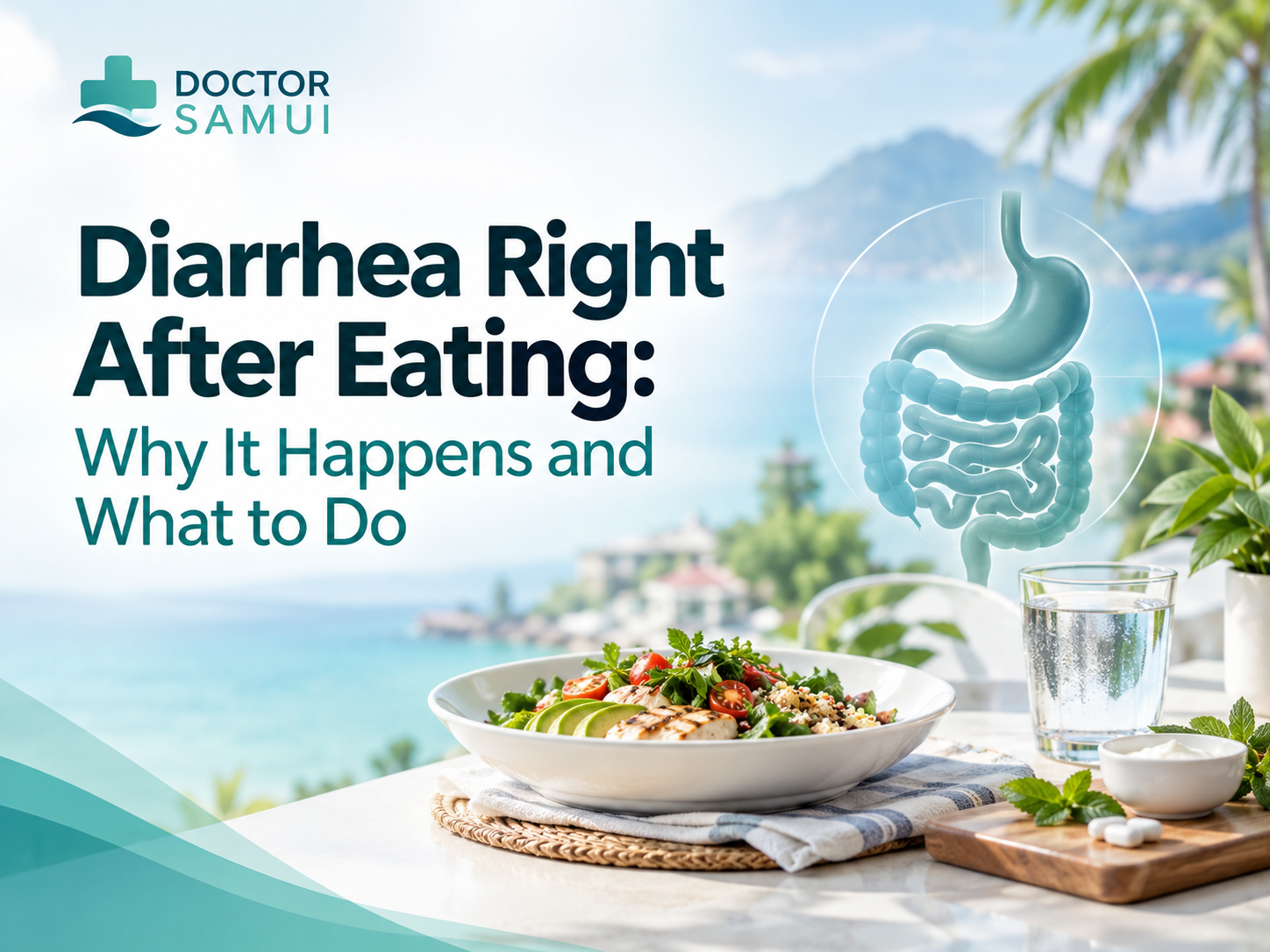
Diarrhea that starts within minutes of eating is usually your gut overreacting to food, spice, fat, or an unfamiliar bacterial load. On Koh Samui, tropical heat speeds up bacterial growth in food, and humid conditions make dehydration worse than it would be at home. Most mild cases settle within one to two days with oral rehydration. If you have fever, blood in your stool, or cannot keep fluids down, see a doctor the same day.
You finish a plate of green curry at a beachside restaurant in Chaweng, and twenty minutes later you are rushing back to your hotel room. It happens to a lot of visitors here, and it happens fast. Diarrhea right after eating has a short list of causes, most of them manageable, and knowing which one you are dealing with makes the next few hours much clearer.
What catches people off guard on Koh Samui is how quickly a mild episode can tip into something worse. Thirty-five degree heat, a full day at the beach, and two rounds of loose stools add up faster than the same thing would back home. This covers why it happens, what the timing of your symptoms tells you, when to self-treat, and when to come into our Chaweng clinic or call us to come to you.

Why You Get Diarrhea Right After Eating
Your gut has a normal reflex: when food arrives in the stomach, the colon gets a signal to move things along and make room. Most of the time you barely notice it. But when your system is stressed, inflamed, or dealing with something unfamiliar, that reflex fires harder than it should. The result is loose, urgent stools within fifteen to thirty minutes of finishing a meal.
This is called the gastrocolic reflex, and it is not always a sign of infection. Sometimes it is your gut reacting to high-fat food, spice, or simply the stress of travel. Other times it is the first sign that something you ate was contaminated.
What the Timing of Your Symptoms Tells You
Timing is the most useful clue you have before you see a doctor. Diarrhea within fifteen to thirty minutes of eating usually means your gastrocolic reflex is overactive, or you ingested a pre-formed toxin left behind in food that has been sitting out in the heat.
Diarrhea starting two to eight hours after eating points more toward a bacterial infection. Salmonella, E. coli, and Campylobacter are the common ones here. If symptoms begin closer to twenty-four hours or later, Norovirus is more likely. That timeline matters because it changes whether antibiotics are part of the answer.
Why Koh Samui Specifically Increases Your Risk
Beach wisdom gets this one wrong fairly often: people assume the food stall on the main road is the risky choice and the hotel buffet is safe. In this heat, it works the other way around just as easily. Open-air buffets in thirty-five degree heat, pre-cut fruit left on display, and coconut milk curries rich enough in fat to amplify the gastrocolic reflex all create a higher-risk food environment than most visitors expect.
Capsaicin, the compound that makes Thai chilies hot, directly stimulates the gut lining and can trigger loose stools even when the food is perfectly safe. First-time visitors to Southeast Asia often have zero tolerance for this, and the gut reaction feels exactly like the start of food poisoning. Your gut also has no existing immunity to the local bacterial strains here. Minor contamination that a local resident handles without any symptoms can put a tourist in bed for two days.
Ice is worth thinking about too. Most large restaurants and hotels on Koh Samui use commercial ice, which is fine. Smaller roadside spots are less predictable, and ice is one of the more common sources of contamination that people overlook.
Acute vs Chronic: Is This a One-Off or a Pattern?
One bad meal is not the same as three months of diarrhea after every meal. If this is your first or second day on the island and symptoms started after a specific meal, this is almost certainly acute gastroenteritis: an irritated or infected gut that needs rest and rehydration.
If you are a long-stay expat or you have been dealing with this pattern for weeks, that is a different story. Consistent post-meal diarrhea can point to IBS-D (the diarrhea-dominant form of irritable bowel syndrome), bile acid malabsorption, or bacterial overgrowth in the small intestine. These conditions do not resolve with rehydration sachets and plain rice. A stool test can rule out ongoing infection, and that is a reasonable starting point before anything else.
Red Flag Symptoms: When to Stop Self-Treating Diarrhea After Eating
Most cases on Koh Samui are unpleasant but not dangerous. These are the signs that change that.
Fever above 38.5°C alongside diarrhea suggests a bacterial infection that may need antibiotics. Blood or mucus in your stool is never something to manage at home. More than four to five episodes in a single day, especially in this heat, puts you at real risk of dehydration.
Children under five dehydrate much faster than adults. If your child has had three or more episodes, is not urinating, has dry lips, or seems unusually sleepy, that is urgent. Do not wait to see if it settles overnight. Severe abdominal cramping that does not ease between episodes also warrants same-day assessment.
What to Eat and Drink While You Recover on Koh Samui
The most important thing is fluid, and the right kind of fluid. Oral rehydration salts (ORS) are available at every 7-Eleven on the island. Start them straight away, not just plain water. Plain water alone does not replace the electrolytes you are losing.
Coconut water is a reasonable supplement between ORS sachets. It is naturally high in potassium and widely available here. For food, plain jasmine rice, banana, and plain crackers are what you want. Skip the pad see ew, the som tam, and anything coconut-milk-heavy until you have had at least twenty-four hours without symptoms. Every roadside stall and most hotel restaurants can do plain boiled rice on request.
What Doctor Samui Can Do That You Cannot Do at Your Hotel
If you are too unwell to leave your room, that is exactly when our 24/7 hotel and villa visit service matters. A doctor comes to you with a full kit, assesses you properly, and can start IV rehydration if you are unable to keep oral fluids down. IV fluids deliver electrolytes directly into your bloodstream, bypassing a stomach that is not cooperating.
At our walk-in clinic in Chaweng, we can run a stool test the same day, check for bacterial infection, and prescribe the right antibiotic if one is needed. We cover the whole island: Chaweng, Lamai, Bophut, Maenam, Choeng Mon, Bang Rak, and beyond. If you are not sure whether your situation warrants a visit, reach out first. We would rather answer a question than have someone spend a night dehydrating when they did not need to. For more detail on how we approach this, see our diarrhea treatment page.
Feeling rough after a meal on Koh Samui? Walk into Doctor Samui’s Chaweng clinic any time, or call us for a doctor to visit your hotel or villa, day or night, anywhere on the island. We offer same-day stool testing, IV rehydration, and antibiotic treatment when needed. English, German, and Hebrew speaking staff available.
FAQ
Dr. Ponlawat Pitsuwan
Physician, Doctor Samui
a walk-in clinic based in Chaweng, Koh Samui, with 24/7 hotel and villa visits across the island. He sees tourists, families, and long-stay expats for acute gastrointestinal illness, food poisoning, traveller’s diarrhea, and dehydration. His focus is straightforward, evidence-based care delivered in plain language.