Clinically reviewed by Dr. Ponlawat Pitsuwan, Physician, Doctor Samui. Last reviewed: August 2026
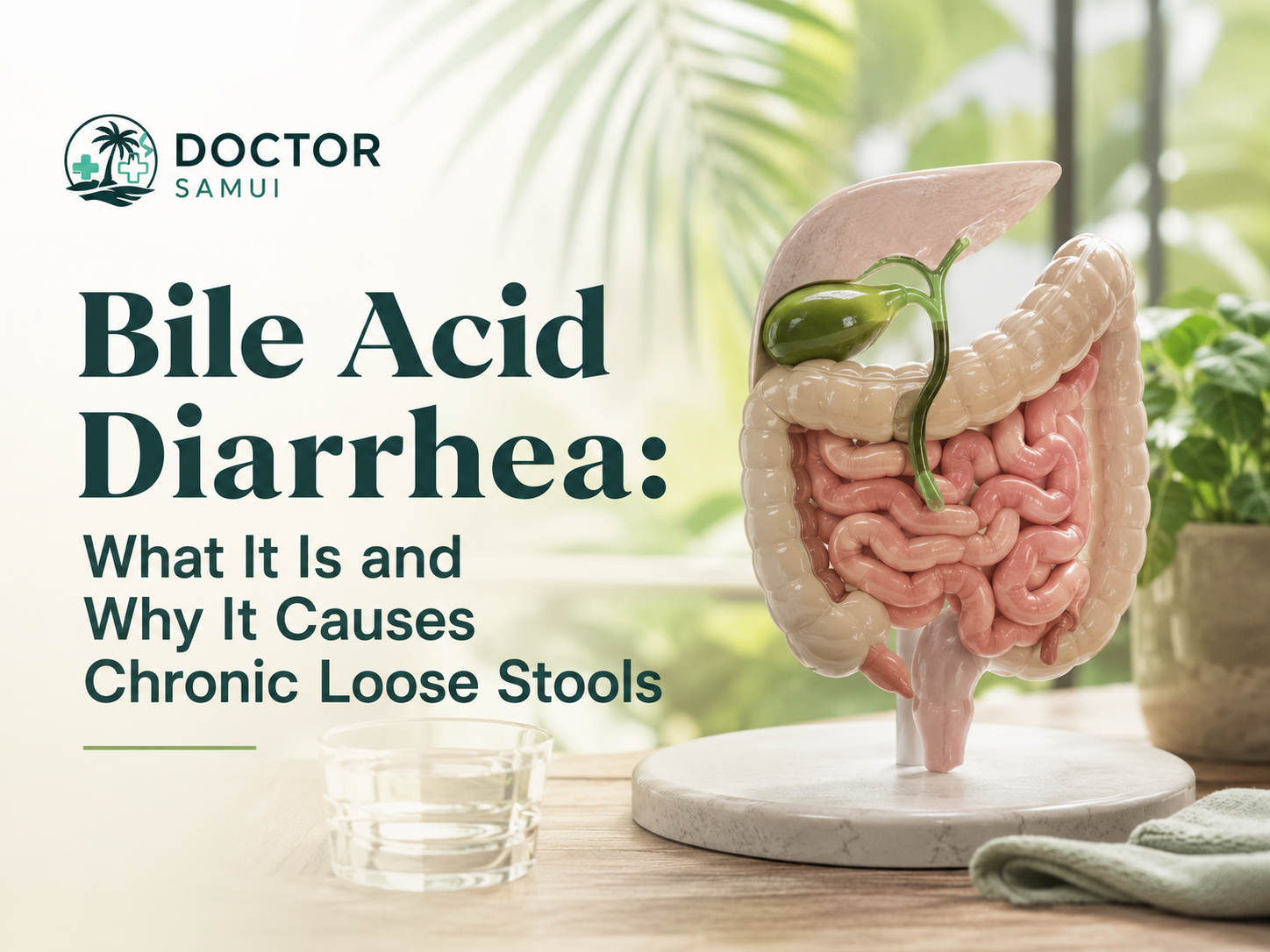
Bile acid diarrhea happens when bile acids, the digestive fluids your liver makes to break down fat, spill into the colon instead of being reabsorbed. This triggers urgent, watery, often pale or yellow-green loose stools that can persist for months or years. It is frequently mistaken for IBS. It responds well to specific treatment once identified.
You had a rough few days of food poisoning in week two of your trip. You recovered, mostly. But three weeks later you are still sprinting to the bathroom every morning, the stools are loose and sometimes an odd yellow-green colour, and anything fatty makes it worse. That is not lingering traveller’s diarrhea. That pattern, especially when it starts after a gut infection and just keeps going, is one of the clearest signs of bile acid diarrhea we see at our Chaweng clinic.
Bile acid diarrhea, also called bile acid malabsorption or bile salt diarrhea, is one of the most underdiagnosed causes of chronic loose stools anywhere in the world. Many people living with it for years have been told they have IBS. If loose stools are your daily normal and nothing has explained why, this is worth understanding. We assess and treat it at Doctor Samui, either at the clinic or at your hotel.

What Is Bile Acid Diarrhea and Why Most People Have Never Heard of It
Your liver makes bile acids to help digest fat. Normally they do their job in the small intestine and then get reabsorbed near the end of it. From there they cycle back to the liver and start again.
When that reabsorption breaks down, bile acids spill into the colon. The colon is not designed to handle them. They pull water in and speed everything up. The result is urgent, watery diarrhea.
The condition goes by several names: bile acid diarrhea, bile acid malabsorption, and bile salt diarrhea all refer to the same problem. The name confusion is part of why it gets missed. Doctors who were not trained on it may not think to look.
What Causes Bile Acid Diarrhea
Primary bile acid diarrhea
In primary bile acid diarrhea, the liver simply makes more bile acids than the gut can handle. There is no structural damage, no surgery, no obvious trigger. It is more common than most clinicians realise.
Secondary bile acid diarrhea
Secondary bile acid diarrhea has a specific cause. The most common ones include Crohn’s disease affecting the lower small intestine, gallbladder removal, radiation to the abdomen or pelvis, small intestinal bacterial overgrowth, microscopic colitis, and certain medications including metformin.
Post-cholecystectomy diarrhea deserves a specific mention. When the gallbladder is removed, bile flows continuously into the gut rather than being released in controlled amounts. Some people tolerate this fine. Others develop persistent loose stools within weeks or months of surgery.
Post-infectious bile acid diarrhea
This is the pattern we see most often on Koh Samui. A severe bout of traveller’s diarrhea or food poisoning damages the part of the small intestine responsible for reabsorbing bile acids. The mechanism does not always fully recover. Loose stools that started during a gut infection and never fully cleared can have this as the underlying cause.

Symptoms of Bile Acid Diarrhea
The main symptoms are watery or loose stools, urgency that gives little warning, and bloating or cramping, especially after meals. These are also classic IBS symptoms, which is exactly why this condition gets mislabelled so often.
Nocturnal diarrhea is a sign that often gets missed: waking at night to use the bathroom is uncommon in IBS and always warrants a closer look. Stool colour is also a useful clue. Stools may be pale and greasy, difficult to flush, or yellow, green, or orange. These colours come from bile pigments moving through too fast to be broken down normally.
Fecal urgency, the kind where you have minutes not hours, is another marker. It causes real anxiety and affects daily life, social plans, eating out, and any kind of travel around the island. Many patients have quietly adjusted their whole routine around it by the time they sit down with us.
Why Bile Acid Diarrhea Is So Often Mistaken for IBS
The overlap with diarrhea-predominant IBS is real. Both cause loose stools, urgency, bloating, and cramping. But research suggests that somewhere between a quarter and a third of people labelled with this type of IBS actually have bile acid diarrhea driving their symptoms.
The reason misdiagnosis happens is straightforward: IBS is diagnosed by symptoms and by ruling other things out. Bile acid diarrhea requires a clinician to actively test for it. If nobody thinks to test, the IBS label sticks.
Documented diagnostic delays of more than five years exist in the clinical literature. Five years of daily symptoms that are treatable from the start. If you have been told your gut is simply sensitive and nothing has worked, it is worth asking whether bile acid malabsorption has actually been ruled out.
How Bile Acid Diarrhea Is Diagnosed
The reference test is a nuclear medicine scan called a SeHCAT test, which measures how well your body retains bile acids over a week. It is accurate and reliable. It is also unavailable on Koh Samui and across most of Thailand outside major centres in Bangkok.
In practice, what we do at Doctor Samui is what most clinicians do when specialist tests are out of reach. We rule out other causes first using blood and stool tests, then run a supervised trial of bile acid treatment. A clear response to treatment strongly supports the diagnosis. This is a practical, evidence-supported pathway and it works for the vast majority of patients we see.
Treatment Options for Bile Acid Diarrhea
Bile acid sequestrants
The first-line treatment is a class of medication called bile acid sequestrants. They bind bile acids in the gut and stop them from irritating the colon. Cholestyramine is the older option and works well, but many people find it hard to take consistently. Colesevelam comes in tablet form and is better tolerated, which makes it more practical for most patients, including those managing symptoms while travelling.
Diet changes that help
A low-fat diet reduces the amount of bile your liver needs to produce. This does not mean zero fat, but cutting fatty meals, fried food, and heavy sauces makes a reliable difference for most people. Adding soluble fibre, found in oats, peeled fruit, and cooked vegetables, helps bulk the stool and slow transit time.
In Koh Samui’s heat, dehydration from chronic loose stools is a real risk. Replacing fluids consistently matters. If you are struggling to keep up with oral fluids, an IV drip for rehydration can help bridge the gap while treatment begins to take effect.
When Loose Stools on Koh Samui Might Be More Than Traveller’s Diarrhea
Traveller’s diarrhea normally resolves within one to two weeks. If you are past that window and still symptomatic, something else is happening. Post-infectious bile acid diarrhea is one possibility. Persistent infection is another. So is a condition that was already present and got triggered by the stress of a gut illness.
The mistake we see most often is waiting it out. Weeks turn into months. The holiday ends and the symptoms follow people home. If loose stools have lasted more than two to three weeks after a gut illness in Thailand, a proper clinical assessment is the right next step, not more waiting.
The combination of heat, reduced appetite, and ongoing fluid loss from frequent stools puts you at real risk. That risk goes up if you are spending time outdoors, on day trips to Angthong, hiking to the Na Muang waterfalls, or doing anything active on the island. This is not a condition to self-manage for months without knowing what is driving it.
Getting Assessed for Bile Acid Diarrhea at Doctor Samui
If this article describes what you have been living with, whether for three weeks or three years, the path forward starts with a proper clinical assessment. At our Chaweng clinic we take a full history, run blood and stool tests to rule out infection and other causes, and discuss whether a treatment trial is appropriate for you.
We do not have a SeHCAT scanner. But we do have a clear, practical pathway that gets most patients to a working diagnosis and a treatment plan for chronic diarrhea without one. For guests at hotels and villas across the island, we offer 24/7 house visits so you do not need to travel while symptomatic.
Chronic loose stools are not something you should accept as your new normal, especially when there is a treatable diagnosis waiting to be found.
If you have had loose stools for more than two or three weeks, especially after a gut illness in Thailand, Doctor Samui can assess you for bile acid diarrhea and other causes of chronic diarrhea. We offer walk-in appointments at our Chaweng clinic and 24/7 hotel and villa visits across Koh Samui. Our team will take a full history, run the relevant tests, and discuss a treatment plan with you in plain language. You do not need to keep waiting for this to resolve on its own.
FAQ
Dr. Ponlawat Pitsuwan
Physician, Doctor Samui
a walk-in clinic based in Chaweng, Koh Samui, with 24/7 hotel and villa visits across the island. He sees tourists, families, and long-stay expats for chronic and acute gastrointestinal conditions including bile acid diarrhea, post-infectious gut symptoms, and traveller’s diarrhea. His focus is straightforward, evidence-based care delivered in plain language.