
Clinically reviewed by Dr. Ponlawat Pitsuwan, Physician, Doctor Samui.
Last reviewed: November 2026
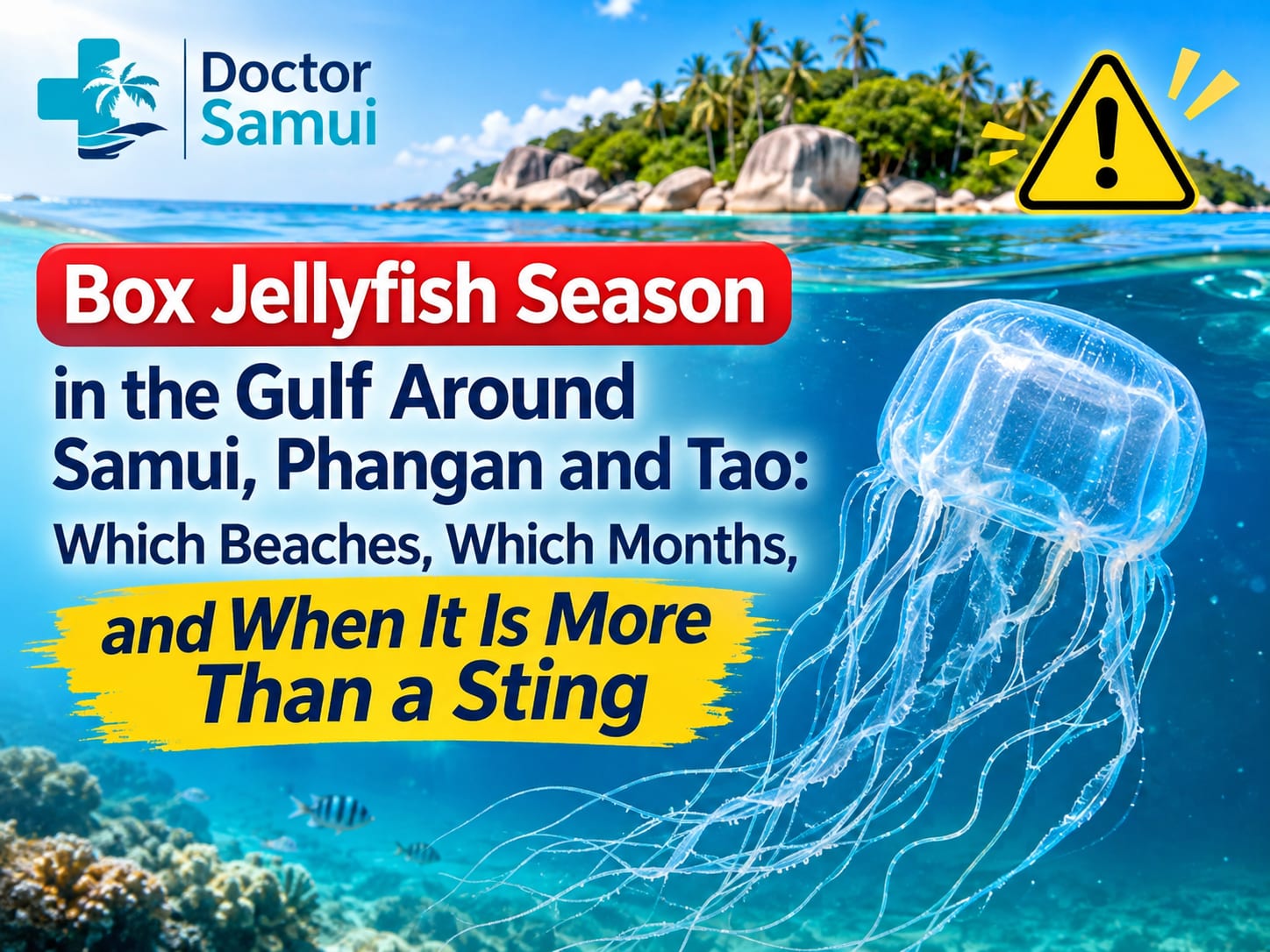
Box jellyfish are confirmed in the Gulf of Thailand waters around Koh Samui, Koh Phangan, and Koh Tao, with stings clustering most between July and October. The species present in the Gulf differ from those on the Andaman coast and carry venom capable of causing cardiac arrest. A sting with chest pain, breathing difficulty, or rapid collapse is a medical emergency. Any child stung needs clinical assessment regardless of how mild it looks.
You step off the longtail at Chaweng late morning, the water is flat and green, and nothing about the sea looks like a problem. That is exactly when it matters. Box jellyfish do not announce themselves, and the Gulf of Thailand has its own species and its own season.
The short answer: July through October carries the highest recorded risk around Samui, Phangan, and Tao. The east coast beaches face more exposure than sheltered west-coast bays. A small number of stings cross from painful to genuinely dangerous fast. This page covers the season, the geography, and when to stop treating it yourself.

What "Box Jellyfish" Means in the Gulf of Thailand, Compared With the Andaman Coast
Not all box jellyfish are the same. The species confirmed in the Gulf of Thailand include Chironex indrasaksajiae and Chiropsoides buitendijki, both multi-tentacled chirodropids. Their venom affects the heart and nervous system. They are not the same species discussed in Phuket and Andaman Sea content, so risk profiles based solely on Andaman data may not apply directly here.
Irukandji-type jellyfish are well documented on the Andaman coast, causing delayed systemic symptoms. The Gulf chirodropid species are larger, leave visible tentacle marks, and can cause faster cardiovascular collapse. Chirodropid box jellyfish have been recorded on both coasts of Thailand, so the species and risk profiles are not identical between the two sides of the country.
The Surat Thani province coastline, which includes Samui, Phangan, and Tao, sits within the confirmed habitat range of these Gulf chirodropids. This is not a theoretical risk imported from elsewhere.
Box Jellyfish Season Koh Samui, Phangan and Tao: Months and Conditions When Stings Cluster
July through October is when recorded stings concentrate around these islands. This aligns with the Gulf of Thailand’s rainy season, when inshore currents shift and jellyfish move closer to shore. The Thai Department of Disease Control references this window in its beach hazard guidance.
Do not treat the season as a strict on-off switch. Stings have been reported outside this window. Thai public beaches have no lifeguards, so there is nobody scanning the water before swimmers enter. At dawn and dusk, jellyfish are more likely to be close to the surface and near shore.
Vinegar stations have been installed at points along Lamai beach following a documented sting incident there. They are not present at every beach access point. Confirm with your resort whether one is within reach of where you plan to swim.
East-Coast Beaches Such as Chaweng and Lamai Versus More Sheltered West-Coast Bays
Chaweng and Lamai face northeast, directly into the Gulf. During the rainy season, swell and inshore currents push marine animals toward these beaches. This is where most documented stings in the Samui area have occurred.
The west-coast bays, including Taling Ngam and Nathon, are more sheltered. That does not make them risk-free, but the conditions that concentrate jellyfish near shore are less pronounced there. Families choosing to swim during peak months may find the west coast a lower-risk option.
Stinger nets exist at a small number of private resort sections along Chaweng and Lamai. They are not standard on public beach areas, and net coverage ends at the resort boundary. Knowing this before you walk into the water matters.
How to Tell a Mild Sting From a Medical Emergency
A mild chirodropid sting causes immediate, sharp burning pain at the contact site, followed by red raised welts in a linear or ladder-like whip pattern. This is painful and distressing but manageable with correct first aid and clinical review.
A severe sting looks different quickly. The venom in Gulf box jellyfish can affect cardiac rhythm. Symptoms that signal a medical emergency include chest pain, irregular heartbeat, difficulty breathing, sudden weakness or collapse, or loss of consciousness. These are not symptoms to monitor from the beach.
Get the person out of the water and call for help immediately. Do not let someone with these symptoms walk back to the hotel alone.
Breathing Trouble, Severe Pain, and Stings in Children
Children carry a higher risk from the same amount of venom because of their smaller body mass. A sting that produces moderate symptoms in an adult can produce a serious reaction in a child. Any child stung by a box jellyfish should be seen by a doctor, regardless of how they appear in the first few minutes.
Cardiac arrest and respiratory failure from a severe chirodropid sting can develop within minutes. If a victim loses consciousness, begin CPR immediately and do not stop until emergency help arrives.
If the person is breathing and conscious but has chest pain, tingling beyond the sting site, or visible distress, treat it as urgent. Contact Doctor Samui’s 24-hour emergency line or get to the nearest medical facility without delay.
What Beach Wisdom Gets Wrong About Jellyfish Stings
The advice about urinating on a jellyfish sting is wrong, and it can make things worse. Urine can trigger further venom release from any tentacle fragments still on the skin. The same applies to rubbing the area with sand or a towel.
Vinegar, applied by pouring, is the evidence-supported first step for chirodropid box jellyfish stings. It stops unfired venom cells from firing. Remove any visible tentacle fragments carefully with a card or stick, not bare fingers, before rinsing.
Detailed first aid, including tentacle removal steps and what to avoid, is covered on the Doctor Samui accident and trauma treatment page. Read that page before your trip, not after.
After a Severe Sting: Island Hospital Care and When a Transfer Off Samui Is Discussed
Koh Samui has hospital-level care on the island. If you are stung on Samui and need emergency assessment, getting to a facility is faster here than from either Phangan or Tao.
Koh Phangan has a government hospital, but its capacity for severe envenomation is limited. Koh Tao has a small clinic. A serious sting on Koh Tao means a boat or helicopter transfer before you reach full emergency care. Dive boat operators on Tao should know this. The time between a severe sting and cardiac involvement can be short, so where you are on the water matters.
For stings in Chaweng or Lamai, the Doctor Samui walk-in clinic in Chaweng provides immediate clinical assessment, and 24-hour hotel and villa visits are available across the island. The west-coast areas of Taling Ngam and Nathon are also covered. For anything suggesting cardiac or respiratory involvement, the nearest emergency department is the right destination.
If a transfer off Samui is needed, Bangkok Hospital Samui handles inter-island coordination. Your travel insurance may cover this. Doctor Samui can assist with clinical documentation and handover if needed from your hotel or villa.
Stung on Koh Samui, Phangan, or Tao and unsure whether symptoms need urgent care? Doctor Samui’s walk-in clinic in Chaweng is open 24 hours. Hotel and villa visits are available across the island at any time. For chest pain, breathing difficulty, or any sting involving a child, call immediately. Clinical documentation for transfers to a larger facility is also available.
Frequently Asked Questions
Dr. Ponlawat Pitsuwan
Physician, Doctor Samui
a walk-in clinic based in Chaweng, Koh Samui, with 24-hour hotel and villa visits across the island. He sees tourists, families, and long-stay expats for marine envenomation, trauma from water and beach activities, and urgent care during and after island day trips. His focus is straightforward, evidence-based care delivered in plain language.
References
- Sucharitakul P et al. Chirodropid box jellyfish in the Gulf of Thailand: distribution, seasonality and species composition from a 2009–2016 survey. Marine Biodiversity, 2019; 49(3):143–149.
- Yanagihara AA, Shohet RV. Cubozoan venom-induced cardiovascular collapse is caused by hyperkalemia and prevented by zinc gluconate in mice. PLOS ONE, 2012; 7(12):e51368.
- Fenner PJ, Williamson JA. Worldwide deaths and severe envenomation from jellyfish stings. Medical Journal of Australia, 1996; 165(11):658–661.
- Tiong KS et al. Rapid and accurate species-specific PCR for the identification of lethal Chironex box jellyfish in Thailand. Mahidol University Repository, 2021.
- Loten C et al. Are we using the correct first aid for jellyfish? Medical Journal of Australia, 2017; 206(6):232–233.
- Tibballs J. Australian venomous jellyfish, envenomation syndromes, toxins and therapy. Toxicon, 2006 (marine envenomation review cited in RACGP AFP). RACGP Australian Family Physician, 2015; 44(1–2):28–32.
The information in this article is for educational purposes only and does not constitute medical advice. It should not be used to self-diagnose or replace a consultation with a qualified physician. If you have concerns about your health, contact a licensed medical professional. For appointments at Doctor Samui, visit doctorsamui.com.
