Clinically reviewed by Dr. Ponlawat Pitsuwan, Physician, Doctor Samui.
Last reviewed: October 2026
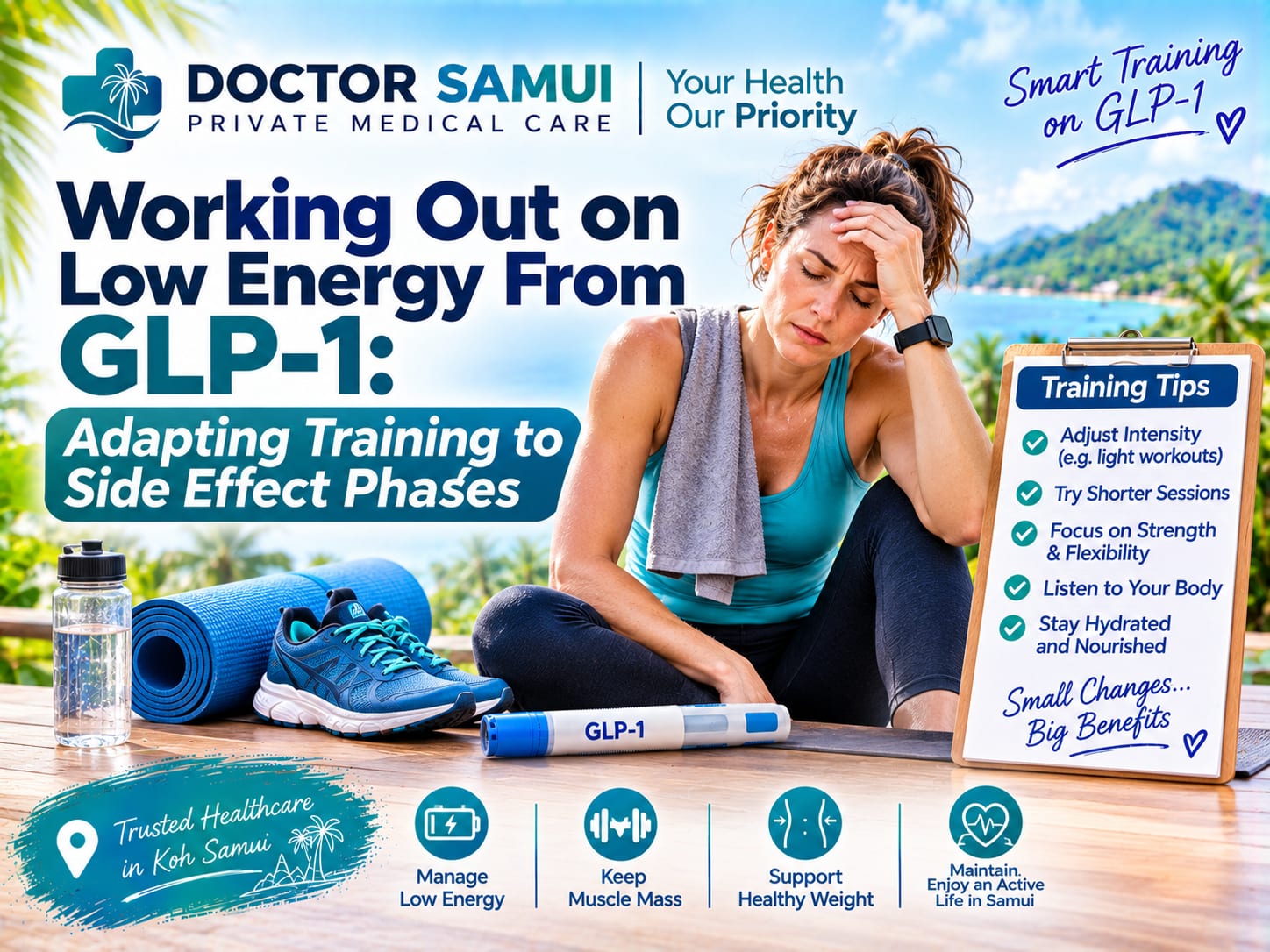
GLP-1 medications like semaglutide slow gastric emptying, reduce appetite, and often cause fatigue, especially in the first weeks after each dose increase. The answer is not to stop training. It is to match your workout to your side-effect phase. On high-fatigue days, low-impact movement protects muscle without draining you further. On better days, resistance training is the priority. Knowing which phase you are in changes everything.
You have booked a sunrise paddleboard session near Chaweng Beach. You are three weeks into semaglutide, down a few kilos, and feeling good about it. Then the day after your injection hits, and you cannot get off the hotel bed. This is not weakness. This is the dose-escalation window, and many people on a GLP-1 receptor agonist like semaglutide or tirzepatide feel it at some point, especially during dose increases.
You do not have to choose between resting and training. You have to choose the right kind of training for the right day. This guide maps your GLP-1 low energy workout options to your side-effect cycle, covers fuelling and hydration for Samui’s heat, and tells you exactly when fatigue stops being normal and starts needing a doctor.

Why GLP-1 Drains Your Energy During the Dose Escalation Window
There are two very different reasons you feel drained on GLP-1, and they need different fixes.
The first is drug-adaptation fatigue. In the weeks after each dose increase, your body is adjusting to stronger receptor signalling. Nausea, slower digestion, and disrupted hunger cues all pull energy down. This kind of fatigue tends to peak in the first few days after injection, then ease before your next dose.
The second is under-fuelling fatigue. GLP-1 medications suppress appetite so effectively that some patients eat far too little for their activity level. Under-fuelling worsens progressively. It does not track with injection timing. And it puts lean mass, the muscle you want to keep, at serious risk.
If your fatigue is worst on days one and two after injection and improves by day five or six, that is adaptation. If you feel equally flat every day regardless of where you are in your injection cycle, look at how much you are eating.
Phase-Based Training: Matching Your GLP-1 Low Energy Workout to Your Cycle
Think of your week in two zones: the high-fatigue window and the recovery window.
The high-fatigue window covers roughly the first 48 hours after injection. Nausea and energy dips tend to be strongest here, especially during dose escalation. In this window, the goal is to keep moving without creating more stress. A slow walk along the Chaweng promenade, a gentle yoga session in an air-conditioned room, or 20 minutes of pool walking all count. You are maintaining the habit and keeping blood sugar stable, not chasing output.
The recovery window is days three through six for most patients, when GI symptoms ease and energy rises. This is your training window. Use it. Resistance training belongs here, and it is the single most important thing you can do on GLP-1 to protect lean mass. Do not save your best energy for cardio.
Each time your dose increases, the high-fatigue window may widen again. Scale back with each increase, then rebuild. This is not failure. It is the titration schedule working as intended.

Strength Training to Protect Muscle on GLP-1
On GLP-1, your body is in a significant caloric deficit. Without a clear signal to keep muscle, it will burn it. Resistance training sends that signal. Cardio alone does not.
Aim for two to three resistance sessions per week during your recovery window. Compound movements, squats, rows, presses, deadlifts, work more muscle per set, which matters when your total training volume is limited. On days when full sets feel too heavy, reduce the number of sets rather than the weight. Two sets of eight to ten reps at your normal load still tells your muscles to stay.
Progressive overload still applies even on reduced calories. You may not add weight every week, but aim to maintain it. If you are consistently losing strength rather than maintaining it, that is worth discussing with a doctor. This is especially true for patients over 50, where age-related muscle loss is an existing risk.
Low-Energy Workout Options That Work on High-Fatigue Days
On a bad day, something is almost always better than nothing. But the bar should be low.
Pool walking is ideal in Samui’s heat. The water keeps your core temperature down, the resistance works your legs without impact, and you can stop whenever you need to. Seated resistance band work targets the same muscle groups as gym exercises without loading your spine when you feel unsteady. A 15-minute slow walk in the early morning before the heat builds is enough to count.
Avoid hot yoga, HIIT, or any session requiring sustained high effort on high-fatigue days. In Koh Samui’s humidity, your body is already working hard to stay cool. Adding intense exercise when you are depleted and potentially dehydrated from GI side effects raises your risk of heat illness faster than it would on a normal training day.
Fuelling and Hydration Around Workouts on GLP-1
Standard pre-workout advice says eat 30 to 45 minutes before training. That window does not work on GLP-1. Semaglutide slows gastric emptying, so food from a meal eaten 45 minutes earlier may still be sitting in your stomach when you start moving, and that triggers nausea.
Shift your pre-workout meal to at least two hours before training. Keep it small and protein-forward. Eggs, Greek yoghurt, a small portion of chicken, these digest more smoothly than carbohydrate-heavy meals and support lean mass retention. On high-nausea days, a few sips of a protein drink is enough. Do not train fasted if you can avoid it. On a significant caloric deficit, fasting before exercise accelerates muscle breakdown.
Hydration on Samui deserves its own mention. Koh Samui is hot and humid year-round, and sweat losses here are higher than most patients are used to at home. GLP-1 may reduce your awareness of thirst, in part because eating less means taking in less fluid through food, so you may not feel dehydrated until you already are. Sip electrolyte fluid, not plain water alone, before and during any session longer than 20 minutes. If you have had vomiting or diarrhoea in the previous 24 hours, oral rehydration is often not enough. IV fluid replacement at the clinic or via a house call is a faster and more reliable option. The team can come to you if you are not up to travelling: IV therapy in Lamai and IV therapy in Chaweng are both available, as are house calls in Bophut and across the island.
When to See a Doctor About GLP-1 Fatigue on Samui
Most GLP-1 fatigue is manageable and self-limiting. Some of it is not. GLP-1 medications are not suitable for everyone. They are not recommended for people with a personal or family history of medullary thyroid carcinoma or multiple endocrine neoplasia type 2, and they should not be used during pregnancy. If you are unsure whether semaglutide or tirzepatide is appropriate for you, a doctor can review your medical history before you start.
Normal adaptation fatigue tracks with your injection cycle, improves by day four or five, and eases as your dose stabilises. Warning signs that need clinical assessment are different. Dizziness or lightheadedness during exercise may signal low blood sugar or dehydration. Muscle weakness that is getting progressively worse rather than fluctuating needs checking. Muscle cramps or confusion during or after training should not be pushed through.
Fatigue that is not improving between doses after several weeks at the same dose level is also worth reviewing. If you are a long-stay expat on Samui and you have been pushing through fatigue for weeks without improvement, a proper review, blood work, muscle mass assessment, and a look at your nutrition plan, is worth doing before things get worse. Doctor Samui’s GLP-1 programme includes ongoing clinical support, not just the prescription.
Struggling with GLP-1 fatigue on Koh Samui? Doctor Samui’s Chaweng clinic offers GLP-1 consultations, ongoing monitoring, and IV hydration for patients managing side effects. House calls are available 24 hours a day across the island, including Lamai, Bophut, Maenam, and Choeng Mon. Walk in or call to book a same-day appointment.
FAQ
Dr. Ponlawat Pitsuwan
Physician, Doctor Samui
a walk-in clinic based in Chaweng, Koh Samui, with 24/7 hotel and villa visits across the island. He sees tourists, families, and long-stay expats for GLP-1 management, weight-related health concerns, fatigue, and exercise-related illness. His focus is straightforward, evidence-based care delivered in plain language.
References
- Wilding JPH, et al. Once-Weekly Semaglutide in Adults with Overweight or Obesity. New England Journal of Medicine, 2021.
- Wilding JPH, et al. Once-Weekly Semaglutide in Adults with Overweight or Obesity. PubMed Central (PMC8089593), 2021.
- Society for Cachexia and Wasting Disorders. Glucagon-like peptide-1 receptor agonists for sarcopenia and muscle wasting disorders: a systematic review of efficacy and mechanisms. 2024.
- World Health Organization. Physical activity fact sheet. WHO, 2020.
- Frontiers in Endocrinology. GLP-1 receptor agonists and body composition: emerging evidence on lean mass. 2024.
The information in this article is for educational purposes only and does not constitute medical advice. It should not be used to self-diagnose or replace a consultation with a qualified physician. If you have concerns about your health, contact a licensed medical professional. For appointments at Doctor Samui, visit doctorsamui.com.