Clinically reviewed by Dr. Ponlawat Pitsuwan, Physician, Doctor Samui.
Last reviewed: October 2026
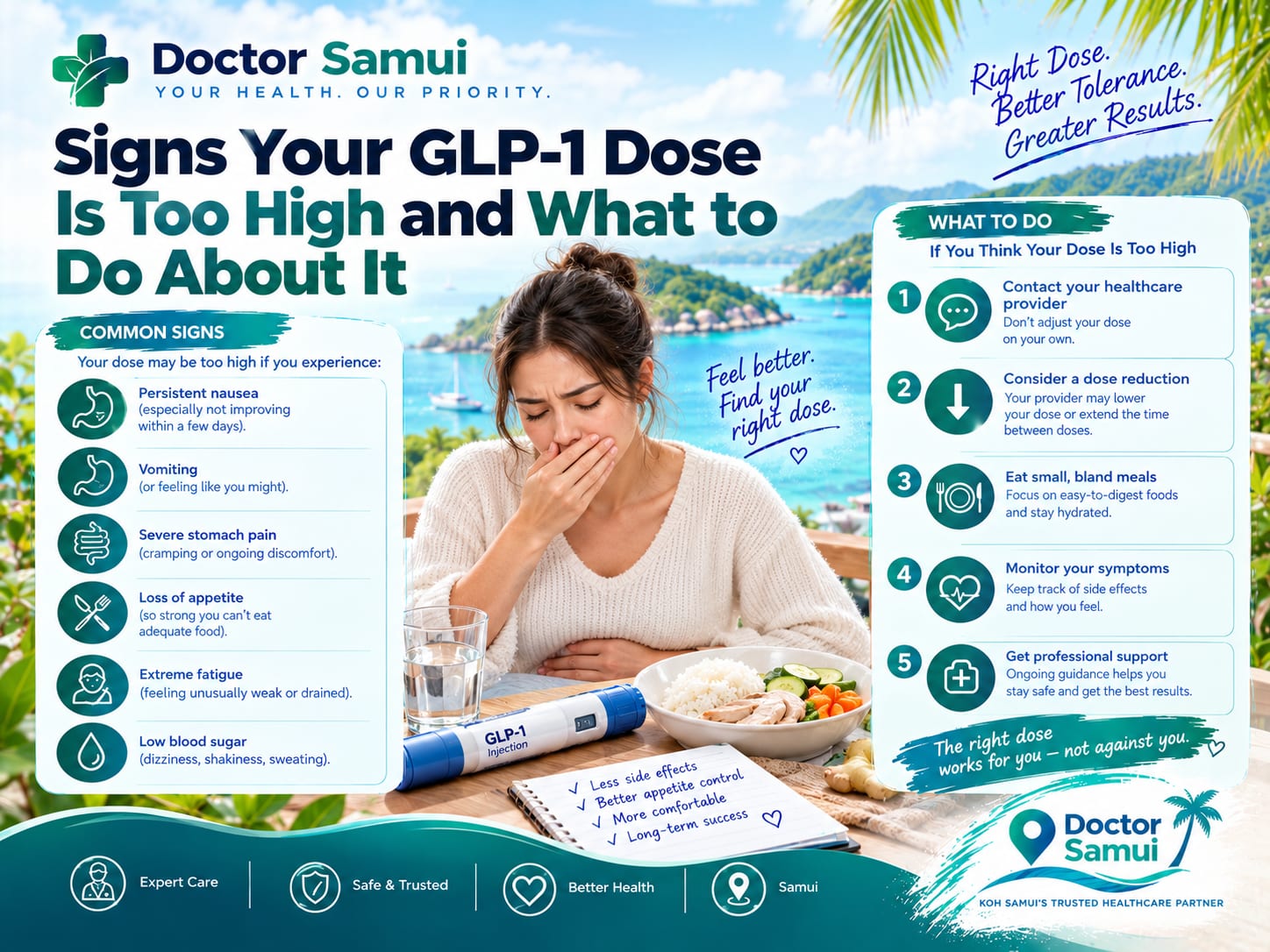
Signs that your GLP-1 dose is too high include persistent vomiting that prevents you from keeping fluids down, severe cramp-like abdominal pain, dizziness on standing, and symptoms that do not ease within 48 to 72 hours of a new dose. Mild nausea in the first days after starting or stepping up a dose is expected. The symptoms above are not. If you are on Koh Samui and unsure which category you are in, Doctor Samui can assess you the same day, at the clinic or at your hotel.
You did your injection the evening before a beach day, ate a small dinner, and woke up at 3am unable to stop vomiting. Now you are searching your symptoms between trips to the bathroom, wondering whether this is the drug doing its job or something that actually needs a doctor.
That question matters, and the answer is not always obvious. GLP-1 medications like semaglutide (Ozempic, Wegovy) and tirzepatide (Mounjaro) do cause nausea, especially when you first start or step up your dose. But there is a line between expected side effects and a dose that is genuinely too high for your body right now. This guide helps you find that line, tells you which symptoms mean go to a clinic today, and explains what treatment looks like if you need it.
Normal Start-Up Nausea vs. Signs Your GLP-1 Dose Is Too High
Nausea in the first week or two after a new dose is common. Your stomach empties more slowly on these medications, and your body needs time to adjust. That kind of nausea is usually mild, eases with small meals, and does not stop you from drinking water.
A dose that is too high looks different. The nausea is constant. You cannot finish half a glass of water without feeling worse. You may vomit repeatedly over several hours. Your stomach cramps rather than just feeling unsettled.
The key question is function: can you keep fluids down? If yes, watch and wait with small sips and bland food. If no, and this has been going on for more than four to six hours, you need to be seen.
Gastrointestinal Signs Your Dose May Be Too High
Nausea and vomiting are the most common signs, but there are others worth knowing.
Severe stomach-slowing can happen at higher doses. Food and liquid sit in your stomach for hours. You feel full and nauseated long after eating, sometimes with bloating or reflux. This is different from the mild fullness that is part of how the medication works.
Diarrhoea, stomach cramps, and an inability to tolerate any food for more than a day or two also suggest the dose is more than your body can handle right now. These symptoms alone are not emergencies. But if they are stopping you from eating or drinking, they become one.

Red Flags That Need Immediate Medical Attention
Some symptoms go beyond a high dose and need same-day assessment.
Severe upper abdominal pain that radiates to your back is a red flag for pancreatitis, an inflammation of the pancreas that has been reported with GLP-1 medications. Do not wait for this to pass on its own.
Signs of low blood sugar such as shaking, sweating, sudden confusion, or weakness matter most if you are also taking insulin or a sulfonylurea drug like glibenclamide or glipizide. GLP-1 medications alone carry a low risk of low blood sugar, but that risk rises when combined with other glucose-lowering medications. If you are on a combination and feel shaky and confused, treat it as urgent.
Dark urine, dizziness when you stand up, and a dry mouth that does not improve with sips of water point to dehydration significant enough to need IV fluids. At that point, trying to drink your way out of it usually does not work.
Why Dosing Errors Happen, and Why They Happen More on Holiday
Most dosing errors are not careless mistakes. They happen for specific, understandable reasons.
Compounded semaglutide, produced by compounding pharmacies rather than the original manufacturer, sometimes uses different concentration formats. A patient used to one concentration can inject the wrong volume when switching products. The result is a dose two or three times what was intended.
Unit versus milligram confusion is another common source of error. Some pen devices are labelled in units, others in milligrams. Reading the wrong scale on an unfamiliar pen can lead to a significant overdose.
Cold-chain storage failure is a real risk in tropical heat. Most GLP-1 pens should be stored at 2 to 8°C before first use and kept below 30°C once opened. On Koh Samui, a pen left in a beach bag, a hot car, or a room without air conditioning for several hours may degrade in ways that are not visible. A degraded pen does not always mean a lower dose. It can mean an unpredictable one. Checking your storage habits is part of managing this medication safely here.
How Long Symptoms Last After a Too-High Dose
Semaglutide has a half-life of approximately seven days, according to its prescribing information. Drug levels fall slowly, not overnight. If you injected a dose that was too high, you should not expect to feel back to normal the next morning. Symptoms from a dosing error can persist for several days.
This is not a sign that something is permanently wrong. It is just how the drug works. What it means practically is that waiting it out without support is harder than it sounds, and care during that window makes a real difference.
Tirzepatide has a shorter half-life than semaglutide per its prescribing information, so symptoms from a tirzepatide dosing error may resolve somewhat faster, though individual variation matters.
What Treatment Looks Like If You Come In
There is no specific antidote for a GLP-1 overdose. Treatment is supportive, which means managing your symptoms while the drug level falls.
A doctor will check your hydration and blood glucose first. If you are dehydrated, IV fluids with electrolyte replacement are the fastest way to feel better. Antiemetic medication can break the nausea cycle and let you start tolerating fluids again. Blood glucose monitoring matters especially if you are also on insulin or a sulfonylurea.
You can read more about GLP-1 side effects from a high dose and how they are managed on our GLP-1 page. IV rehydration is available at the Chaweng clinic and through 24/7 hotel and villa visits across the island. If you are staying in Lamai, a house call doctor in Lamai can come to you directly. The same applies if you are in Bophut, Choeng Mon, or further around the ring road.
Managing Your GLP-1 Dose While Travelling or Living on Koh Samui
If you are a long-stay expat or a tourist managing a weekly injection schedule while here, a few things are worth keeping in mind.
Time-zone shifts affect dose timing. If you moved your injection day to fit your travel schedule, you may have shortened the gap between doses without realising it. Even a few days less between doses can increase side effects.
The heat here is a real factor. Keep your pen in the hotel minibar fridge, not on the bathroom counter. If the power goes out, even briefly, note how long the pen was unrefrigerated. Manufacturer labels give guidance on maximum time outside refrigeration, and those limits matter more in a hot climate.
Your prescriber is likely back home, but that does not mean you are on your own. A doctor here can assess an acute reaction, give IV fluids, manage symptoms, and advise on whether to hold your next scheduled dose. Doctor hotel visits in Koh Samui are available around the clock for exactly this situation, and all consultations are documented so your home prescriber has a clear record when you return.
If you are on Koh Samui and unsure whether your GLP-1 symptoms are normal or a sign your dose is too high, do not wait and hope. Doctor Samui offers same-day assessments at the Chaweng walk-in clinic and 24/7 hotel and villa visits across the island. We can check your hydration, blood glucose, and symptoms, give IV fluids if needed, and advise on your next dose. Contact us directly or visit the clinic in Chaweng.
Frequently Asked Questions
Dr. Ponlawat Pitsuwan
Physician, Doctor Samui
a walk-in clinic based in Chaweng, Koh Samui, with 24/7 hotel and villa visits across the island. He sees tourists, families, and long-stay expats managing GLP-1 medications and dealing with reactions, dehydration, and dose-related concerns while away from their usual prescriber. His focus is straightforward, evidence-based care delivered in plain language.
References
- Nauck MA, Quast DR, Wefers J, Meier JJ. GLP-1 receptor agonists in the treatment of type 2 diabetes — state-of-the-art. Mol Metab. 2021 Apr;46:101102.
- U.S. Food and Drug Administration. Mounjaro (tirzepatide) prescribing information. 2022.
- Eli Lilly and Company. What is the half-life of Mounjaro (tirzepatide)? Lilly Medical, 2023.
- Eli Lilly and Company. How should the Mounjaro (tirzepatide) KwikPen be stored? Lilly Medical UK, 2023.
- The Pharmacist. GLP-1 product information updated to highlight risk of severe acute pancreatitis. 2024.
The information in this article is for educational purposes only and does not constitute medical advice. It should not be used to self-diagnose or replace a consultation with a qualified physician. If you have concerns about your health, contact a licensed medical professional. For appointments at Doctor Samui, visit doctorsamui.com.