Clinically reviewed by Dr. Ponlawat Pitsuwan, Physician, Doctor Samui.
Last reviewed: October 2026
GLP-1 receptor agonists have been in clinical use since 2005, built on decades of research stretching back to a hormone discovered in the early 1980s and a pivotal finding in Gila monster saliva in the 1990s. Semaglutide is not made from lizard venom. It is a human-sequence-based medicine engineered to resist breakdown, backed by major cardiovascular outcome trials and over 20 years of real-world safety data. These are among the most rigorously studied metabolic medicines available today.
You are sitting on a villa terrace in Lamai, six weeks into a long stay on Samui, and your doctor back home mentioned GLP-1 treatment before you left. You Googled it. Half the articles say it comes from lizard saliva. The other half make it sound brand new. Neither version is quite right, and neither helps you make a decision.
The real story spans about 40 years. It moves from a hormone in your own gut to a peptide in a desert lizard, and ends with some of the most closely studied weight and diabetes medicines in the world. These are not new drugs, and their safety record is long.

What GLP-1 Actually Does in the Body
GLP-1, glucagon-like peptide-1, is a hormone your gut releases after you eat. It tells your pancreas to produce more insulin when blood sugar rises. It slows digestion and signals to your brain that you are full.
Your gut also produces a related hormone called GIP, and together these two drive a large part of the normal post-meal insulin response. GLP-1 also suppresses glucagon, the hormone that raises blood sugar. That matters in type 2 diabetes, where glucagon is often overactive.
The problem is that your body makes GLP-1 in tiny amounts and destroys it almost instantly. That is where the science had to start.
The 1980s Discovery and the DPP-4 Problem
Danish researcher Jens Holst and his colleagues isolated and described GLP-1 in the early 1980s. It lowered blood sugar without causing dangerous hypoglycaemia, the low-blood-sugar crash that made older diabetes medicines difficult to use. It also appeared to reduce appetite.
But there was a fundamental obstacle. An enzyme called DPP-4 breaks down natural GLP-1 within one to two minutes of it entering the bloodstream. Injecting the natural hormone was pointless as a treatment, because it was gone before it could do anything useful. Throughout the late 1980s and into the 1990s, GLP-1 remained a biologically exciting dead end.
The question researchers needed to answer was this: could you build a molecule that did what GLP-1 does, but lasted long enough to matter?

The Gila Monster Discovery and What It Actually Proved
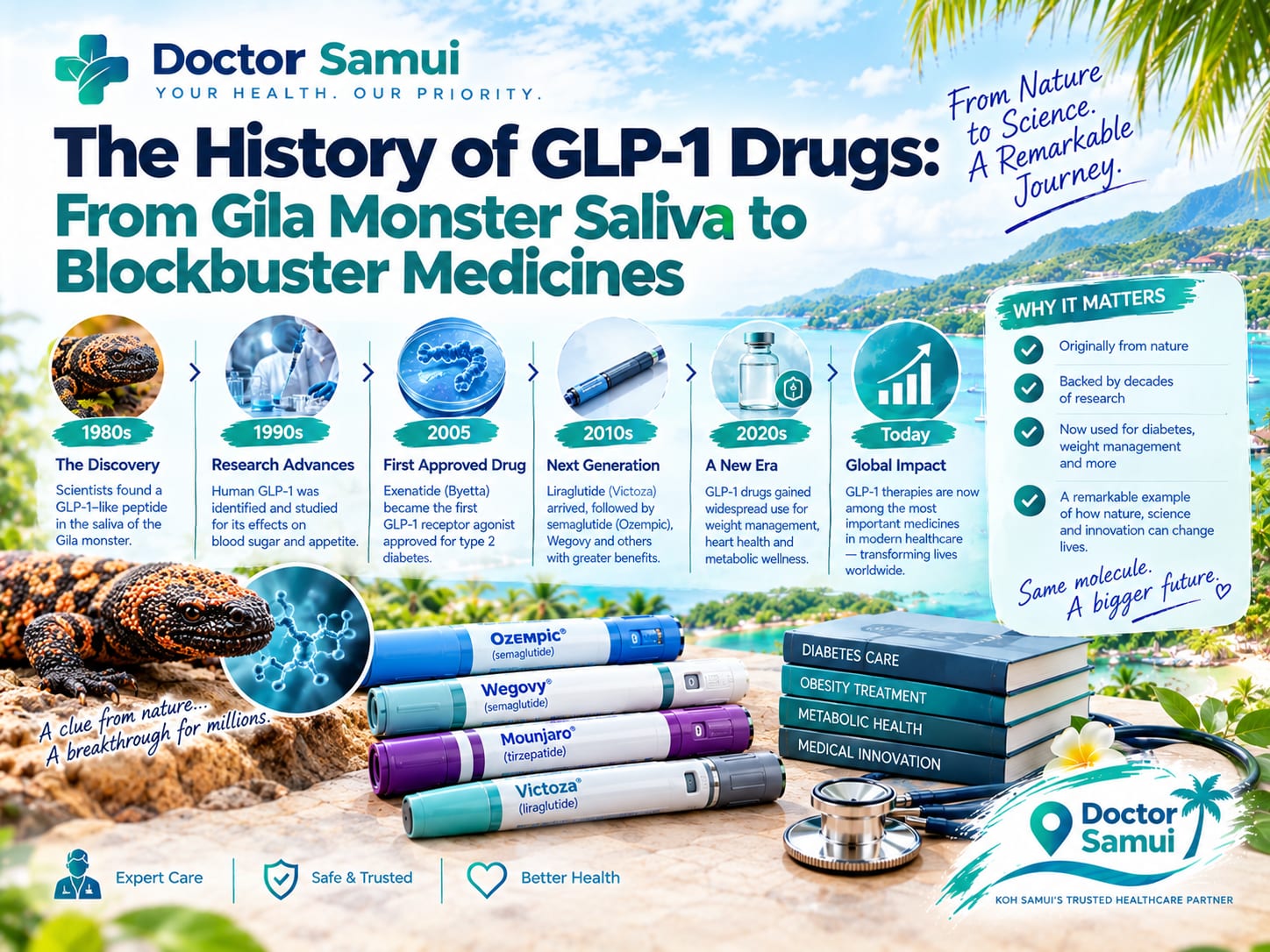
In the early 1990s, Dr John Eng, an endocrinologist at the Veterans Affairs Medical Center in New York, was studying peptides in animal venoms and secretions. He identified a peptide in the saliva of the Gila monster, a large lizard native to the American Southwest, that was structurally similar to GLP-1. He named it exendin-4.
Exendin-4 was not the source material for modern GLP-1 drugs. What it proved was that a GLP-1-like molecule could resist DPP-4 degradation. The Gila monster’s peptide had a slightly different amino acid sequence that kept it stable in the bloodstream for hours, not seconds. That was the proof of concept that unlocked the entire field.
Eli Lilly and Amylin Pharmaceuticals licensed the discovery and developed exenatide, sold as Byetta, which received FDA approval in 2005. Exenatide required twice-daily injections. It was the first GLP-1 receptor agonist approved for clinical use, and it worked. But researchers wanted something that lasted longer and was simpler to use.
From Twice-Daily Injections to Once-Weekly Doses
Novo Nordisk took a different route. Rather than using exendin-4 as the structural template, they started with the human GLP-1 sequence and engineered it to resist DPP-4 breakdown through two key modifications.
First, they attached a fatty acid side chain that binds to albumin, a protein naturally circulating in your blood. This slows the drug’s release and extends its time in the body. Second, they made specific amino acid substitutions at points where DPP-4 normally attacks the molecule. The result was liraglutide, approved in 2010 as Victoza for type 2 diabetes and later as Saxenda for weight management.
Semaglutide, approved as Ozempic in 2017, took this engineering further. A stronger albumin-binding chain and refined substitutions extended the half-life enough for once-weekly dosing. Wegovy, the higher-dose semaglutide formulation licensed specifically for chronic weight management, followed in 2021. Semaglutide is produced via recombinant DNA technology in pharmaceutical facilities. It contains no lizard-derived material.
GLP-1 Moves Beyond Diabetes: The Weight Loss Evidence
The weight loss effects of GLP-1 drugs were observed early but initially treated as secondary to the glucose-lowering action. Large-scale clinical trials changed that. The SUSTAIN programme for semaglutide and the SCALE trials for liraglutide showed consistent, clinically meaningful reductions in body weight, not just blood sugar.
The STEP trials for higher-dose semaglutide showed significant average weight loss compared to placebo in adults with obesity but without diabetes. These results established GLP-1 receptor agonists as a dual-indication drug class for both type 2 diabetes and chronic weight management.
Two Decades of Safety Data and What It Tells Us
This is where the history argument for GLP-1 medicines is strongest. Exenatide has been in clinical use since 2005. Liraglutide since 2010. Semaglutide since 2017. That is a combined real-world evidence base across tens of millions of patients.
Major cardiovascular outcome trials have strengthened the safety and benefit picture. The LEADER trial for liraglutide and the SUSTAIN-6 and SELECT trials for semaglutide showed not only safety but a reduction in major cardiovascular events in high-risk patients. SELECT, published in 2023, showed semaglutide reduced cardiovascular events in people with obesity and established cardiovascular disease but without diabetes. Few drug classes can claim that level of cardiovascular outcome evidence.
Known risks are real and must be discussed with a doctor before starting. These include gastrointestinal side effects, a contraindication in people with a personal or family history of medullary thyroid cancer or multiple endocrine neoplasia type 2, and caution in active or previous pancreatitis. These are reasons to have a proper clinical assessment first, not reasons to avoid GLP-1 medicines in most patients.
The Latest Chapter: Oral Semaglutide, Tirzepatide, and What Comes Next
An oral form of semaglutide, Rybelsus, was approved for type 2 diabetes. Getting a peptide to survive the digestive system required its own engineering breakthrough, using an absorption enhancer called SNAC. Oral semaglutide for weight management is in advanced development.
Tirzepatide, sold as Mounjaro and approved by the FDA in 2022 for type 2 diabetes, is a dual agonist. It activates both GLP-1 and GIP receptors at the same time. The SURMOUNT trials showed significant weight loss results, in some analyses exceeding those seen with semaglutide alone. Whether that advantage holds across all patient types is still being studied. Newer molecules targeting additional pathways are already in clinical trials.
What This GLP-1 History Means If You Are Considering Treatment on Samui
If you are a long-stay expat or a visitor spending real time on Koh Samui and you are thinking about GLP-1 treatment, this history matters. Not as trivia, but as context for a treatment decision.
These medicines have a development arc going back 40 years, major trials behind them, and more than two decades of clinical use. That does not make them right for everyone. It does mean that when you sit down with a doctor to discuss starting treatment, the evidence base supporting that conversation is substantial.
GLP-1 medications are prescription-only. A proper consultation covers your medical history, your current medications, your cardiovascular risk, and whether any of the key contraindications apply to you. Baseline metabolic checks before starting are standard. At Doctor Samui’s Chaweng clinic, GLP-1 consultations for expats and longer-stay visitors include the bloodwork and clinical assessment needed to start treatment safely. You can read more about the full treatment approach on our GLP-1 service page.
If you want a thorough health picture before starting any metabolic medication, a health check-up in Koh Samui is a natural first step. For expats managing ongoing conditions across a long Samui stay, knowing that a clinic on the island handles the monitoring and follow-up matters as much as the initial prescription.
Thinking about GLP-1 treatment on Koh Samui? Doctor Samui’s Chaweng clinic offers GLP-1 consultations for expats and longer-stay visitors, including clinical assessment, baseline bloodwork, and ongoing follow-up. We also provide 24-hour hotel and villa visits across the island if you need to speak with a doctor from where you are staying. Visit doctorsamui.com or contact us to book a consultation.
Frequently Asked Questions
Dr. Ponlawat Pitsuwan
Physician, Doctor Samui
a walk-in clinic based in Chaweng, Koh Samui, with 24-hour hotel and villa visits across the island. He sees tourists, families, and long-stay expats for metabolic health consultations, GLP-1 treatment, health check-ups, and general medical care. His focus is straightforward, evidence-based care delivered in plain language.
References
- Holst JJ. The physiology of glucagon-like peptide 1. Physiological Reviews. 2007;87(4):1409–1439.
- Marso SP, et al. Semaglutide and cardiovascular outcomes in patients with type 2 diabetes (SUSTAIN-6). New England Journal of Medicine. 2016;375:1834–1844.
- Lincoff AM, et al. Semaglutide and cardiovascular outcomes in obesity without diabetes (SELECT). New England Journal of Medicine. 2023;389:2221–2232.
- Garvey WT, et al. Two-year effects of semaglutide in adults with overweight or obesity: the STEP 5 trial. Nature Medicine. 2022;28:2083–2091.
The information in this article is for educational purposes only and does not constitute medical advice. It should not be used to self-diagnose or replace a consultation with a qualified physician. If you have concerns about your health, contact a licensed medical professional. For appointments at Doctor Samui, visit doctorsamui.com.