Clinically reviewed by Dr. Ponlawat Pitsuwan, Physician, Doctor Samui.
Last reviewed: October 2026
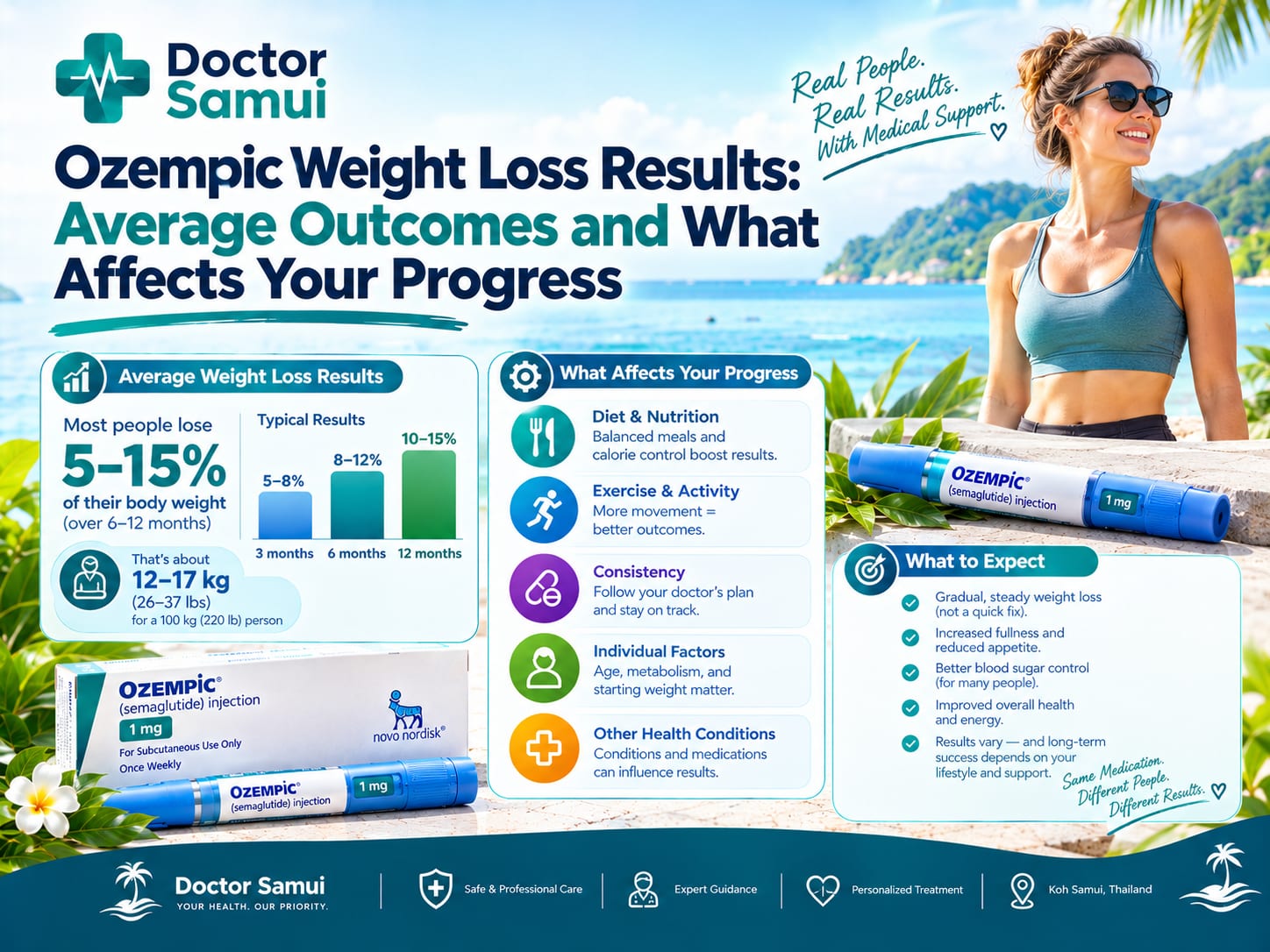
Ozempic (semaglutide up to 2 mg) produces average weight loss of around 7% of body weight over 68 weeks in people with type 2 diabetes, based on the 1 mg arm of the STEP-2 trial. The STEP-2 trial also tested the higher 2.4 mg dose used in Wegovy, which produced around 9.6% loss in that same population. The STEP-1 trial, which tested Wegovy (2.4 mg) in people without diabetes, showed around 15% loss over 68 weeks. Your actual result depends on your starting weight, dose, how long you stay on treatment, and factors like insulin resistance and genetics. Most people notice meaningful change between months two and three, with results peaking between months nine and twelve.
You have been on Koh Samui for three months, based out of a villa near Lamai or working remotely from a Chaweng café, and your semaglutide supply is running low. The number on the scale is not where you expected it to be, and you want a straight answer before you decide whether to continue.
Ozempic weight loss results vary depending on dose, population, and treatment duration. The trials show meaningful differences between the two products, and those differences are worth understanding before setting expectations.

What the Trial Data Actually Shows About Ozempic vs Wegovy
The 15% figure comes from the STEP-1 trial, which tested semaglutide at 2.4 mg, the dose used in Wegovy, approved specifically for obesity.
Ozempic is approved for type 2 diabetes. Its maximum dose is 2 mg. In the STEP-2 trial, which studied people with type 2 diabetes and overweight or obesity, participants receiving 1 mg of semaglutide lost around 7% of their body weight over 68 weeks. Those receiving 2.4 mg lost around 9.6%. If you are taking Ozempic off-label for weight management at doses below 2 mg, the figures are lower still.
This distinction matters. If your doctor prescribed Ozempic rather than Wegovy, setting a 15% target based on misquoted data sets you up to feel like a failure when you are actually on track.
Your Ozempic Weight Loss Timeline: A Realistic Picture
The first four to sixteen weeks are the dose titration phase. Your body is adjusting to the medication and the dose is being raised gradually to reduce nausea. Weight loss during this phase is often modest. Do not judge the drug by week four.
Most people see clearer appetite suppression and measurable weight loss between months two and three. Active loss typically continues through months three to nine. After that, the rate slows as your body adapts to a lower weight and your total daily energy expenditure falls.
A plateau between months nine and twelve is clinically expected. It does not mean the medication has stopped working. It means your body has reached a new set point at this dose.

Why Ozempic Weight Loss Results Vary Between People
Several things influence how much you lose, and diet alone does not explain the full picture. To understand why ozempic weight loss results vary between people, you need to look at the underlying biology.
Genetics affect how strongly your GLP-1 receptors respond to semaglutide. Insulin resistance reduces the metabolic benefit even when appetite suppression is working. Thyroid disorders, PCOS, and medications that promote weight gain can all blunt your response. People with higher starting body weight tend to lose more in absolute kilograms, though percentage loss can still be lower if underlying metabolic factors are not addressed.
Around ten to fifteen percent of people in semaglutide trials lost less than five percent of their body weight. This is sometimes called the non-responder group. It usually means a clinical review is needed to look at dose, contributing conditions, and whether a different approach fits better.
The Role of Lifestyle on the Island: Caloric Deficit and Muscle Mass
Semaglutide reduces appetite. It does not make a caloric deficit automatic. If your eating patterns, alcohol intake, or activity level on Samui have shifted significantly, your results will reflect that.
Preserving muscle mass matters more than most people realise. Rapid weight loss without adequate protein and resistance activity tends to include muscle loss, which lowers your resting metabolic rate and makes future weight management harder. Aim for adequate protein intake and some form of resistance activity alongside your treatment.
Alcohol is worth flagging for anyone spending time on the island. Regular drinking adds calories and can worsen insulin sensitivity. A clinical review can help you identify how much this is affecting your progress.
Why Weight Loss Slows: The Plateau Explained
When you lose weight, your body burns fewer calories at rest. This is metabolic adaptation. It happens with every form of weight loss, and semaglutide does not prevent it.
At a plateau, the drug is still suppressing appetite and supporting insulin sensitivity. But the gap between calories in and calories out has narrowed as your body adjusts. Increasing physical activity, reviewing your diet, or discussing a dose adjustment with your clinician are the practical responses.
Stopping the medication because of a plateau is one of the most common reasons people report poor long-term results. A supervised review is more useful than stopping.
What Happens to Ozempic Weight Loss Results When You Stop
The appetite-suppressing effect of semaglutide stops when you stop taking it. Without the drug, hunger signals return toward baseline.
Evidence from the STEP-1 extension trial shows that participants who stopped semaglutide regained most of their lost weight within about one year of stopping, without sustained lifestyle support. The extension followed participants for approximately 52 weeks after stopping treatment. This reflects the biology of obesity as a chronic condition, not a personal failure.
Planning a supervised exit strategy, rather than simply stopping the injection when your supply runs out, gives you the best chance of holding your results. If you are managing this on Koh Samui, that conversation is available at the Doctor Samui clinic in Chaweng.
Getting Started or Continuing Your GLP-1 Programme on Koh Samui
Semaglutide is available in Thailand, though supply can fluctuate. If you started a GLP-1 programme before arriving on the island and need continuity of care, prescribing, or dose adjustment, Doctor Samui’s GLP-1 programme covers this for both long-stay expats and visitors.
Bring your current prescription details or injectable pen if you still have one. A clinical review covers your current weight, dose, any side effects affecting your progress, and whether your current plan is optimised. If you are based away from Chaweng, house calls and IV therapy are available in Bophut and across the island, so coming into the clinic is not always necessary.
If you started treatment in the UK, Germany, Australia, or elsewhere and arrived mid-programme, your dose history matters. The goal is continuity, not starting from scratch.
Medical Supervision and Your Ozempic Weight Loss Results
Supervision is not just a safety requirement. It directly affects how much weight you lose and how long you keep it off.
The most preventable reason for poor ozempic weight loss results is early discontinuation due to nausea in the first few weeks. A supervised titration approach, where dose increases are timed to your tolerance rather than a fixed schedule, significantly reduces this risk. People who stay on the full titration course get substantially different results from those who stop at week six because no one adjusted the pace.
Dose optimisation, monitoring for non-response, and managing side effects before they cause dropout are what clinical oversight adds. This is about staying on the medication long enough for it to work. A health check-up in Koh Samui can also identify any underlying conditions, such as thyroid dysfunction or insulin resistance, that may be limiting your response before you continue treatment.
Doctor Samui offers GLP-1 prescribing, dose review, and ongoing monitoring for Ozempic and semaglutide patients at our Chaweng clinic and through 24-hour house calls across the island. Whether you are starting treatment, continuing a programme from home, or hitting a plateau and unsure what to do next, we can review your current plan and help you move forward. Walk in or contact us to arrange a visit.
Frequently Asked Questions
Dr. Ponlawat Pitsuwan
Physician, Doctor Samui
a walk-in clinic based in Chaweng, Koh Samui, with 24-hour hotel and villa visits across the island. He sees tourists, families, and long-stay expats for GLP-1 weight management, including semaglutide prescribing, dose optimisation, and ongoing monitoring for patients managing treatment on the island. His focus is straightforward, evidence-based care delivered in plain language.
References
- Davies M, Færch L, Jeppesen OK, et al. Semaglutide 2.4 mg once a week in adults with overweight or obesity, and type 2 diabetes (STEP 2): a randomised, double-blind, placebo-controlled, phase 3 trial. Lancet. 2021;397(10278):971-984.00213-0/fulltext)
- Wilding JPH, Batterham RL, Davies M, et al. Weight regain and cardiometabolic effects after withdrawal of semaglutide: The STEP 1 trial extension. Diabetes Obes Metab. 2022;24(8):1553-1564.
- Wilding JPH, Batterham RL, Calanna S, et al. Once-weekly semaglutide in adults with overweight or obesity (STEP 1). N Engl J Med. 2021;384(11):989-1002.
- U.S. Food and Drug Administration. Ozempic (semaglutide) injection prescribing information. FDA, 2022.
- World Health Organization. Obesity and overweight fact sheet. WHO, 2024.
The information in this article is for educational purposes only and does not constitute medical advice. It should not be used to self-diagnose or replace a consultation with a qualified physician. If you have concerns about your health, contact a licensed medical professional. For appointments at Doctor Samui, visit doctorsamui.com.