
Clinically reviewed by Dr. Ponlawat Pitsuwan, Physician, Doctor Samui. Last reviewed: September 2026
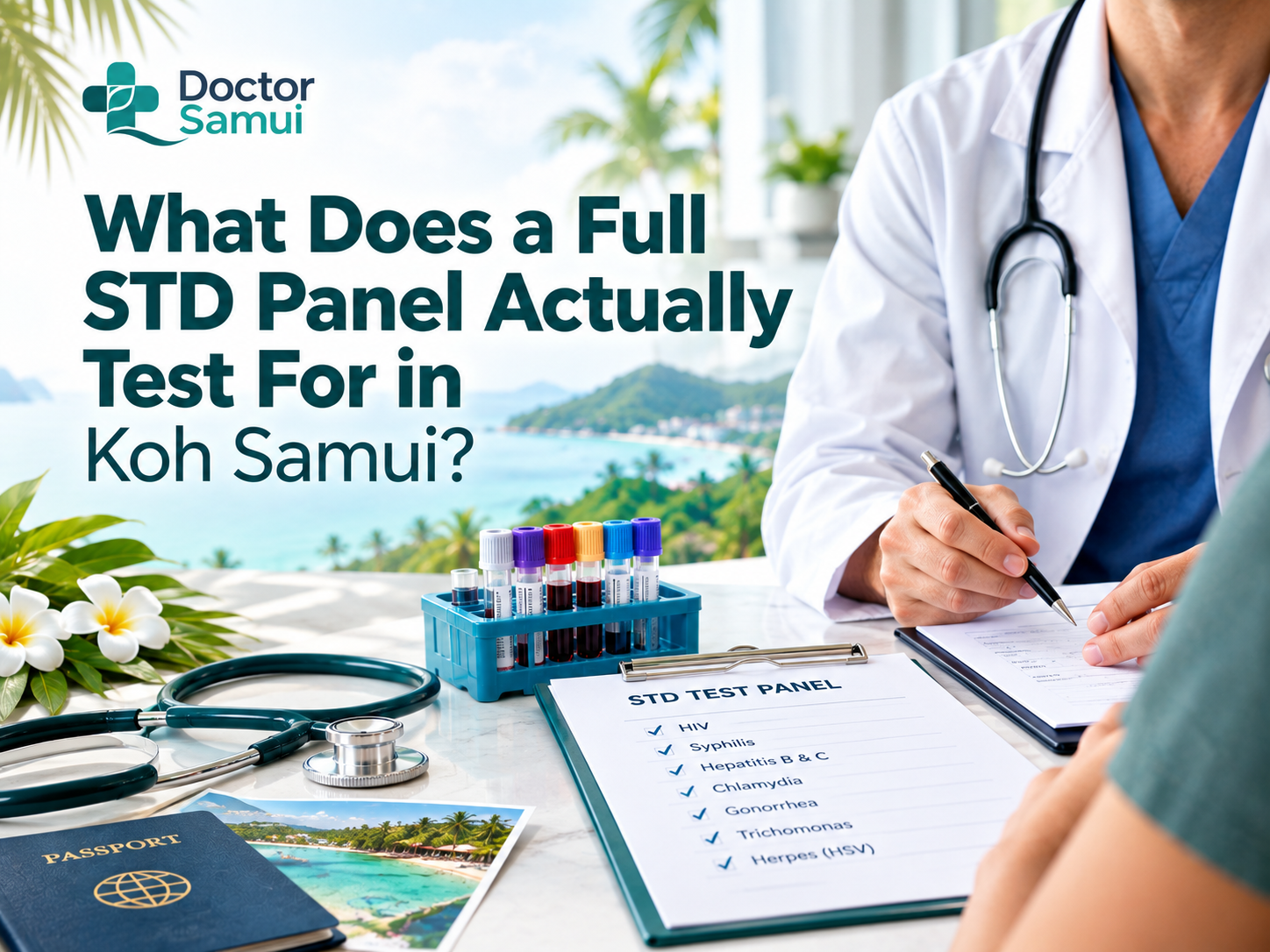
A full STD panel at Doctor Samui tests for HIV, syphilis, chlamydia, gonorrhea, hepatitis B, hepatitis C, and herpes. Some panels also include trichomoniasis and mycoplasma genitalium depending on your risk. Testing uses a blood draw and urine sample. Results come back within 24 to 48 hours, and a doctor reviews every result with you in person or by phone.
You booked two weeks on the island. A night in Chaweng turned into something unplanned, and now you are wide awake on your hotel bed at midnight, phone in hand, running searches. You are not the first person to sit exactly there. What most people want to know first is simple: what does the panel actually test for?
It is a fair question, because "full STD panel" is not a regulated term. It can mean four tests at one clinic and twelve at another. Knowing what is in yours, and whether the timing is right, is the difference between a useful result and a false negative that leaves you no clearer than before.

What "Full Panel" Actually Means — and Why No Two Clinics Are the Same
There is no official list that defines a full STD panel. Every clinic sets its own. Some use the label for a basic four-test screen. Others include herpes, both hepatitis strains, and additional bacterial infections. When you call ahead and ask, the only useful follow-up question is: what exactly is included?
At Doctor Samui, the standard panel covers HIV, syphilis, chlamydia, gonorrhea, hepatitis B, hepatitis C, and herpes simplex for both HSV-1 and HSV-2. That covers the infections most likely to be transmitted sexually and most likely to cause serious harm if missed. The doctor consultation before testing means we can add or remove specific tests based on what actually happened and what your risk looks like.
Every Test in the Full STD Panel Koh Samui Patients Ask About
HIV
We use a fourth-generation antigen-antibody blood test. This detects both the virus protein and your body’s immune response, which makes it more accurate earlier than older tests. If there is any concern about a very recent exposure, timing matters — more on that below.
Syphilis
A blood sample is all that is needed. The standard markers are a VDRL or RPR test. If that comes back reactive, we confirm with a second specific antibody test before any diagnosis is made. Syphilis is curable with antibiotics when caught early. A lot of people with syphilis have no symptoms at all, which is exactly why testing matters.
Chlamydia and Gonorrhea
These two are almost always tested together using a nucleic acid amplification test, or NAAT, which looks directly for the genetic material of the bacteria. It is far more accurate than older swab cultures. For most patients, a urine sample is enough. If you have symptoms at a specific site, a throat or rectal swab can be added at the consultation.
Hepatitis B and Hepatitis C
Hepatitis B is detected with a surface antigen blood test called HBsAg. A positive result means active infection. We also check your vaccination status at this point: if you are not immune and not infected, this is a good time to start the hepatitis B vaccine series. Hepatitis C is a separate blood test looking for the antibody your body produces in response to the virus.
Herpes (HSV-1 and HSV-2)
Herpes is not always included in basic panels elsewhere on the island. Our panel includes HSV IgG blood testing for both strains. The IgG test tells us whether you have been exposed to herpes at some point in the past. It will not detect a brand-new infection from the last week or two because antibodies take time to form. If you have an active sore or blister right now, tell the doctor at the start of the consultation — that changes the approach.
What a More Complete Panel Can Also Include
Some infections are not on every standard panel but matter for certain risk profiles.
Trichomoniasis is a common parasitic infection that often causes no symptoms at all. It is detected by urine or swab. Mycoplasma genitalium is a bacterial infection that can cause urethritis and pelvic inflammation, and it is increasingly resistant to standard antibiotics, which makes correct identification important before treatment. HPV cannot be screened with a blood test in the same way as other infections. For women, cervical screening is the relevant test. For men, there is no reliable blood screen. If any of these are relevant to your situation, the doctor will discuss them before we decide what to run.
When to Test — Window Periods by Infection
Testing too early is one of the most common mistakes we see. If you test before an infection is detectable, you get a negative result that means very little.
| Infection | Earliest Reliable Detection |
|---|---|
| HIV (4th-gen test) | Around 18 to 45 days after exposure |
| Chlamydia and Gonorrhea (NAAT) | As early as 7 to 14 days after exposure |
| Syphilis | Around 3 to 6 weeks after exposure |
| Hepatitis B | Around 3 to 6 weeks after exposure |
| Hepatitis C | Around 8 to 11 weeks for antibody test |
| Herpes IgG | At least 12 weeks for a reliable result |
A negative result during the window period does not mean you are clear. It means you tested too early. The right approach is often to test now for a baseline, then retest at the correct interval. The doctor will advise on that timing at the consultation.
Full Panel vs a Targeted Test — Which One Do You Actually Need
Not everyone who comes in needs the full panel.
A routine annual check for a long-stay expat is a different situation from someone who had an exposure 10 days ago with a specific concern. If you had unprotected sex with a new partner and you are not sure of their status, a full panel makes sense. If you are a regular PrEP user coming in for a scheduled HIV and renal screen, we run a targeted set. If you have symptoms — a specific discharge, a sore, burning when you urinate — the doctor will direct testing toward what fits the picture. The consultation always comes first. That is where we work out what you actually need, not a fixed menu.
How Doctor Samui Runs the Panel
You can walk into our Chaweng clinic any day without an appointment. The doctor sees you first, you talk through what happened, and then the nurse takes a blood sample and urine sample on the spot. Results come back digitally within 24 to 48 hours. The doctor goes through every result with you directly and answers your questions.
If coming to the clinic is not practical, Doctor Samui does hotel and villa visits across the whole island, 24 hours a day. That covers Chaweng, Lamai, Bophut, Maenam, Choeng Mon, and further out. The nurse comes to you, collects the samples, and the process is the same from there. Many patients use this option because it is private and they do not have to travel when they are already anxious. Our staff speak English, German, and Hebrew.
After Your Test — What Happens If a Result Is Positive
A positive result is not the end of the conversation. It is the start of treatment.
Bacterial infections — chlamydia, gonorrhea, syphilis — are curable with the right antibiotic at the right dose. For gonorrhea, resistance patterns matter, and we prescribe accordingly. Viral infections like herpes and hepatitis are managed rather than cured: antiviral medication controls herpes outbreaks and reduces transmission risk, and hepatitis management depends on the strain and stage.
For HIV: if your result is positive, we connect you to ongoing care straight away. If you are worried about a very recent HIV exposure in the last 72 hours, do not wait for a test result first. PEP (post-exposure prophylaxis) needs to start within 72 hours to be effective. Call or come in now. If you test negative and want ongoing protection, PrEP (pre-exposure prophylaxis) is available at Doctor Samui as a continuing prescription. On the science of transmission: if someone is living with HIV and on treatment with an undetectable viral load, they cannot transmit the virus sexually. That is established and consistent evidence, known as U=U.
We provide a medical letter for any patient who needs documentation of their diagnosis and treatment, whether for travel insurance, a home-country follow-up appointment, or continuity of care after flying out.
Practical Details — Cost, Insurance, and What to Bring
Bring your passport or a photo ID. Walk-ins are welcome and no referral is needed. If you want a hotel or villa visit, calling ahead helps us schedule the nurse to your location.
Travel insurance policies vary. Most do not cover routine STI screening, but many do cover testing and treatment when there are symptoms or a documented exposure. We provide itemised receipts and a medical letter for insurance claims. Check your policy wording before you test if that is a concern.
Worried about a recent exposure, or just want peace of mind while you are on the island? Doctor Samui offers confidential STI and HIV testing at our Chaweng clinic and with 24-hour hotel and villa visits across Koh Samui. A doctor reviews every result with you directly. Walk in any day, or call ahead to arrange a visit to your hotel or villa. You can find full details on our STD testing in Koh Samui page.
Does a full STD panel in Koh Samui test for herpes?
At Doctor Samui, yes. Herpes IgG blood testing for both HSV-1 and HSV-2 is part of our panel. The blood test detects past exposure, not a brand-new infection from the last week or two. If you have an active sore right now, tell the doctor at the start of the consultation because that changes the approach entirely.
How soon after unprotected sex can I get tested in Koh Samui?
It depends on the infection. Chlamydia and gonorrhea can show up on a NAAT test as early as one to two weeks after exposure. HIV with a fourth-generation test is reliable from around 18 to 45 days. Syphilis and herpes take longer. If you are not sure of your timing, come in and the doctor will advise whether to test now, wait, or do both.
Can I get an STD test at my hotel in Koh Samui?
Yes. Doctor Samui does hotel and villa visits 24 hours a day across the island. A nurse comes to your location, takes a blood draw and urine sample, and results are delivered digitally within 24 to 48 hours. It is a good option if you want privacy or if getting to the Chaweng clinic is not straightforward from where you are staying.
What happens if my STD test result comes back positive at a clinic in Koh Samui?
We start treatment the same day where possible. Bacterial infections like chlamydia, gonorrhea, and syphilis are curable with the right antibiotic course. Viral infections are managed with antivirals. We also provide a medical letter summarising your diagnosis and treatment, which you can use for home-country follow-up or a travel insurance claim. Everything is handled privately.
Is a full STD panel the same at every clinic in Koh Samui?
No, and this is worth knowing before you book. "Full panel" is not a regulated term, so it can mean four tests at one clinic and twelve at another. Always ask what is specifically included. At Doctor Samui, the panel covers HIV, syphilis, chlamydia, gonorrhea, hepatitis B, hepatitis C, and herpes, with additional tests added based on your individual risk at the doctor consultation.
What if I need PEP after an exposure in Koh Samui?
PEP needs to start within 72 hours of the exposure to be effective, so do not wait for a test result first. Contact Doctor Samui immediately if you think you have had a high-risk HIV exposure in the last three days. We can start PEP the same day and run the baseline tests alongside it.
Dr. Ponlawat Pitsuwan
Physician, Doctor Samui
a walk-in clinic based in Chaweng, Koh Samui, with 24-hour hotel and villa visits across the island. He sees tourists, families, and long-stay expats for sexual health consultations, STI and HIV testing, PrEP and PEP, and ongoing infection management. His approach is straightforward, evidence-based care explained in plain language.
