
Clinically reviewed by Dr. Ponlawat Pitsuwan, Physician, Doctor Samui.
Last reviewed: November 2026
Molluscum contagiosum in adults is a viral skin infection that causes small, dome-shaped bumps with a dimple in the centre. On the genitals, it spreads mainly through skin-to-skin sexual contact. It is not detected by standard STI blood tests, so you need a clinical skin examination. Treatment options include cryotherapy with liquid nitrogen, curettage, and topical agents applied by a clinician, though some cases resolve without treatment.
You are back at your villa in Chaweng, two weeks after a great trip, and you notice a few small bumps in your groin that were not there before. They do not hurt. They barely itch. But something is different. That gap between exposure and appearance is exactly why molluscum contagiosum catches adults off guard.
Molluscum contagiosum is caused by a poxvirus, a family entirely separate from HPV, herpes, or any infection covered by a standard STI panel. A routine blood test will not find it. Diagnosis is clinical: a doctor looks at the skin. If you have noticed these bumps on Koh Samui, the right first step is a skin assessment, not searching images at midnight.

What Molluscum Contagiosum Looks Like
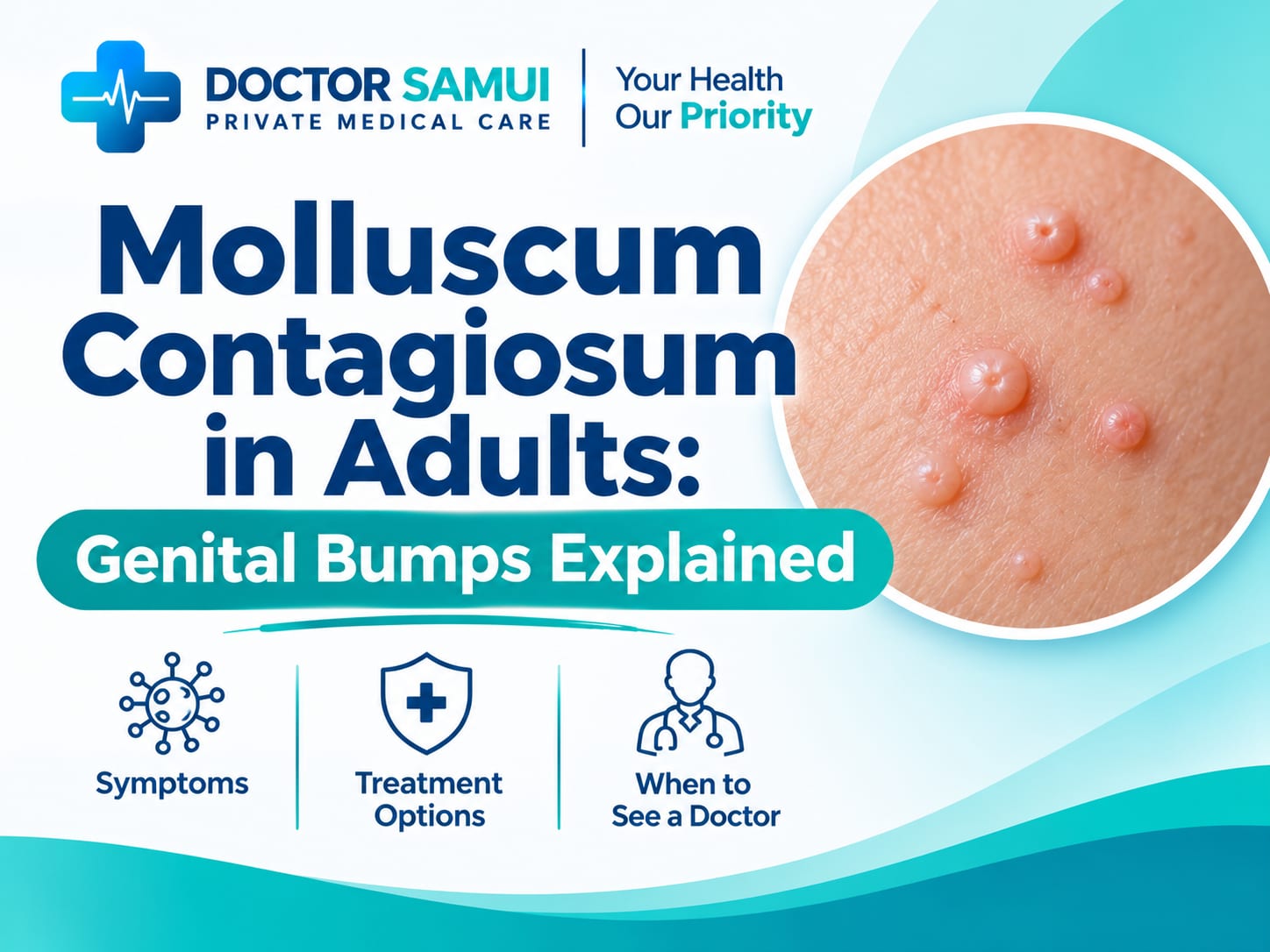
The bumps are small, round, and skin-coloured or slightly pearly. Each one has a tiny dimple in the centre, which doctors call central umbilication. That dimple is the most reliable visual clue.
On the genitals and inner thighs, they usually appear in clusters. Each bump is typically a few millimetres across, firm to the touch, and does not burst easily on its own.
A dermoscope, a handheld magnifying tool, makes the central dimple much clearer and helps rule out other causes of genital bumps. At Doctor Samui’s Chaweng clinic, the lesions are examined directly and a clinical diagnosis is usually possible in the same visit.
One thing patients often miss: bumps can appear on the lower abdomen, thighs, and buttocks, not only directly on genital skin. If you touch one area and then scratch elsewhere, the virus can spread to new sites on your own body, a process called autoinoculation.
Molluscum Versus Genital Warts
Genital warts and molluscum look different once you know what to look for, but they are easy to confuse at first glance.
Genital warts are caused by HPV. They tend to be flat or cauliflower-shaped and rough to the touch. Molluscum bumps are smooth, dome-shaped, and have that central dimple. HPV can persist in the skin long after warts clear. Molluscum does not: when the lesions go, the virus goes with them.
| Feature | Molluscum Contagiosum | Genital Warts (HPV) |
|---|---|---|
| Shape | Dome-shaped, smooth | Flat or cauliflower-textured |
| Central dimple | Yes | No |
| Virus family | Poxvirus | Human papillomavirus |
| Residual virus after clearing | No | Can persist in skin |
| Detected by STI panel | No | No (diagnosed clinically or by biopsy) |
| Self-resolution common | Yes | Less predictable |
Both infections spread through skin-to-skin contact. Neither shows up on a routine STI blood screen. If you are unsure which one you have, a doctor needs to look.

How Molluscum Contagiosum Spreads in Adults
The most common route in adults is direct skin-to-skin contact during sex. Condoms reduce the risk but do not eliminate it, because molluscum can appear on skin that a condom does not cover, including the inner thighs, pubic area, and buttocks.
Sharing towels, razors, or swimwear can also transfer the virus. This matters on Koh Samui specifically, where resort pools, spa facilities, and beach clubs involve shared equipment and close contact. Spread through objects and surfaces is well documented for molluscum contagiosum.
You can spread it to other parts of your own body by touching a lesion and then scratching elsewhere. Avoid shaving directly over any bumps: the razor can nick lesions and carry the virus to new skin.
Treatment for Molluscum Contagiosum in Adults
Waiting is a legitimate option for some people. The infection does clear on its own in many healthy adults, though the timeline varies and can extend to many months. For genital lesions, most adults prefer active treatment rather than waiting up to 18 months or more, both for their comfort and to avoid passing it to a partner.
Cryotherapy with liquid nitrogen freezes each lesion individually. It is effective, but most people need more than one session spaced a few weeks apart. On darker skin tones, there is a real risk of post-inflammatory pigmentation: a lighter or darker patch where the lesion was frozen. Discuss this before you start.
Curettage removes lesions physically in a single procedure using a small instrument. It works well for a limited number of lesions and gives faster visible clearance than cryotherapy. Local anaesthetic is applied first, and some minor scarring is possible.
Topical options include potassium hydroxide solution and cantharidin, a blistering agent. Cantharidin is applied by a clinician in a clinic setting. Potassium hydroxide solution can be applied at home by the patient, though a clinician should guide the starting concentration and explain when to stop. Multiple applications are usually needed for both.
If you have HIV, take long-term steroids, or use immunosuppressive medication, molluscum can be more extensive and persistent. These cases do not reliably self-resolve and need active treatment. If you are immunocompromised and have genital bumps, get assessed promptly. Our sexual health services at Doctor Samui can be part of the same visit.
When to See a Doctor About Genital Bumps on Koh Samui
Get the bumps looked at if they are on or near the genitals, if they are spreading, if there are many of them, or if you have any reason to think your immune system is not at full strength.
A clinical visit at Doctor Samui takes around fifteen to twenty minutes for assessment and an initial treatment session if you choose to proceed. The doctor examines the lesions, confirms the diagnosis, discusses your options, and can begin cryotherapy or curettage the same day. No appointment is needed at the walk-in clinic in Chaweng.
Molluscum will not show up on a standard STI panel. If you want a full sexual health screen alongside your skin assessment, ask for one specifically. We can run full STD testing at our Koh Samui clinic and assess the bumps in a single visit. If you are staying outside Chaweng, 24-hour hotel and villa visits are available across the island.
Noticed small bumps on your genitals or inner thighs on Koh Samui? Doctor Samui’s walk-in clinic in Chaweng offers same-day skin assessment and treatment for molluscum contagiosum in adults, including cryotherapy and curettage. Full sexual health screening is available in the same visit. Walk in any time, or call for a 24-hour hotel or villa visit anywhere on the island.
Frequently Asked Questions
Dr. Ponlawat Pitsuwan
Physician, Doctor Samui
a walk-in clinic based in Chaweng, Koh Samui, with 24-hour hotel and villa visits across the island. He sees tourists, families, and long-stay expats for genital skin conditions, sexual health concerns, and molluscum contagiosum assessment and treatment. His focus is straightforward, evidence-based care delivered in plain language.
References
- Leung AKC, Barankin B, Hon KLE. Molluscum Contagiosum: An Update. Recent Patents on Inflammation and Allergy Drug Discovery. 2017;11(1):22-31.
- Centers for Disease Control and Prevention. About Molluscum Contagiosum. CDC, 2024.
- NHS. Molluscum Contagiosum. NHS.uk.
- Forbat E, Al-Niaimi F, Ali FR. Molluscum contagiosum: review and update on management. Pediatric Dermatology. 2017;34(5):504-515. Summarised in: Harder S, et al. Tools for Practice: Molluscum contagiosum. Canadian Family Physician. 2019.
The information in this article is for educational purposes only and does not constitute medical advice. It should not be used to self-diagnose or replace a consultation with a qualified physician. If you have concerns about your health, contact a licensed medical professional. For appointments at Doctor Samui, visit doctorsamui.com.
