Clinically reviewed by Dr. Ponlawat Pitsuwan, Physician, Doctor Samui.
Last reviewed: October 2026
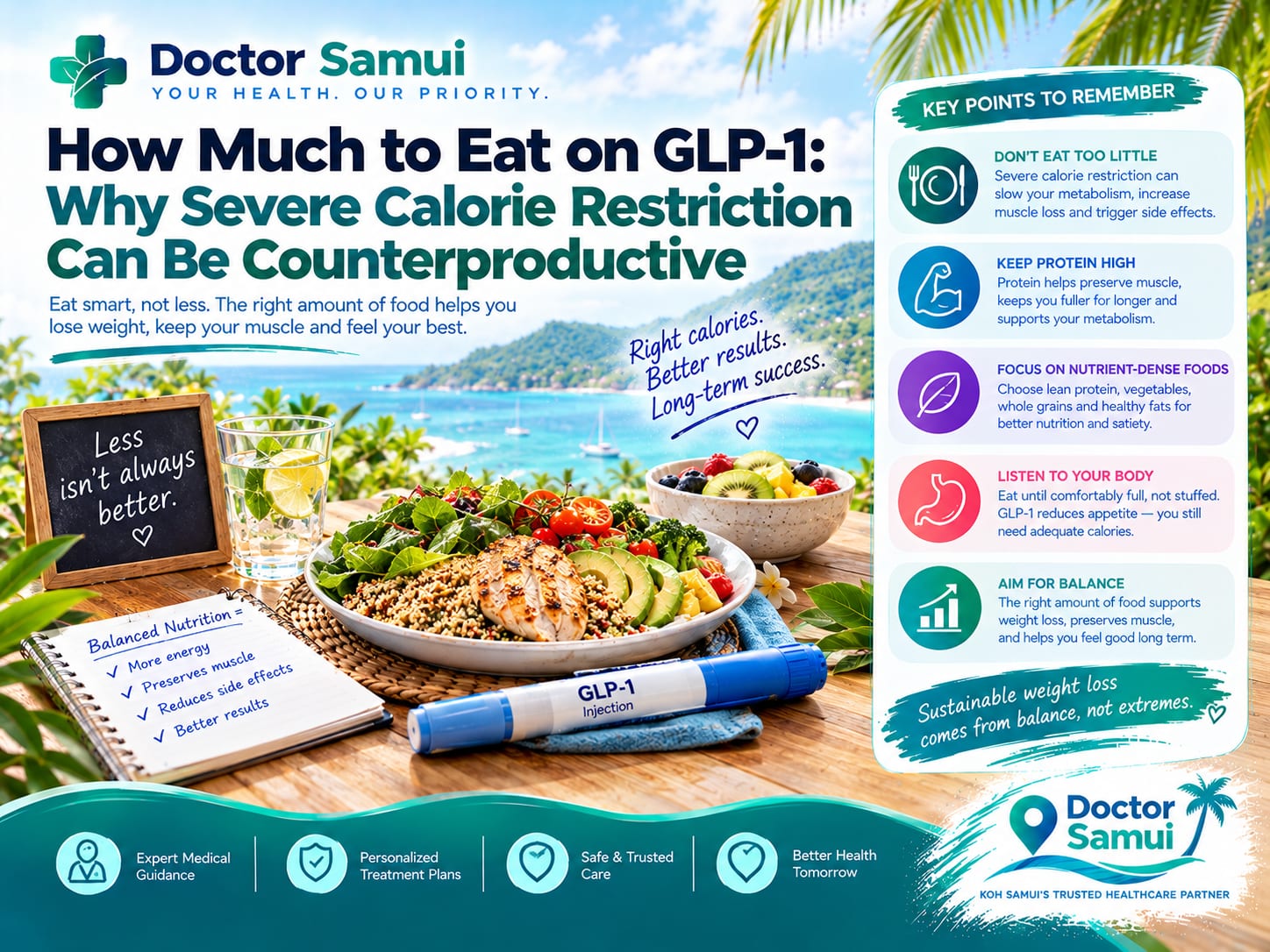
GLP-1 medications like semaglutide and tirzepatide suppress appetite strongly, but eating too little can backfire. Severe calorie restriction on these drugs risks accelerated muscle loss, slowed metabolism, bone density reduction, and eventual weight-loss stalls. A moderate, protein-rich deficit, set with a doctor, not guessed from a generic meal plan, produces better long-term results than eating as little as possible.
You are three weeks into semaglutide, staying long-term near Chaweng, and you realise at 4 pm that you have eaten almost nothing since a small breakfast. Anyone with a personal or family history of medullary thyroid carcinoma or multiple endocrine neoplasia syndrome type 2 should not use semaglutide or tirzepatide, and severe abdominal pain, persistent vomiting, or signs of an allergic reaction require urgent medical attention. The weight is moving. You feel fine. So you let it go. That pattern is exactly where GLP-1 calorie restriction starts working against you.
Eating too little on these medications does not speed up fat loss. It triggers a response that works against you: lean muscle breaks down, your resting metabolism slows to compensate, and the progress that felt effortless in week two plateaus by month three. Understanding why eating enough matters when appetite is low is an important and often overlooked part of GLP-1 therapy.
Why Severe GLP-1 Calorie Restriction Stalls Fat Loss Instead of Speeding It Up
GLP-1 medications create a calorie deficit by reducing how much you want to eat. That is the mechanism. The problem comes when appetite suppression pushes intake so low that the body reads it as a famine signal.
When calories drop too far, the body reduces the energy it burns at rest to preserve itself. You lose weight, but a growing portion of that weight is muscle, not fat. That matters because muscle is metabolically active. Less muscle means a lower resting metabolic rate, which means the deficit you started with gradually shrinks on its own.
The STEP 1 trial, which studied semaglutide over 68 weeks, found that a meaningful portion of weight lost included lean tissue alongside fat. The exact proportion depends on protein intake and activity level, both of which most GLP-1 users under-manage because they are focused on the number on the scale.
What the Evidence Says About Lean Mass Loss on GLP-1
A 2025 study published in Frontiers in Nutrition found that GLP-1 users consistently fall short of the protein intake needed to preserve lean mass during calorie-restricted weight loss. The clinical target is 1.2 to 2.0 grams of protein per kilogram of body weight per day.
The standard dietary protein figure of 0.8 g/kg/day is a baseline for sedentary healthy adults in maintenance. It is not a target for someone actively losing weight on medication. On a GLP-1, you need more protein, not less, even though your appetite is telling you the opposite.
For a 70 kg person, hitting the lower end of that range means around 84 grams of protein per day. With appetite suppressed to the point where some patients eat one small meal, that number is genuinely hard to reach without planning.

Is There a Safe Calorie Floor on GLP-1?
There is no official minimum calorie guideline written specifically for GLP-1 users. No dietary reference intake, no Thai Ministry of Public Health standard, no FDA prescribing label sets one. That absence matters, because any specific number you read online is an estimate, not a clinical mandate.
That said, intakes below 1,200 kilocalories per day carry consistent risks regardless of medication: micronutrient deficiency, fatigue, electrolyte imbalance, accelerated muscle breakdown, and reduced bone density over time. Some patients on GLP-1s drop to 500 to 800 kilocalories per day without realising it, because the medication removes hunger cues so effectively.
Your calorie floor is individual. It depends on your starting weight, activity level, lean mass, and underlying health. A clinician sets that number based on your actual data. A generic meal plan cannot.
Risks Beyond Muscle: Bone Density, Fatigue, and Metabolic Slowdown
Muscle loss gets most of the attention, but it is not the only consequence of eating too little on a GLP-1.
Bone density is affected by calorie restriction, particularly when protein and calcium intake are both low. Women post-menopause face a real risk of bone density reduction when losing weight rapidly without adequate nutrition. Fatigue is another common sign that intake has dropped too far: not tiredness from a full day, but a flat, persistent low energy that does not resolve with sleep.
Chronic mild dehydration is a less-discussed risk. GLP-1 medications reduce thirst signals alongside hunger. In Koh Samui’s heat and humidity, that compounds quickly. You may not feel thirsty, your fluid intake drops, and your kidneys process less than they should. If you are losing weight fast and feeling persistently drained, that warrants a clinical review, not just pushing through.
How Much Protein Do You Actually Need on GLP-1?
The 1.2 to 2.0 g/kg/day target is not a range for athletes. It is the range supported by clinical evidence for preserving lean mass during calorie-restricted weight loss. If you weigh 80 kg, that is 96 to 160 grams of protein per day. If you weigh 60 kg, that is 72 to 120 grams.
Hitting that on a suppressed appetite requires intentional food choices. Protein-dense options that work well in Samui’s food environment include grilled chicken, eggs, tofu, fish, and legumes. A small meal of chicken rice covers roughly 30 to 40 grams of protein. You need two to three equivalent meals to reach the lower target, on a day when you may not feel hungry for any of them.
This is the practical reason why GLP-1 therapy requires dietary structure, not just appetite reduction. The medication does not choose what you eat. Those decisions still matter, and they matter more than most people expect.
Hydration and Micronutrients in Koh Samui’s Climate on GLP-1
GLP-1 medications reduce appetite and thirst together. In a temperate climate, this is manageable. In Koh Samui, where daily temperatures and humidity are both high for most of the year, chronic under-hydration is a genuine risk.
Standard guidance suggests at least two to three litres of water per day for most adults. In heat with physical activity, that floor rises. On a GLP-1, you may not feel the prompt to drink. Setting reminders and tracking fluid intake actively is worth doing.
Micronutrient shortfalls are another underappreciated consequence of low calorie intake. Below a certain threshold, it becomes very difficult to meet daily needs for iron, magnesium, B vitamins, and vitamin D through food alone. If your intake has been consistently low for more than a few weeks, a blood panel to check for deficiencies is a reasonable step. Doctor Samui can run those tests the same day at the Chaweng clinic.
Exercise Is Not Optional on GLP-1 Therapy
Resistance training is the most effective tool for preserving lean mass during GLP-1-assisted weight loss. Cardiovascular exercise supports heart health and metabolic function. Both matter and neither replaces the other.
The evidence on GLP-1 and body composition consistently shows that patients who combine medication with resistance training lose a smaller proportion of lean tissue than those who rely on calorie restriction alone. You do not need a gym. Bodyweight exercises done consistently three times a week make a measurable difference.
If you are living long-term in Koh Samui or managing your weight here as an expat, building a consistent exercise routine alongside your medication is part of making the treatment work. It is not an optional extra.
GLP-1 Support in Koh Samui Without a Home GP
Managing GLP-1 therapy without a home GP is a real challenge for expats and long-stay visitors on the island. You may have started the medication abroad or sourced it in Bangkok, and now you are several months in without anyone tracking your progress, adjusting your dose, or reviewing your nutrition.
Generic online meal plans are not written for your weight, your activity level, your blood markers, or the Thai food environment you are actually eating in. For more on why eating enough matters when appetite is low, the Doctor Samui GLP-1 page sets out what supervised care on the island looks like. You can also access a doctor hotel visit in Koh Samui if you are staying in a villa or resort and would rather not travel to the clinic.
If you are losing weight fast and feeling weaker than expected, or if your weight loss has stalled despite staying on medication, come in. Those patterns are worth investigating. For patients in the north of the island, IV therapy and house calls in Maenam and IV therapy in Bophut are available for same-day visits. A health check-up in Koh Samui is also a practical starting point if you want a full picture of where your nutrition and body composition currently stand.
If you are on semaglutide or tirzepatide and unsure whether you are eating enough to protect your muscle and keep your metabolism working, Doctor Samui can help. We offer GLP-1 dietary consultations at our Chaweng clinic and through 24-hour villa and hotel visits across Koh Samui. Book a same-day appointment or request a house call to get personalised calorie and protein targets based on your actual weight, health history, and activity level.
Frequently Asked Questions
Dr. Ponlawat Pitsuwan
Physician, Doctor Samui
a walk-in clinic based in Chaweng, Koh Samui, with 24-hour hotel and villa visits across the island. He sees tourists, families, and long-stay expats for weight management consultations, GLP-1 therapy oversight, and general health concerns including nutrition and metabolic health. His focus is straightforward, evidence-based care delivered in plain language.
References
- Wilding JPH et al. Once-Weekly Semaglutide in Adults with Overweight or Obesity. New England Journal of Medicine, 2021.
- Garvey WT et al. Two-year effects of semaglutide in adults with overweight or obesity: the STEP 5 trial. Nature Medicine, 2022. DXA substudy lean mass data from STEP 1 available at PMC8089287
- Johnson et al. Suboptimal protein intake for hypocaloric diet needs while using glucagon-like peptide-1 receptor agonists. Frontiers in Nutrition, 2025.
- World Health Organization. Obesity and overweight fact sheet. WHO, 2024.
The information in this article is for educational purposes only and does not constitute medical advice. It should not be used to self-diagnose or replace a consultation with a qualified physician. If you have concerns about your health, contact a licensed medical professional. For appointments at Doctor Samui, visit doctorsamui.com.