Clinically reviewed by Dr. Ponlawat Pitsuwan, Physician, Doctor Samui.
Last reviewed: October 2026
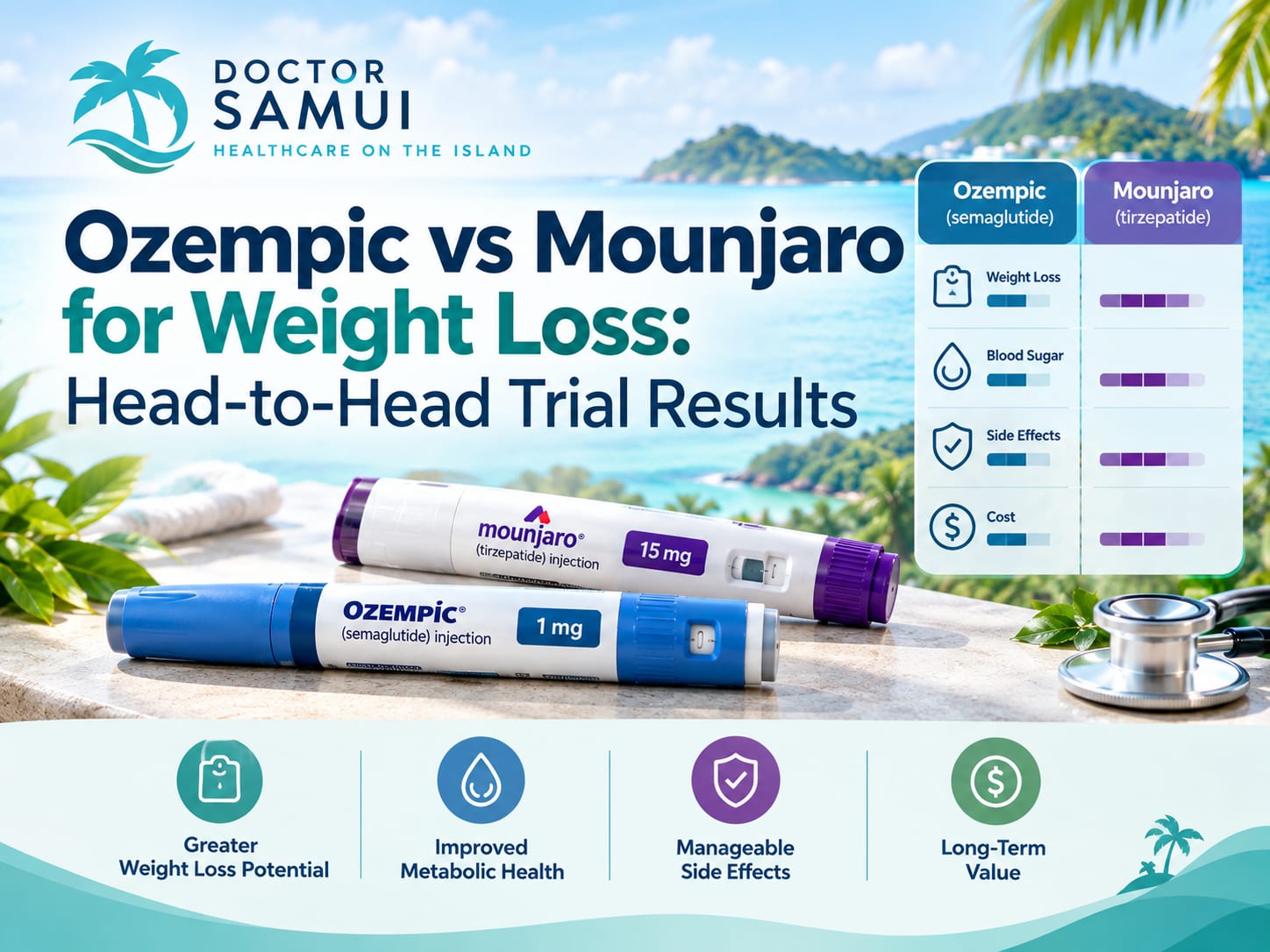
In the only head-to-head trial, tirzepatide (Mounjaro) produced greater average weight loss than semaglutide (Ozempic) in people with obesity but without type 2 diabetes. The headline numbers were 20.2% versus 13.7% of body weight over 72 weeks in the SURMOUNT-5 trial. But the right choice depends on your medical history, not just those percentages. Both drugs require medical supervision, proper baseline screening, and a reliable supply chain.
You have been on Samui for six months. Walking the beach every morning, eating well, doing the right things. Still stuck. A friend switched from Ozempic to Mounjaro and lost another eight kilograms. Now you are reading trial results at midnight trying to work out which drug actually wins.
The short answer: tirzepatide produced more weight loss in the one trial that directly compared them. The longer answer is what matters before you decide.
These drugs are not interchangeable for every situation. Semaglutide has cardiovascular outcome data that tirzepatide does not yet match. Supply and authenticity risks in Thailand are real. And both drugs cause significant weight regain when stopped. None of that appears in the headline percentage. This article walks through all of it, so you can have a proper conversation with a doctor rather than deciding based on a single number.

The One Head-to-Head Trial, What SURMOUNT-5 Actually Found
SURMOUNT-5 directly compared tirzepatide against semaglutide in adults with obesity or overweight plus at least one weight-related health condition. It excluded people with type 2 diabetes. That matters when you read the results.
Over 72 weeks, participants on tirzepatide lost an average of 20.2% of body weight. Those on semaglutide lost an average of 13.7%. The difference was statistically significant. Both drugs were titrated to their maximum approved doses, which makes the comparison fair.
What SURMOUNT-5 does not tell you: how either drug performs in people with type 2 diabetes, what happens beyond 72 weeks, or whether tirzepatide’s advantage holds when people miss doses, travel, or stop and restart.
How to Read the Trial Numbers, Percentages, Kilograms and What They Mean for You
A percentage sounds clean but hides a lot. If you weigh 100 kg, 20.2% means losing about 20 kg. If you weigh 80 kg, it means about 16 kg. The absolute number is what you actually feel.
Real-world observational data tends to show smaller differences than controlled trials. A JAMA Internal Medicine analysis of real-world GLP-1 users found tirzepatide still outperformed semaglutide, but by a smaller margin than SURMOUNT-5. Adherence, dose, diet, and starting weight all narrow the gap. Our guide on how to read weight loss trial results explains this in more detail.
The takeaway: tirzepatide has a real edge in controlled conditions. In practice, someone who takes their injection consistently and stays in contact with a doctor will do better on either drug than someone who does not.

How These Drugs Work, and Why Tirzepatide Has Two Mechanisms
Semaglutide activates one receptor: the GLP-1 receptor. GLP-1 is a hormone released after eating. Activating it reduces appetite, slows stomach emptying, and improves insulin sensitivity.
Tirzepatide activates that same receptor plus a second one, the GIP receptor, another hormone involved in appetite and metabolism. Whether that second mechanism explains tirzepatide’s greater weight loss is still debated. What the trials show is a better outcome, not definitively why.
One practical result: both drugs share a similar side effect profile, because nausea and GI symptoms come mainly from the GLP-1 pathway.
Side Effects Compared, Nausea, GI Issues and the Warnings That Matter
Both drugs share the same class of side effects. Nausea is the most common, especially during dose escalation. Vomiting, diarrhoea, and constipation occur with both. Most people find these ease once the dose is stable, but not everyone tolerates the maximum dose.
Both carry a thyroid warning on the product label. People with a personal or family history of medullary thyroid carcinoma, or MEN2 (multiple endocrine neoplasia type 2), should not use either medication. This is a contraindication, not a theoretical risk.
Both also carry a pancreatitis warning. If you develop severe, persistent abdominal pain while using either drug, stop the injection and see a doctor the same day. People with a history of pancreatitis should discuss suitability carefully before starting.
Beyond Weight Loss, Cardiovascular and Kidney Data
This is where the two drugs genuinely diverge. Semaglutide was studied in a large cardiovascular outcomes trial called SELECT. It enrolled people with obesity but without diabetes who had established cardiovascular disease. SELECT showed a statistically significant reduction in major cardiovascular events. That evidence directly shaped prescribing guidelines for high-risk patients.
Tirzepatide’s cardiovascular outcomes trial data is still emerging. That does not mean it is unsafe for the heart. It means we have less long-term evidence at this point.
For kidney protection, both drugs have shown benefit in early data, but the evidence base is currently stronger for semaglutide. If cardiovascular disease or kidney function is part of your picture, that conversation with a doctor is not optional.
What Happens When You Stop, Weight Regain and Long-Term Use
Both drugs require ongoing use to maintain results. Extension data from the STEP 1 trial showed that people who stopped semaglutide regained a substantial portion of lost weight within roughly one year. Discontinuation data for tirzepatide shows a similar pattern.
This is not a treatment failure. It reflects obesity as a chronic condition that needs ongoing management. These are not short courses; for most people, they are long-term medications.
Before starting either drug, think through what your plan looks like if you need to stop, reduce the dose, or travel for extended periods. A doctor who knows your history can help you work that out before it becomes a problem.
Access, Supply and Counterfeit Risks in Thailand
Counterfeit and compounded semaglutide products are a documented global risk. The FDA and WHO have both issued warnings about fake GLP-1 products circulating in Asia and internationally. Compounded versions are not held to the same manufacturing standards as the original approved medications.
In Thailand, these medications are available, but the supply chain matters. Buying from an unverified online source or an unlicensed vendor introduces real safety risks: wrong concentration, contamination, or a product with no active ingredient at all.
Doctor Samui sources medications through verified, licensed channels and confirms what you are receiving at your consultation. If you are already on Ozempic or Mounjaro from a previous provider and want to continue safely on Koh Samui, we can review your current treatment and help you carry on without interruption.
Starting Safely on Koh Samui, What a Consultation Involves
Neither drug should be started without a baseline assessment. At minimum, that means reviewing your thyroid history, any personal or family cancer history relevant to the contraindications above, your cardiovascular and kidney status, and your current medications. Some medications interact with GLP-1 drugs, particularly other diabetes treatments.
Blood tests before starting are standard practice. You do not need to fly back home to get this done properly. Doctor Samui runs health checkups and blood panels in Koh Samui at the Chaweng clinic, and we can arrange a consultation for long-stay residents or visitors who want to start, continue, or switch GLP-1 medications.
We also see patients across the island. If you are staying in Lamai, you can book IV Therapy and house call services in Lamai or arrange a clinic visit. For residents in Bophut or Maenam, mobile doctor services in Bophut are available too. The consultation is the same whether you come to us or we come to you.
Doctor Samui offers GLP-1 consultations for long-stay residents and visitors at the Chaweng walk-in clinic and through 24-hour house calls across Koh Samui. If you are considering Ozempic or Mounjaro, want to switch between them, or need to continue your current treatment safely while on the island, contact the clinic to arrange an assessment. We can run the necessary baseline bloods, review your medical history, and source verified medication through licensed channels.
Frequently Asked Questions
Dr. Ponlawat Pitsuwan
Physician, Doctor Samui
a walk-in clinic based in Chaweng, Koh Samui, with 24/7 hotel and villa visits across the island. He sees tourists, families, and long-stay expats for GLP-1 weight loss consultations, metabolic health assessments, and ongoing medication management. His focus is straightforward, evidence-based care delivered in plain language.
References
- Garvey WT, et al. "Tirzepatide once weekly for the treatment of obesity in people with type 2 diabetes (SURMOUNT-2)." Lancet, 2023. For SURMOUNT-5, see: Wadden TA, et al. Tirzepatide vs semaglutide for obesity: SURMOUNT-5. NEJM 2025, doi:10.1056/NEJMoa2416394
- Lincoff AM, et al. "Semaglutide and Cardiovascular Outcomes in Obesity without Diabetes (SELECT trial)." New England Journal of Medicine, 2023.
- Wilding JPH, et al. "Weight regain and cardiometabolic effects after withdrawal of semaglutide: The STEP 1 trial extension." Diabetes, Obesity and Metabolism, 2022.
- Rodriguez PJ, et al. "Semaglutide vs Tirzepatide for Weight Loss in Adults With Overweight or Obesity." JAMA Internal Medicine, 2024.
- Jastreboff AM, et al. "Tirzepatide Once Weekly for the Treatment of Obesity (SURMOUNT-1)." New England Journal of Medicine, 2022.
The information in this article is for educational purposes only and does not constitute medical advice. It should not be used to self-diagnose or replace a consultation with a qualified physician. If you have concerns about your health, contact a licensed medical professional. For appointments at Doctor Samui, visit doctorsamui.com.