Clinically reviewed by Dr. Ponlawat Pitsuwan, Physician, Doctor Samui. Last reviewed: October 2026
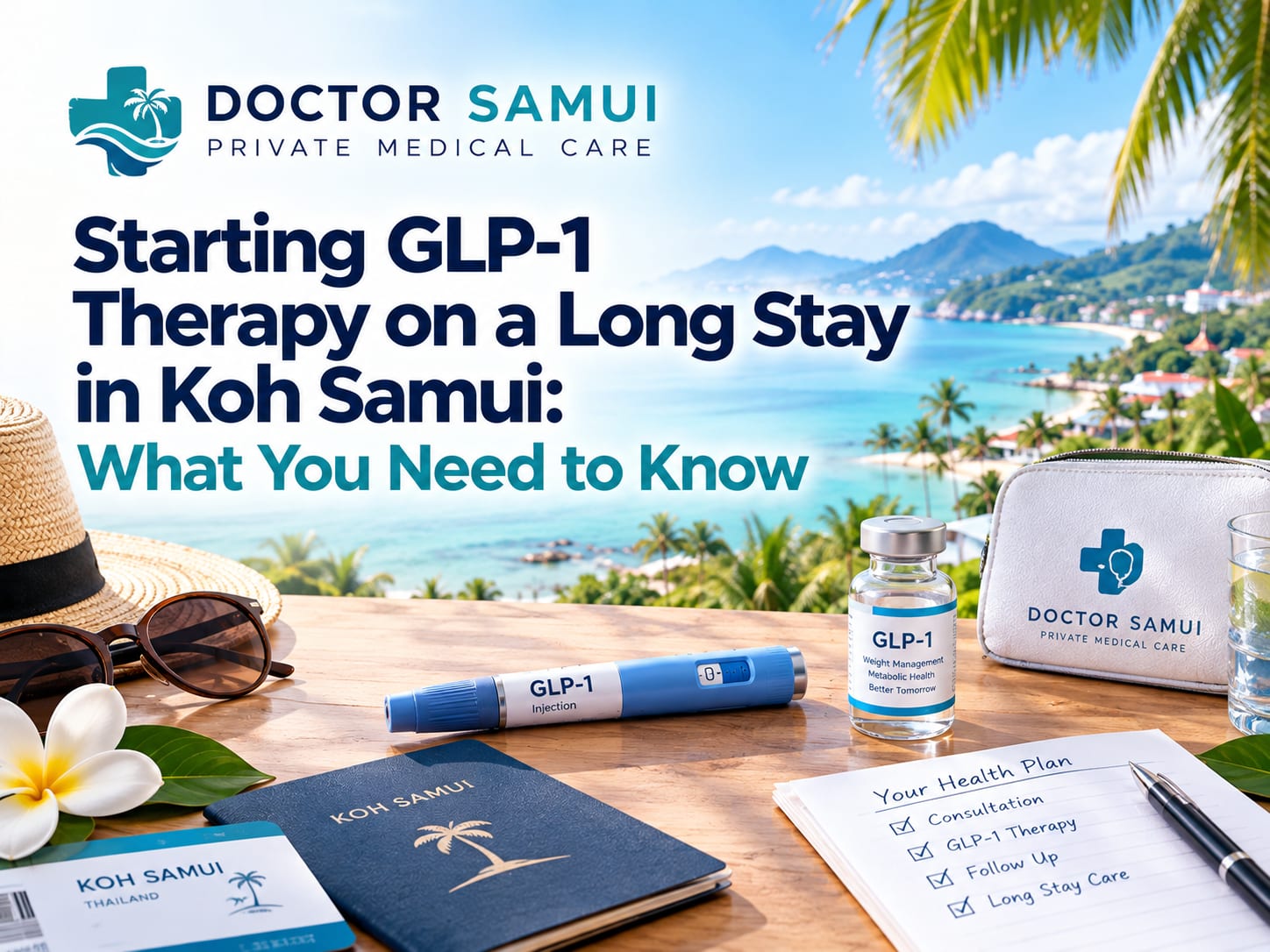
GLP-1 receptor agonists like semaglutide and tirzepatide can be started or continued on a long stay in Koh Samui with the right medical support. Doctor Samui provides initial consultations, baseline blood tests, local prescriptions, and ongoing dose monitoring for long-stay visitors and expats across the island. Pen storage in tropical heat and supply continuity are the two practical issues that matter most here.
You have rented a villa in Bophut for three months. You are eating well, sleeping well, walking the beach every morning. If there was ever a time to get serious about your metabolic health, this is probably it. GLP-1 therapy, the weekly injection that reduces appetite and helps regulate blood sugar, is now available through Doctor Samui for long-stay visitors and expats who want proper medical supervision on the island, not a trip to a Bangkok hospital.
Whether you are starting for the first time or already mid-protocol on Ozempic or Mounjaro at home, a few things matter specifically here: tropical heat and pen storage, local prescription access, dose titration without your home GP, and how island life actually affects your results.

How GLP-1 Therapy Works on a Long Stay in Samui
GLP-1 medications, semaglutide (Ozempic, Wegovy) and tirzepatide (Mounjaro), mimic a hormone your gut releases after eating. They slow how quickly your stomach empties, signal fullness to your brain, and reduce what many patients call "food noise," the constant background thinking about eating. For people with type 2 diabetes, they also help regulate blood sugar directly.
You inject once a week. You start at a low dose and increase gradually over weeks to months. This slow escalation is not optional. It is how you avoid the worst of the nausea and stomach upset that comes with starting too high, too fast.
Why a Long Stay on Koh Samui Is a Genuinely Good Time to Start
Most people begin GLP-1 therapy during a stressful period at home, juggling work and clinic appointments. A long stay in Samui removes a lot of that friction. You have time to rest through early side effects. You are not skipping doses because life got in the way.
The food helps too. Fresh seafood, light Thai dishes, and vegetable-heavy meals available across the island naturally support the reduced-appetite effect of the medication. Regular low-intensity movement, a morning walk along Chaweng beach, an evening swim off Lamai, genuinely supports metabolic health and builds on what the medication is already doing over a 12 to 16-week titration window. That is a real clinical advantage.

Getting a GLP-1 Prescription on Koh Samui as a Foreigner
Your visa status does not affect whether you can be prescribed here. Tourist visa, retirement visa, Thailand Elite, long-stay — it makes no difference. You need a clinical consultation and, in most cases, baseline blood work. That is it.
If you are starting fresh, the consultation at Doctor Samui covers your weight, blood pressure, relevant medical history, and a blood panel before anything is prescribed. These medications are not dispensed on request alone. If you are already on a dose at home, bring your original packaging and any letter from your home prescriber. That makes the transition straightforward.
Thai pharmacies do not dispense GLP-1 medications over the counter. You need a prescription from a licensed physician. For stays over six weeks, sourcing locally is usually more practical than importing. Find out more about the GLP-1 therapy service at Doctor Samui on our dedicated page.
Storing Your GLP-1 Pen in Koh Samui’s Heat
This is the practical problem long-stay patients handle badly most often. Koh Samui’s ambient temperature sits above 30°C for most of the year. That is the upper safe limit for an in-use pen stored at room temperature. Unopened pens must be kept refrigerated at 2 to 8°C at all times.
Your villa fridge is fine in most cases. Two things go wrong on this island, though: power cuts and over-cooling. A brief outage may not spoil your pen, but a fridge set too cold that freezes the pen will. Check your temperature setting, and check again after any outage. A frozen pen should not be injected.
For beach days or boat trips out toward Angthong, a FRIO evaporative cooling wallet keeps your pen within a safe range without electricity. Never leave a pen in a car, a beach bag left in the sun, or a hotel safe that is not climate-controlled. If you are unsure whether your pen has been compromised, contact us before injecting. Injecting a degraded pen means no therapeutic effect, and you may feel off without knowing why.
Managing Dose Titration Away From Your Home Doctor
Most patients arrive mid-titration. They started on 0.25 mg semaglutide at home, stepped up to 0.5 mg, and are now two months into a long stay wondering whether to increase again. Without their GP available, they either stay at the same dose indefinitely or increase without any clinical oversight. Both are problems.
Staying too low for too long slows your results. Increasing without a check-in means nobody is reviewing your side effects, your weight trend, or whether your blood pressure has shifted. Doctor Samui provides on-island dose titration support, including follow-up consultations at the Chaweng clinic or at your villa or resort. You do not need to travel to the mainland for this.
During dose escalation, a check-in roughly every four weeks is standard. Once you reach a maintenance dose, reviews can stretch to every six to eight weeks. The schedule is built around your stay.
Lifestyle Factors on Koh Samui That Affect Your Results
Thai food at local restaurants is generally well-suited to GLP-1 therapy: light, protein-forward, and not calorie-dense. The issue is usually the beach-bar culture. Alcohol reduces the weight-loss effect of these medications and worsens nausea, particularly in the early weeks of a new or increased dose. If you are spending four nights a week at a bar along Chaweng beach, the medication will work against that pattern, not with it.
Heat itself suppresses appetite, which can feel like the medication is working brilliantly when you first arrive. It can also mask dehydration. Drink more water than you think you need. GLP-1 slows gastric emptying, which means nausea compounds quickly when you are already dehydrated in 33-degree heat after an afternoon on the sand.
The patients who do best on a long stay are the ones who treat it as a genuine reset, not a holiday with a weekly injection on the side.
Insurance, Costs, and What to Expect to Pay
International expat health plans, Cigna Global and April International are the most common among long-stay residents here, often cover the consultation and baseline blood work. They rarely cover the medication itself when the clinical indication is weight management rather than type 2 diabetes. Get the clinical indication noted clearly in your paperwork before submitting a claim.
Payment at Doctor Samui is cash or card. Itemised receipts are available for reimbursement claims. If your insurer requires a detailed consultation note or a letter of medical necessity, we issue those as standard.
If you are planning a long stay in Koh Samui and want to start or continue GLP-1 therapy with proper medical supervision, Doctor Samui can help. We offer initial consultations, baseline blood panels, local prescriptions, and ongoing dose titration support from our Chaweng clinic or at your villa or resort anywhere on the island. Contact us to book a consultation, or ask a question before your stay begins.
Frequently Asked Questions
Dr. Ponlawat Pitsuwan
Physician, Doctor Samui
a walk-in clinic based in Chaweng, Koh Samui, with 24-hour hotel and villa visits across the island. He sees long-stay visitors and expats for metabolic health, GLP-1 therapy initiation and monitoring, and ongoing chronic condition management. His focus is straightforward, evidence-based care delivered in plain language.