
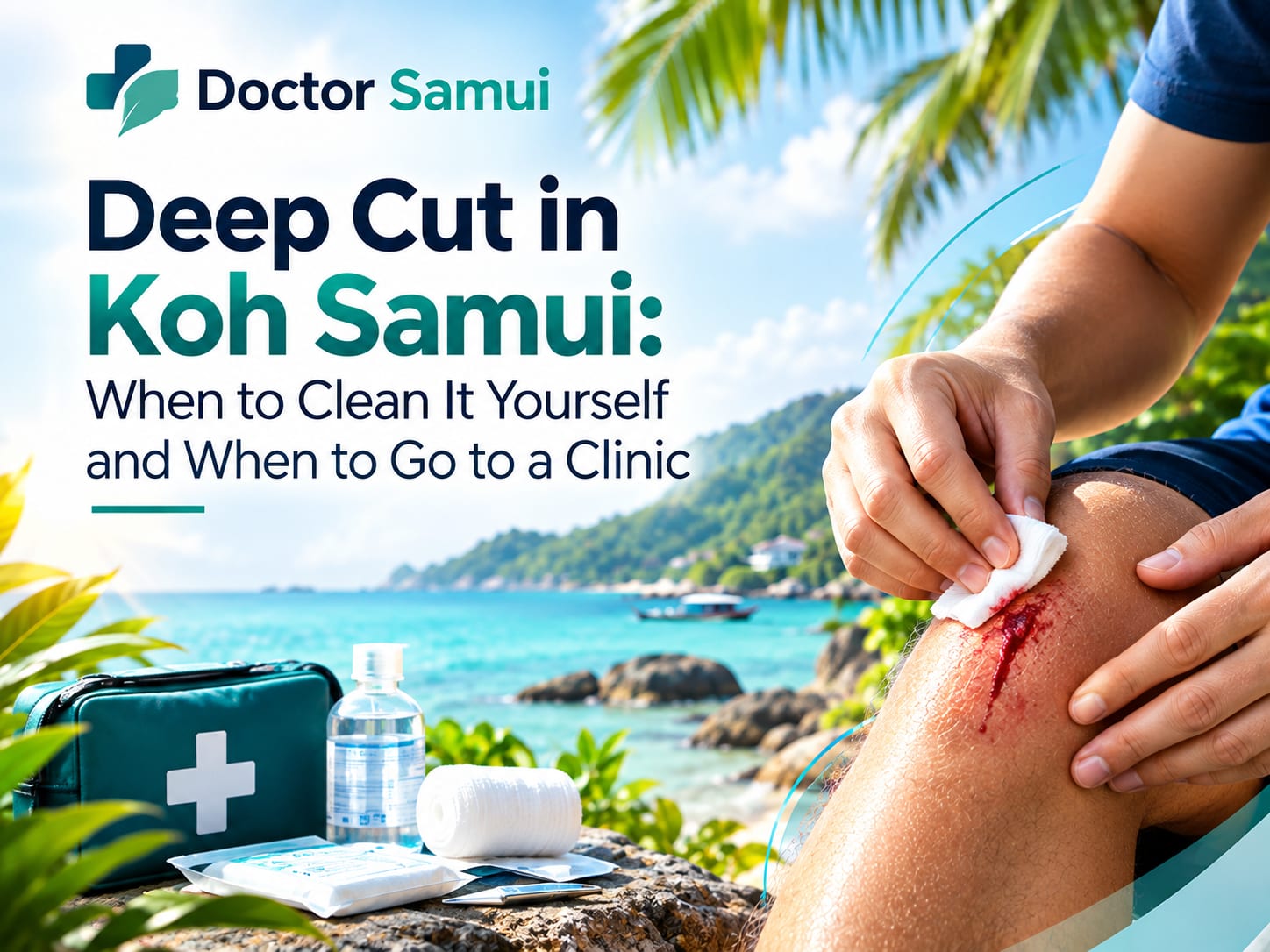
Clinically reviewed by Dr. Ponlawat Pitsuwan, Physician, Doctor Samui.
Last reviewed: September 2026
Most small cuts on holiday can be cleaned at home with running water and a sterile dressing. But in Koh Samui’s heat and humidity, a wound that would take two or three days to show infection back home can turn red and swollen within 24 hours. Any cut that gapes open, will not stop bleeding, exposes yellow fatty tissue underneath, or came from coral, asphalt, or a rusty object needs a doctor the same day.
You are halfway down the Na Muang waterfall trail, the rocks are wet, and one slip later you are sitting on a stone with a gash on your shin bleeding through your shirt. Or it happens at the reef near Chaweng — a coral ledge catches your knee as you climb back onto the boat. Either way, you are staring at a wound on a tropical island, far from your usual doctor, trying to decide whether this is a clean-it-and-carry-on situation or a get-to-a-clinic-now one.
The answer depends on a few clear things: how deep it is, what caused it, and whether it will close on its own. This article walks you through exactly that decision, what to do in the first ten minutes, and what to expect if you need wound care here on Samui.

Why Cuts Infect Faster in Koh Samui Than at Home
Back home, you might rinse a cut, put on a plaster, and check it in two days. Here, two days is too long to wait.
The heat and humidity create ideal conditions for bacteria to grow fast in an open wound. Seawater around the island carries bacteria rarely found at home that can cause serious infections within hours of entering a wound. Coral leaves behind microscopic fragments along with its own bacteria, and if debris stays in the wound it can trigger persistent, hard-to-treat skin infections. Soil on waterfall trails and roadside asphalt carry different but equally unfamiliar bacterial strains.
The practical result: a wound that looks clean at midday can be red, swollen, and warm by evening. Do not wait until morning if that is happening.
Common Causes of Deep Cuts on Koh Samui
The cause of a cut matters as much as its depth, and it changes how urgently you need to act.
Coral cuts from snorkelling near Chaweng or Lamai, or day trips out to Angthong Marine Park, often look minor at first. Coral is not a clean surface. It leaves microscopic fragments in the wound, and the bacteria it carries can drive infection within hours. These always need proper irrigation at a clinic, even when the cut looks small.
Scooter accidents on the ring road produce what we call road rash: skin scraped across asphalt that is sometimes shallow and sometimes much deeper than it looks. Gravel and grit get embedded in the tissue. Wiping it with antiseptic is not enough — the wound needs to be cleaned and any embedded material removed before it can heal cleanly.
Waterfall and rock slips, broken glass at beach bars, pool tile edges, and rusty objects are also common. Each carries different contamination, but the principle is the same: where the cut came from tells you how seriously to treat it.

First Aid for a Deep Cut: What to Do in the First 10 Minutes
Before you can get to a clinic, four things matter.
Press firmly on the wound with the cleanest cloth or clothing you have. Hold pressure for at least ten minutes without lifting to check. Keep the injured area raised above heart level if you can.
Once bleeding slows, rinse the wound with clean running water for at least five minutes. Bottled water works fine if tap water is questionable. This is the single most important thing you can do before a doctor sees it.
Cover the wound with the cleanest material available. Do not use cotton wool directly on raw tissue — it sticks and tears the wound when removed. A folded piece of clean fabric or a sterile dressing is better.
Two things will make the wound worse: pouring neat iodine or hydrogen peroxide directly into a deep cut, and going back in the sea or pool. Both can wait.
When to Clean It Yourself and When to Go Straight to a Clinic
You can manage it yourself if the cut is less than about one centimetre long, the edges stay together on their own, bleeding stops within ten minutes of firm pressure, and it was caused by something reasonably clean like smooth glass or a tile edge. Clean it well, cover it, and watch it closely for the next 24 hours.
Go to a clinic the same day if any of the following apply. The wound gapes open or you can see yellow or white tissue underneath. Bleeding will not stop after ten minutes of pressure. The cut is on your face, hand, or over a joint. It was caused by coral, asphalt, rusty metal, an animal bite, or contaminated water. Your child has the cut. You are not up to date on tetanus vaccination.
Go immediately if bleeding is heavy and uncontrolled, if a red streak is tracking up your arm or leg from the wound, or if you feel feverish, dizzy, or confused. A spreading red streak means infection is moving through your lymph system and needs urgent attention.
What Happens at Doctor Samui — Step by Step
Walk-in wound care at our Chaweng clinic, or a doctor coming to your hotel, follows the same clear process.
We examine the wound and clean the area around it. Then we irrigate the wound with sterile saline under pressure, which clears debris and bacteria far more effectively than rinsing alone. If there is embedded material — gravel, coral fragments, or damaged tissue — we remove it before closing the wound. Skipping this step is the main reason holiday wounds get infected after home treatment.
If the wound needs closing, we apply a local anaesthetic so you feel pressure but not pain. Depending on the wound, we use stitches or wound closure strips. For most body wounds, non-dissolvable stitches stay in for seven to ten days; over joints, closer to ten to fourteen days. We check whether you need a tetanus booster and prescribe antibiotics if there is infection risk. We also provide full medical reports for any travel insurance claim.
For more detail on when a wound needs stitches versus other closure methods, see our guide to laceration and wound care and our page on accidents and injuries on Koh Samui.
When You Cannot Get to a Clinic
Sometimes travelling is not simple. You are at a villa in Maenam at two in the morning, your child has a bad cut, and getting to Chaweng is not a realistic option right now.
Doctor Samui’s 24/7 hotel and villa service covers the whole island: Chaweng, Bophut, Maenam, Lamai, Hua Thanon, Choeng Mon, Bang Rak, and beyond. A doctor arrives with a full wound care kit — sterile irrigation equipment, sutures, local anaesthetic, dressings, and tetanus vaccine. Most deep cuts, including those needing stitches, can be fully managed at the bedside. If your injury needs an X-ray to rule out a fracture, we will advise you to come in to the clinic. You can find more about our accident and trauma care and minor surgical procedures on our service pages.
Scarring and Sun Exposure After a Deep Cut
Almost no one warns tourists about this, and the consequences come back to us regularly.
A healing wound exposed to strong UV sunlight can develop a dark patch of skin that takes months or longer to fade. In Koh Samui’s sun, that risk is real. Once your wound has closed, keep it covered with a dressing or high-SPF sunblock for the rest of your trip and for several weeks after you get home.
Waterproof dressings are available at our clinic and let you shower without soaking the wound. Stitches need to stay dry until removal, and even after that, the new skin underneath is fragile. Ask us before you get back in the pool.
Insurance and Getting Stitches Removed Before You Fly
Travel insurance covers wound care in most cases. Bring your policy details and we will provide a detailed medical report for your claim. Keep all receipts from the visit.
If your stitches are due to come out after your flight home, let us know at your first visit. We can often plan stitch removal before departure. If timing does not allow it, most GPs and travel clinics at home can remove stitches placed elsewhere — it is a simple procedure, and we will provide clear written instructions for whoever does it.
Got a cut that needs proper assessment? Doctor Samui offers same-day walk-in wound care at our Chaweng clinic, including sterile irrigation, sutures, tetanus vaccination, and full medical reports for travel insurance. If you cannot travel, we come to you — 24 hours a day, across the whole island, including Chaweng, Lamai, Bophut, Maenam, and beyond. English, German, and Hebrew speaking doctors available.
FAQ
Dr. Ponlawat Pitsuwan
Physician, Doctor Samui
a walk-in clinic based in Chaweng, Koh Samui, with 24/7 hotel and villa visits across the island. He treats tourists, families, and long-stay expats for wound care, laceration treatment, suturing, and tropical infection management. His approach is direct, evidence-based care delivered in plain language.
