
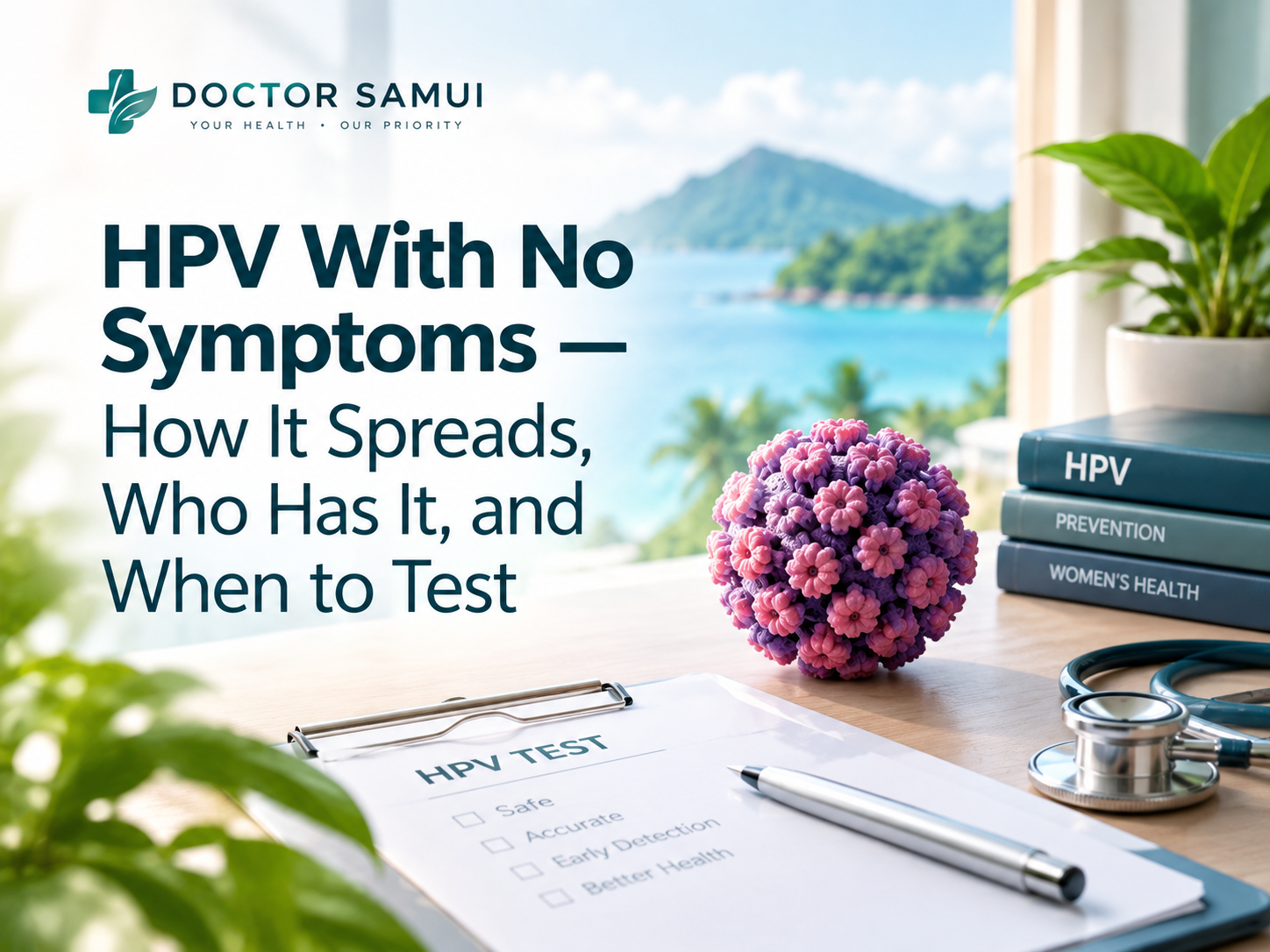
Clinically reviewed by Dr. Ponlawat Pitsuwan, Physician, Doctor Samui. Last reviewed: September 2026
HPV spreads through skin-to-skin contact, not just penetrative sex, and most people who carry it have no idea. The virus can be active and infectious with zero visible signs. If you have had a new sexual partner and have never been screened, that is reason enough to get tested, even without symptoms.
You got back from a boat trip to Angthong Marine Park, met someone, had a good night. No soreness, no unusual discharge, nothing that looked wrong. That does not mean nothing happened. HPV, human papillomavirus, is the most common sexually transmitted infection in the world, and the reason it stays so common is exactly this: most people who carry it feel nothing at all.
Yes, HPV can spread with no symptoms whatsoever. The virus does not need a visible wart, a rash, or any discomfort to pass between people. Understanding how that happens, who is most likely carrying it without knowing, and what testing is available on Koh Samui is what this article covers.
Why HPV Spreads So Easily With No Symptoms
Most sexually transmitted infections need some kind of opening to move between people: a sore, a cut, inflamed tissue. HPV does not. It spreads through direct skin-to-skin contact during what is called a subclinical infection. That means the virus is active in the skin cells and passing to a partner, but has not caused any visible change that you or a doctor could see.
This is not the same as being dormant. When HPV is truly dormant, the immune system is suppressing it and it is not actively spreading. When it is subclinically active, it is infectious. The practical point: someone can pass HPV to you, or receive it from you, with no symptoms on either side.
Every Way HPV Can Spread — Including the Routes People Miss
Penetrative sex is the most common route, but it is not the only one. HPV spreads wherever infected skin meets uninfected skin in the genital area. Oral sex can transmit it to the mouth and throat, with no penetration required.
Hand-to-genital contact is another route that gets overlooked. Shared sex toys that are not cleaned between partners carry the same risk. The virus can also transfer through close skin contact in the genital area without any penetration at all. That is not a myth; it is how the biology works.
Spa pools and shared bathing facilities are lower risk but not zero, particularly for anyone with broken skin. For tourists sharing villas or doing spa days across the island, this is worth knowing, not to panic about, but to be aware of.
High-Risk vs Low-Risk HPV — What the Difference Actually Means
There are more than 100 strains of HPV, and about 40 affect the genital area. They fall into two groups based on cancer risk.
Low-risk strains, most commonly HPV 6 and HPV 11, cause genital warts. These are visible and uncomfortable but do not cause cancer. High-risk strains, particularly HPV 16 and HPV 18, can trigger abnormal cell changes that may, over years, develop into cervical, anal, penile, or throat cancer.
The critical point is this: high-risk strains are more likely to cause no symptoms at all. A person can carry HPV 16 or HPV 18 for years with no warts, no pain, nothing, while the virus slowly causes changes in cervical or anal cells. This is exactly why cervical screening exists.
How Long Can HPV Stay Dormant — and Can It Come Back?
Most HPV infections clear on their own within one to two years. The immune system suppresses the virus and it becomes undetectable. High-risk strains, though, can persist for years without triggering any symptoms or cell changes.
Reactivation is real. If your immune system weakens later due to illness, stress, or medication, HPV that has been quiet can become active again. This is why some people in long-term relationships develop HPV-related cell changes without any new sexual contact. Long-stay expats on Koh Samui who have never been screened are not off the hook just because they have been with the same partner for years. Routine cervical screening every three to five years is the standard for a reason.
Who Is Most Likely to Have HPV Without Knowing It
Statistically, most sexually active adults will carry HPV at some point. The highest rates are in younger adults with new sexual partners, but age alone does not protect you.
Tourists who have had unprotected sex on holiday are an obvious group. The patients at our Chaweng clinic who are most behind on screening, though, are often long-stay expats who have not registered with any local health system, have never had a cervical smear in Thailand, and assume that feeling fine means nothing needs checking.
Men who have sex with men face higher risk of anal HPV and HPV-related anal cancer, and anal screening tests are available for this group. Anyone who is immunocompromised, whether due to HIV, autoimmune conditions, or long-term steroid use, clears HPV more slowly and is at greater risk of persistent infection. If that applies to you, screening matters more, not less.
Getting Tested for HPV on Koh Samui — What Tourists and Expats Need to Know
For women, HPV DNA testing is done alongside or as part of cervical screening. A ThinPrep cervical sample is taken at the clinic and tested for high-risk strains, including specific genotyping to identify which strains are present. This is available at Doctor Samui for tourists and expats who have missed routine sexual health screening back home.
For men with no symptoms, there is currently no widely approved routine HPV test. That is a real limitation across the entire field, not just in Thailand. What is available is a visual examination for genital warts, and for men who have sex with men, an anal screening test is worth discussing.
The most protective step for men who were not vaccinated as teenagers is getting the HPV vaccine. It will not clear an existing infection, but it protects against strains you have not yet been exposed to, and that protection is meaningful. If you have had unprotected sex recently and want to know where you stand, a broader STI screening panel covers HPV-related and other infections together, which is more useful than testing for one thing in isolation. We offer confidential 24/7 hotel and villa visits if you would prefer not to come into the clinic.
What About the HPV Vaccine for Adults?
Not being vaccinated as a teenager does not mean vaccination now is pointless. The 9-valent HPV vaccine, which covers nine strains, is effective for adults up to age 45 under current guidance. If you have not had all your doses, or any doses at all, completing the course is worthwhile.
The vaccine does not treat a current infection and will not clear strains you already carry. But most sexually active people have not been exposed to all nine strains it covers. The protection you gain against the strains you have not yet encountered is real. This comes up regularly when patients travelling through Samui realise they have gaps in their vaccination history — it is a straightforward conversation and the vaccine is available at our Chaweng clinic.
If you are on Koh Samui and want HPV screening, a broader sexual health check, or information about the HPV vaccine, Doctor Samui’s walk-in clinic in Chaweng is open now. We also offer confidential hotel and villa visits across the island 24/7, including Lamai, Bophut, Maenam, Choeng Mon, and beyond. No judgment, plain answers, and results you can act on. Contact us to book or ask a question.
